1 / 39Use ← → to flip
Heat Stress
Heat stress: how the body handles heat, heat illnesses, and prevention.
Slide text
· 39 slides · by University of Utah
The words on each slide as the author wrote them, read from the file by software so they can be searched. Layout, pictures and tables are not shown here: the slides above and the download are the original.
- Slide 1
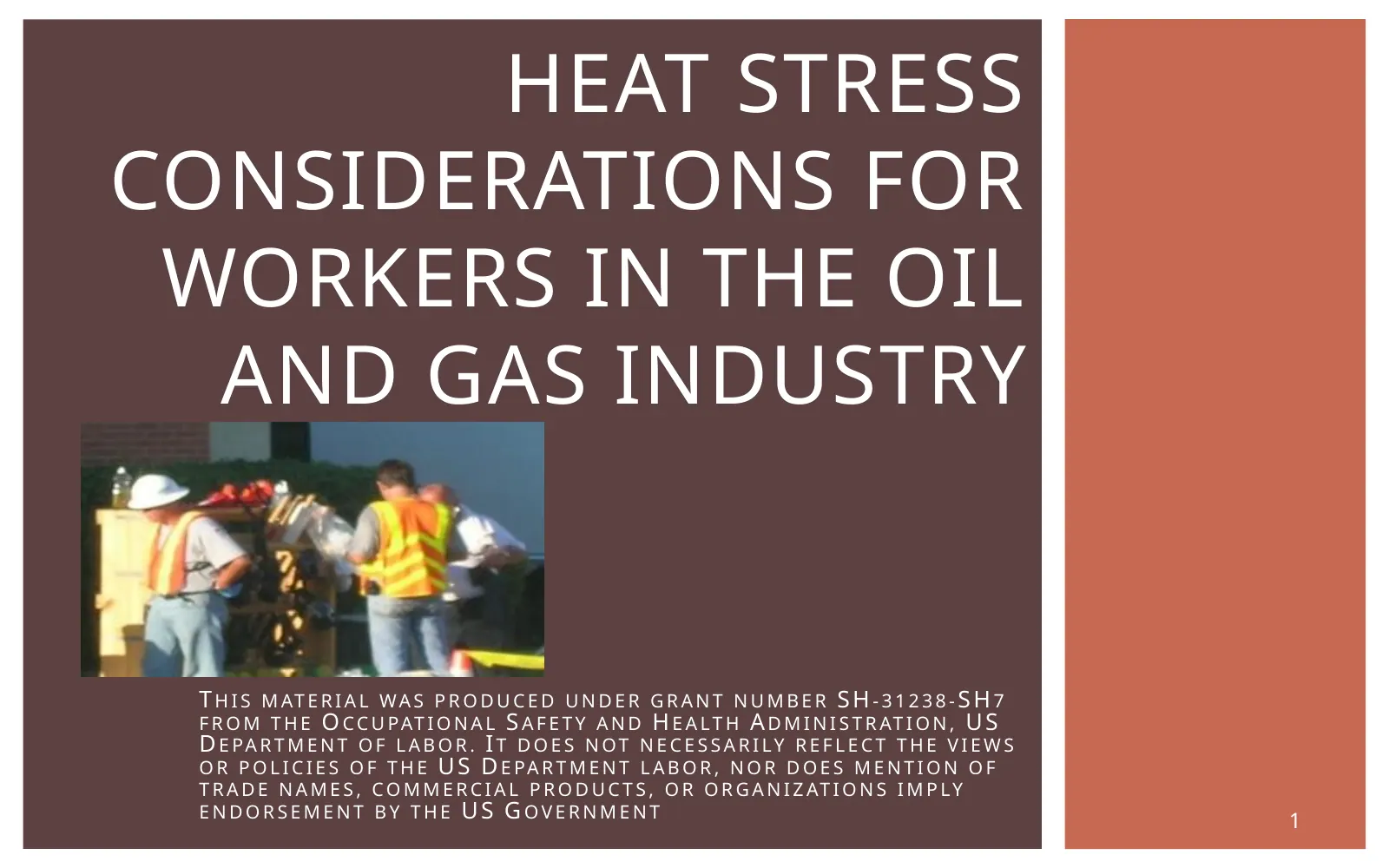
HEAT STRESS
- CONSIDERATIONS FOR WORKERS IN THE OIL
- AND GAS INDUSTRY
- ENDORSEMENT BY THE US G OVERNMENT
- Slide 2
TRAINING PRE-ASSESSMENT
- To begin our training on heat stress, let’s consider a few related questions….
- True or False?
- Energy drinks are great for avoiding heat stress.
- Conductive heat transfer is usually a site worker’s biggest concern.
- Evaporative cooling rates are never important.
- There is a recommended work-rest regimen.
- Breathable clothing can help reduce heat strain.
- Slide 3
WHEN DO HEAT STRESS CONDITIONS PREVAIL?
- Workers experience heat stress when working too hard physically and certain thermal conditions exist — use the right amount of eff ort for the task at hand.
- Find out what thermal conditions exist beforehand
- Wear the appropriate personal protective clothing
- Keep properly hydrated
- Work at the right pace for the job
- Slide 4
HEAT STRESS VERSUS HEAT STRAIN
- Heat stress is the net heat load to which a worker may be exposed from the combined contributions of:
- Environmental factors
- Metabolic cost of work
- Clothing requirements
- Level of acclimatization
- Overall condition of the worker
- Heat strain is the body ’s overall response to heat stress, and attempts to dissipate excess heat from the body.
- Slide 5
HEAT TRANSFER
- Heat is always transferred from the object with the higher temperature to the object(s) with the lower temperature, and travels by one or more of three means:
- Slide 6
HEAT STRESS FACTORS
- Environmental factors (external factors):
- Temperature: the higher the surrounding temperature, the greater the heat load placed on the body
- Humidity: the higher the humidity, the less eff ective sweat evaporation
- Air movement: air movement promotes the evaporation of sweat and convection of heat to the surrounding air
- Radiant heat: radiant sources, including the sun, can place additional heat load on the body
- Metabolic heat factor (internally generated factor):
- Proportional to the intensity of the work performed Clothing factor:
- Diff erent types of clothing can reduce, to varying degrees, the movement of air over the skin’s surface, which impacts heat removal as well as the eff ects of convection and evaporation
- Slide 7
PHYSIOLOGICAL COOLING
- Conduction
- Convection
- Radiation
- Evaporation
- Slide 8
QUESTION / RESPONSE
- The transfer of heat by touch is called:
- Conduction Convection Radiation Evaporation
- 80%
- 40%
- 0%
- 0%
- 0%
- 0%
- 0%
- t io
- t io
- tio
- Slide 9
PROGRESSION OF HEAT STRESS ISSUES
- Transient heat fatigue
- Heat rash
- Heat cramps
- Heat syncope (fainting)
- Heat exhaustion
- Heat stroke
- Slide 10
PREVENTING HEAT STRESS CONDITIONS IN THE OIL/GAS INDUSTRY
- Examples of what to avoid:
- Heavy and “non-breathable” clothing (if possible)
- Working too hard (always work at the rate fi t to the task)
- Using non-standard work procedures
- Not reporting any conditions that could lead to worker heat stress overburden
- Improper work-rest regimens
- Inappropriate rehydration schedules
- WATCH OUT FOR ENERGY DRINKS!
- Slide 11
EFFECTS OF HEAT EXPOSURE
- Sweating, dehydration, salt loss
- Loss of ability to work intensively
- Loss of hand eye coordination
- Increased accident risk
- Increased body temperature (>100.4 degrees F)
- Heat stroke
- Unconsciousness
- Death
- Slide 12
WARNING SIGNS OF OVER-EXPOSURE
- (COMMON SIGNS/SYMPTOMS)
- *More Common Signs/Symptoms:
- Dizziness
- Headache
- Nausea
- Unsteady walk
- Weakness
- Muscle cramps
- Fatigue
- Chills
- *With any signs/symptoms, call for medical evaluation.
- Immediate Actions:
- Remove from heat environment
- Allow to rest in shade; fan and spray with water
- Loosen clothing
- Take sips of water
- While doing the above, call for fi rst aid/medic (Medic will monitor temperature and evaluate for mental confusion)
- If no medic available, call for ambulance/medical evacuation
- Slide 13
WARNING SIGNS OF OVER-EXPOSURE
- (SERIOUS SIGNS/SYMPTOMS)
- Serious Signs/Symptoms:
- Hot body, High temperature
- Confusion/Disorientation (mental status assessment)
- Vomiting
- Involuntary bowl movement
- Convulsion
- Agitation
- Unresponsiveness/Coma
- Immediately Call for Medical
- Evacuation and Perform the Following Actions:
- Lay down in shade with feet elevated until medics arrive
- Undress as much as possible
- Pour cool water over and fan
- Cool by best means possible
- (submerge in water or place on ice packs/sheets)
- Give sips of water if conscious
- Monitor airways and breathing
- Slide 14
QUESTION / RESPONSE
- Which of the following is typically the most serious form of heat stress?
- 100%
- 1. Heat rash
- 2. Heat fatigue
- 50%
- 3. Heat exhaustion
- 4. Heat stroke
- 0%
- 0%
- 0%
- 0%
- 0%
- Slide 15
VULNERABILITY DEPENDENT ON AGE
- Elderly people and infants are aff ected more quickly and are the main victims of heat stroke and death
- Focus on mortality in the elderly
- Adults working in certain environments are aff ected: their ability to do work is reduced and their accident risk is increased
- Focus on productivity and economic cost
- All ages are aff ected in their daily activities (e.g., exercise, ability to walk and bicycle)
- Focus on “wellbeing”; interference with daily activities
- Slide 16
RECOGNITION OF HEAT STROKE
- The partial or complete failure of the sweating mechanism — the body cannot get rid of excess heat, so the body’s core temperature continues to rise … .
- Early Symptoms
- High body temperature
- Hot, red or fl ushed, dry skin
- Headache or dizziness
- Confusion or deliriousness Advanced Symptoms
- Seizure or convulsions
- Loss of consciousness
- No detectable pulse
- Slide 17
HEAT DISORDERS – RISK FACTORS
- The following can increase the possibility of heat disorders:
- Physical Factors
- Environmental Factors
- Age
- Degree of acclimatization
- Medical conditions such as hypertension
- Weight
- Metabolism
- Type of clothing worn
- Degree of physical fitness
- Use of alcohol or drugs
- Prior heat injury
- Surrounding temperature
- Air movement
- Relative humidity
- Radiant heat
- Conduction
- Slide 18
FEDERAL OSHA STANDARDS
- There ARE enforceable recommendations under provisions of Section 5 of the OSHAct, or the “General Duty Clause,” which states that each employer:
- “...shall furnish to each of his employees employment and a place of employment which are free from recognized hazards that are causing or likely to cause death or serious physical harm to his employees.”
- Slide 19
QUESTION / RESPONSE
- What OSHA standard is used to enforce heat stress issues in the workplace?
- 80%
- 1. Thermal Stress Postulate
- 2. General Duty Clause
- 3. Ergonomics & Safety Clause
- 4. Whistleblower Provision
- 40%
- 0%
- 0% 0% 0% 0%
- Slide 20
HEAT STRESS GUIDELINES
- American Conference of Governmental Industrial Hygienists (ACGIH) Threshold Limit Value (TLV) for Heat Stress and Heat Strain
- Section 2 (screening criteria) — Screening threshold based on Wet Bulb Globe Temperature (WBGT) and work-rest regimen:
- The goal is to never exceed a deep body temperature of 38˚C (100.4˚F)
- Section 3 (metabolic rate)
- Slide 21
ACGIH TLV & ACTION LIMIT FOR HEAT STRESS EXPOSURE
- A proper work-rest regimen ensures some time for recovery
- Slide 22
WBGT HEAT STRESS MONITOR
- Digital read-out of:
- Dry bulb temperature (T d b )
- Globe temperature (T g )
- Automatically calculates
- T nwb
- T db
- WBGT in or WBGT out
- Based upon dial selection
- Slide 23
QUESTION / RESPONSE
- What is the deep body temperature that should never be exceeded?
- 100%
- 80%
- 60%
- 40%
- 20%
- 0%
- 37
- 0%
- 0%
- 0%
- 0%
- 38
- 39
- 45
- Slide 24
WET BULB GLOBE TEMPERATURE (WBGT)
- Accounts for dry bulb (regular temperature), wet bulb
- (humidity considered), and radiating heat (globe) temperatures
- With direct exposure to sunlight:
- Your monitored heat stress value is 70% based upon the temperature with humidity considered, 20% based upon the radiating temperature, and 10% based upon the regular air temperature
- Without direct exposure to the sun:
- Your monitored heat stress value is 70% based upon the temperature with humidity considered and 30% based upon the radiating heat temperature
- Slide 25
ACGIH TLV FOR HEAT STRESS AND HEAT STRAIN
- (METABOLIC RATE)
- Rest, light work, moderate work, heavy work, and very heavy work activities all have diff erent levels of calories burned and overall metabolic rates
- Thus, the allowable heat stress and strain a worker can experience before resting is considered in the calculation
- NOTE:
- Metabolic rate considerations and calories burned based on activity
- This is how the TLV is established
- Slide 26
OTHER HEAT STRESS GUIDELINES
- While the WBGT, work-rest regimens, and established TLVs will be the measure used to determine your exposure to heat stress and strain in our industry, there are other less widely used measures that provide a more individualized assessment of what a worker is experiencing
- These are based on additional factors:
- Acclimation
- Sweat
- Physical fi tness
- Vital signs
- Hydration
- Slide 27
QUESTION / RESPONSE
- The WBGT monitor measures all of the following except for:
- 1. Dry bulb temperature
- 2. Wet bulb temperature
- 3. Dew point temperature
- 4. Globe temperature
- 80%
- 40%
- 0%
- pe
- 0% 0% 0% 0%
- pe
- pe
- in o b
- W De
- pe
- Slide 28
ENGINEERING CONTROLS
- General ventilation is used to cool hot air with water (generally cooler air is brought in from the outside)
- Air treatment/air cooling diff ers from ventilation because it reduces the temperature of the air by removing heat (and sometimes humidity) from the air
- Air conditioning is a method of air cooling, but it is expensive to install and operate — an alternative is a chiller
- Local air cooling can be eff ective in reducing air temperature in specifi c areas (e.g., cool rooms, portable blower with built-in air chiller)
- Radiant shielding can be cost-eff ective in many situations because of the resulting increase in worker productivity
- Job redesign to lower worker metabolic rates to reduce heat strain
- Slide 29
ADMINISTRATIVE CONTROLS
- Alter employee work-rest schedules
- Reduce physical activity levels to reduce the amount of metabolic heat internally generated by a worker
- Start work shifts earlier (or later) and end work shifts earlier (or later) in the day to avoid work during the hottest part of day
- Acclimatize workers
- Provide and encourage aff ected workers to drink fl uids to avoid dehydration and encourage them to wear loose-fi tting, breathable clothing
- Consider shutdown to avoid exposures
- Slide 30
PERSONAL PROTECTIVE EQUIPMENT/CLOTHING (PPE/PPC)
- If possible, wear loose-fi tting, breathable clothing
- The clothing will typically be determined by your supervisor to fi t the job and environment
- This is normally the traditional fi re retardant clothing (FRC) used in the industry
- In all cases, make sure that you always wear all PPE/PPC required for the job!
- Slide 31
QUESTION / RESPONSE
- The use of general ventilation is an example of which type of control?
- 1. Engineering
- 2. Administrative
- 3. Personal protective equipment
- 4. Financial
- 80% 40% 0%
- 0%
- 0%
- 0%
- 0%
- Slide 32
- A COMPARISON BETWEEN TRADITIONAL HEAT STRESS CHARACTERIZATION AND A NOVEL APPROACH
- Problem:
- The need for individual-specifi c heat stress assessments
- Current Method of Detection:
- Primarily, the Wet Bulb Globe Temperature (WBGT)
- Problems with WBGT:
- Only takes surrounding conditions into account
- Does not take individual characteristics into account
- Slide 33
IMPORTANCE OF INDIVIDUAL- SPECIFIC CHARACTERIZATIONS
- Heat stroke casualties:
- Many people die from heat stroke every year
- Cause of 1,224 deaths in a 7-day period in Chicago, July 1995
- Results in hundreds of emergency room events and hospitalizations per year in the oil and gas industry
- Individuals react to thermal stress diff erently
- This impacts everyone (and almost every type of workplace)
- Slide 34
OPTIONS FOR CONTROLLING THE HAZARD
- Eliminate where possible
- Use control measures
- Protect all those exposed to the hazard
- Slide 35
SUMMARY
- Unfortunately, working under thermally stressed conditions is a necessity in the oil and gas industry.
- Some options to eliminate or reduce these hazards:
- Standard operating procedures
- Proper personal protective clothing
- Appropriate work-rest regimen
- Always stay hydrated
- “Exert for the task….”
- Stay physically fi t
- Slide 36
QUESTION / RESPONSE
- All people react similarly to the same level of heat stress.
- 1. True
- 2. False
- 100%
- 80%
- 60%
- 40%
- 20%
- 0%
- 0%
- 0%
- True
- False
- Slide 37
REFERENCES
- ACGIH. (2017). 2017 TLVs and BEIs. TLV/BEI Publications.
- OSHA. Occupational Heat Exposure: Standards. link
- to heat at:
- standards.
- Available
- OSHA. (2017). Quick Card: Protecting Workers from Heat Stress. Available at: Link to OSHA Quick Card - Protecting Workers from Heat Stress.
- OSHA. Occupational Heat Exposure: Heat-related Illnesses and First Aid. Available at: Link to heat-related i llnesses and fi rst aid.
- Slide 38
ANY QUESTIONS?
- Slide 39
TRAINING POST-ASSESSMENT
- Now, at the end of our training on heat stress, let’s again consider a few related questions….
- True or False?
- Energy drinks are great for avoiding heat stress.
- Conductive heat transfer is usually a site worker’s biggest concern.
- Evaporative cooling rates are never important.
- There is a recommended work-rest regimen.
- Breathable clothing can help reduce heat strain.
More on Heat
pdf
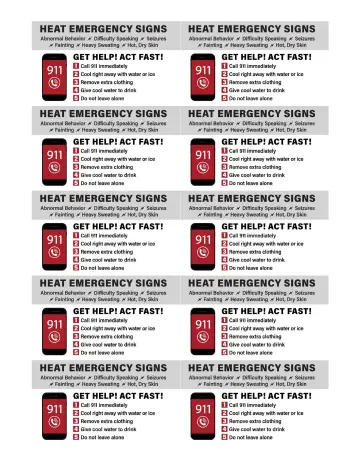
2 slidesHeat Emergency Wallet Card (OSHA 4403)
OSHA card or poster, for General Industry classes.
U.S. Department of Labor, OSHAPublic domain
pdfes
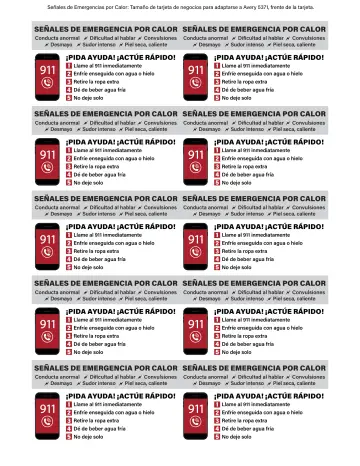
2 slidesHeat Emergency Wallet Card (OSHA 4404) (en español)
OSHA card or poster, in Spanish, for General Industry classes.
U.S. Department of Labor, OSHAPublic domain
pdf
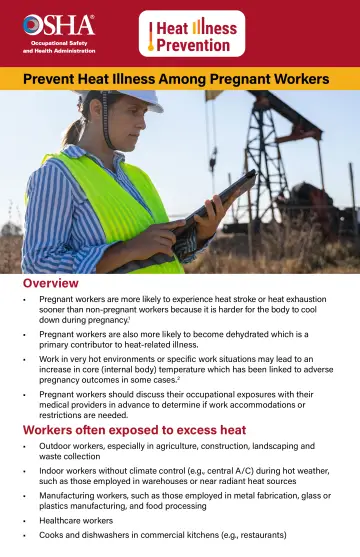
4 slidesHeat Illness Prevention: Prevent Heat Illness Among Pregnant Workers Fact Sheet (OSHA 4376)
OSHA fact sheet or bulletin, for General Industry classes.
U.S. Department of Labor, OSHAPublic domain