1 / 138Use ← → to flip
Heat Illness Prevention Plan
Building a heat illness prevention plan: for supervisors and employers.
Slide text
· 138 slides · by University of Houston Clear Lake
The words on each slide as the author wrote them, read from the file by software so they can be searched. Layout, pictures and tables are not shown here: the slides above and the download are the original.
- Slide 1
Heat-Illness Prevention Plan
- This material was produced under grant number SH-05032- SH8 from the Occupational Safety and Health Administration, U.S. Department of Labor. It does not necessarily reflect the views or policies of the U.S. Department of Labor, nor does mention of trade names, commercial products, or organizations imply endorsement by the U.S. Government.
- Slide 2
Photo Sources
- Bureau of Labor Statistics (BLS)
- California Occupational Safety and Health Administration (Cal OSHA)
- Centers for Disease Control and Prevention (CDC)
- Department of Defense (DOD)
- National Institute for Occupational Safety and Health (NIOSH)
- Occupational Safety and Health Administration (OSHA)
- Public Health Information Library (PHIL)
- Source: Cal OSHA
- Slide 3
Learning Objectives
- 1. Discuss why heat-illness prevention is important
- 2. Know cause, prevention and first aid for heat illnesses
- 3. Understand the approach for heat-illness prevention
- Train workers and supervisors on prevention strategies and to recognize signs and symptoms of heat-related illnesses
- Monitor weather and workplace conditions
- Conduct a heat hazard assessment and assess risk level
- Implement appropriate prevention strategies and controls
- Plan for heat-related medical emergencies
- 4. Understand how physiological monitoring can be used to help prevent heat-related illnesses
- 5. Apply these principles to conduct a heat hazard evaluation and recommend preventative controls (Class Exercises)
- Slide 4
Section 1:
- Why is heat-illness prevention important?
- Slide 5
Class Discussion: Why is heat-illness prevention important?
- Question mark clip art
- Slide 6
Heat-Illness Statistics
- OSHA reported heat-related fatalities among outdoor workers (not all workers) 2008 to 2014
- Source: OSHA
- Slide 7
Statistics for Texas
- Temperature-Related Deaths Texas, 2003-2008
- Temperature-related Deaths
- 439 heat-related deaths reported among Texas residents
- Harris County 41
- Fort Bend 3
- Liberty 3
- Montgomery 3
- Brazoria 2
- Galveston 2
- Source: Texas Health and Human Services (Temperature-related Deaths)
- Slide 8
Houston Area Statistics
- Houston Heat related data, 2013- 2016
- Houston Epidemiology Report
- Source: Houston Health Department
- Slide 9
#1: The number one reason why we all need to look after each other on the job
- We all deserve to go home safe to our family and friends
- Children
- Source: Centers for Disease Prevention and Control (CDC)
- Slide 10
Section 2:
- Heat-Illness Prevention Plan
- Slide 11
Purpose and Scope
- Purpose
- This heat-illness prevention plan was developed to provide supervisors and workers with the training and tools to help protect them from heat-related exposures and illnesses.
- Scope
- Each work site and job task can be unique and contain a number of heat stress hazards that must be addressed prior to the beginning work and during work activities. Supervisors and workers are responsible for assessing these hazards and taking necessary corrective actions to reduce heat-related illnesses.
- Slide 12
Employer Responsibilities
- Employer must ensure that all employees understand and adhere to the policies and procedures of the plan.
- On the job, responsibility of the Safety Manager and supervisors to implement the Heat-Illness Prevention Plan.
- Continual observational safety checks of work operations
- Enforcement of the safety policy and procedures
- Correcting any unsafe practices or conditions immediately
- Safety Manager must approve any changes to the Plan.
- Supervisors Source: OSHA
- Slide 13
Who is responsible for implementation at your company?
- Designated Safety Manager
- Supervisors
- Supervisors (continued)
- Slide 14
Employee Training and Responsibilities
- Each employee trained on procedures and will strictly adhere to them except when doing so would expose the employee to a greater hazard
- Employees are to notify their supervisor of a concern and have the concern addressed before proceeding
- Source: Cal OSHA
- Slide 15
Main Elements of Heat-Illness Prevention Plan
- Control
- Description
- 1. Train supervisors and workers
- Train supervisors and workers on heat-illness prevention strategies, as well as to recognize and report the signs and symptoms of heat-related illnesses.
- 2. Monitor weather and workplace conditions
- Monitor weather workplace conditions and take preventative measures to protect workers when the temperatures exceed 70 °F (21 °C).
- 3. Conduct a heat hazard assessment when temperatures exceed 70 °F
- Determine an effective wet-bulb globe temperature (WBGT- Effective) and use established recommended alert limits (non-acclimatized workers) and exposure limits (acclimatized workers) to determine the heat stress risk level.
- 4. Implement heat-illness prevention strategies
- Implement appropriate heat-illness prevention strategies based on established risk levels for heat stress.
- 5. Plan for heat-related medical emergencies
- Ensure adequate supervision, first aid and medical services are readily available in the event a worker suffers from a heat illness.
- Slide 16
- Section 3: Training
- Slide 17
Elements Heat-Illness Prevention Plan
- 1. Training
- 2. Monitoring
- 3. Hazard Assessment
- 4. Heat-Illness Prevention Strategies
- 5. Emergency Preparedness
- Plan (Clipart)
- Slide 18
Risk Factors for Heat
- Stress
- Environmental risk factors
- 1. Temperature
- 2. Humidity
- 3. Air movement
- 4. Radiant heat
- (e.g., sun exposure)
- Risk Factors (Source: NIOSH)
- Slide 19
Risk Factors for Heat Stress
- Work-related risk factors
- 1. Age
- 2. Physical fitness
- 3. Acclimatization
- 4. Medical conditions
- 5. Medications
- 6. Alcohol and/or drug use
- 7. Caffeine
- Risk Factors (Source: NIOSH)
- Slide 20
How the Body Handles Heat
- Increased heart rate
- Increased blood circulation to skin
- Evaporative cooling from sweating
- Thermogram (Stock Photo)
- Slide 21
The importance of acclimatization
- Reduces risks of dehydration and salt loss
- Sweating and evaporative cooling becomes more efficient
- Salt loss becomes more efficient (less loss)
- Core body temperature maintained more efficiently
- Reduces strain on heart
- Blood circulation to skin becomes more efficient
- Recovery heart rate improves
- More efficient sweating, blood flow to skin and heart rate recovery (CDC & Stock Photo)
- Slide 22
Human body needs to acclimate to hot environments, typically 10-14 days
- Gradually increase exposure to hot environment over 7-14 days
- Avoid prolonged exertion during hottest times of day
- Schedule heavy exertion for cooler parts of day
- Calendar (Clipart)
- Slide 23
When acclimated workers take an extended break they need to re-acclimate
- Acclimatized workers will need 2-3 days of re-acclimatization if they stop working under heat stress conditions more than a week
- Calendar 2 to 3 days (Clipart)
- Slide 24
The importance of consuming water throughout the work shift
- One cup (8 oz.) of cool water or an electrolyte replacement fluid every 15-20 minutes; four cups of water every hour.
- Increased water intake may be needed to account for increased physical exertion and/or sweating.
- Source: Cal OSHA
- Slide 25
Too much water intake can be dangerous
- Too much water intake can lead to headache, nausea, vomiting and/or mental confusion
- Water bottle (Stock Photo)
- Slide 26
Physiological monitoring for dehydration may be necessary under extreme conditions
- If sweat is not trapped within clothing, then we can monitor body weight, which should not drop below 1.5% of starting body weight.
- Urine color is another indicator of potential dehydration. Normal urine should be a pale yellow.
- Sweat trapped by encapsulating suit
- (Source: PHIL)
- Slide 27
Monitoring Body Weight
- Use a scale capable of accurately reading within ± 0.25 lbs.
- Measure your weight at breaks, at least every hour if you are sweating a lot
- Your body weight should not drop by more than 1.5%
- If 150 lbs., then not more than 2 lbs.
- If 200 lbs., then not more than 3 lbs.
- Body Scale (Clipart)
- Slide 28
Monitoring Urine Color
- Urine Color Chart
- Normal urine should be pale yellow
- Darker urine can indicate dehydration
- Some diets, medications and illnesses may affect results
- Source: NIOSH
- Slide 29
Importance of frequent rest breaks and shade
- Prolonged physical exertion and muscle activity increases the body’s core temperature and reduces the body’s ability to cool itself.
- Breaks allow blood to flow to the skin to be cooled.
- Rest breaks slow down the buildup of heat in the body from prolonged muscle activity.
- Rest breaks are important for the heart and allow your heart rate to recover from sustained heat stress and physical exertion.
- Rest breaks in the shade help with cooling, especially if there is air movement with cool air.
- Shade (Source Cal OSHA)
- Slide 30
Heat-Related Illnesses
- Major Heat-Related Illnesses
- Heat Rash
- Heat Cramps
- Heat Syncope
- Heat Exhaustion
- Heat Stroke
- Rhabdomyolysis
- What You Need to Know
- Cause
- Preventative measures
- Signs & symptoms
- First aid treatment
- When to report
- Slide 31
Progression of Heat-Related Illnesses (Source: NIOSH)
- Less Severe Heat Rash
- Heat Cramps
- Heat Exhaustion
- Heat Syncope
- More Severe
- Heat Stroke
- Rhabdomyolysis
- Slide 32
Heat Rash: Cause and Prevention
- Cause
- Irritation of skin due to excessive sweating
- Preventative Measures
- Wear loose fitting clothing that allows sweat to dissipate
- Wear freshly laundered clothing each day
- Avoid working in sweat soaked clothing for prolonged periods (e.g., change at breaks as needed)
- Wash sweat-soaked areas with mild soap and water and dry thoroughly at breaks and after your shift ends
- Slide 33
Heat Rash: Signs & Symptoms
- Itchy and painful clusters of red blisters
- Common to the neck, chest, groin, armpits and creases of the elbows and knees
- Heat rash (Source DOD)
- Slide 34
Heat Rash: First Aid Treatment
- Move person to a cool location
- Have person take a cool shower
- Thoroughly dry the skin following shower
- Continue to ensure skin is cleaned and dried frequently, especially before and after shifts
- Seek medical treatment if rash persists for more than two days or if rash become infected
- Shower (Clipart)
- Slide 35
Heat Rash: Reporting
- Report to supervisor or safety manager
- Seek medical treatment if rash persists for more than two days or if rash becomes infected
- Report to Supervisor (Stock Photo)
- Slide 36
Heat Cramps: Cause and Prevention
- Cause
- Preventative Measures
- Acclimatization to heat helps reduce salt and water loss
- Drink adequate amounts of water throughout the day This is a precursor to more
- serious heat exhaustion
- Salt your foods to taste
- Depletion of salt and water in body due to excessive sweating.
- and/or heat stroke.
- Slide 37
Heat Cramps: Signs & Symptoms
- Muscle cramps, spasms and/or pain
- Common to major muscles used for work
- Arm muscles
- Leg muscles
- Abdominal muscles
- Back muscles
- Heat cramps (Source OSHA)
- Slide 38
Heat Cramps: First Aid Treatment
- Move person to a cool location
- Provide person with an electrolyte replacement fluid to replace lost salt and water
- Seek medical treatment if cramps persist or other heat-illness symptoms develop
- Sports Drink (Stock Photo)
- Slide 39
Heat Cramps: Reporting
- Report to supervisor or safety manager
- Seek medical treatment if cramps persist or other heat-illness symptoms develop
- Elevated body temperature
- Elevated heart rate
- Headache
- Dizziness, etc .
- Check Temperature and heart rate (Stock Photo)
- Slide 40
Heat Syncope: Cause and Prevention
- Cause
- Prolonged standing or sudden rising from a sitting or resting (supine) position
- Dehydration can be a contributing factor
- Preventative Measures
- Acclimatization to heat helps reduce dehydration
- Drink adequate amounts of water throughout the day
- Break up long periods of standing with small rest breaks
- Rise slowly from sitting or resting positions
- Slide 41
Heat Syncope: Signs & Symptoms
- Light-headedness or dizziness
- Fainting
- Worker fainted on job (Source: Cal OSHA)
- Slide 42
Heat Syncope: First Aid Treatment
- If person fainted, then secure the area, elevate their feet above heart level and request immediate first aid and/or medical attention; do not allow them to get up quickly or walk
- If person is only slightly dizzy and able to move
- Have two people assist and carefully move to a cool location and have them lay down on back with feet elevated above heart level
- Provide small amounts of water
- If the dizziness persists, request immediate first aid and/or medical attention
- Provide water and rest (Source: OSHA)
- Slide 43
Heat Syncope: Reporting
- Report to supervisor or safety manager
- If they fainted or dizziness persists, request immediate first aid and/or medical attention
- Provide water, rest and monitor (Source: OSHA)
- Slide 44
Heat Exhaustion: Cause and Prevention
- Cause
- Inability of body to cool itself, often due to a combination of several factors (e.g., high temperatures, humidity, physical exertion, dehydration, clothing that blocks sweat evaporation or alcohol use).
- This is a serious condition that can lead to a life-threatening heat stroke.
- Preventative Measures
- Acclimatization to heat helps reduce dehydration
- Drink adequate amounts of water throughout the day
- Take small rest breaks in shade to allow body to recover from heavy physical exertion and heat exposure
- Protect skin against sunburn, which reduces body’s ability to cool itself
- If possible, perform heavier physical labor towards cooler part of the day (e.g., early morning or evening)
- Slide 45
Heat Exhaustion: Signs & Symptoms
- Elevated core body temperature of 100.4 to 102.2 °F; oral temperature 99.6 to 101.4 °F
- Weak, but rapid pulse (elevated heart rate)
- Cool, moist skin
- May appear pale with clammy skin
- Excessive sweating
- Headache and possible irritability
- Fatigue or weakness
- Dizziness and/or feeling faint
- Nausea and/or vomiting
- Decreased urine output
- Heat exhaustion (Source Cal OSHA)
- Slide 46
Heat Exhaustion: First Aid Treatment
- Seek immediate medical care
- Immediately help the person cool off & monitor them (do not let them out of sight)
- Move to a cool location
- Remove or loosen unnecessary clothing
- Have them drink small amounts of cool water
- Spray skin with cool water and fan rapidly to increase evaporation and cooling
- Monitor body temperature and continue cooling efforts until body temperature returns to a normal temperature below 99 °F (37 °C).
- Implement additional heat stroke treatments if body temperature does not decrease below 100 °F (37.8 °C) after 30 minutes or increases above 102 °F (38.9 °C).
- Heat exhaustion (Source: OSHA)
- Slide 47
Heat Exhaustion: Reporting
- Seek immediate medical care, especially if worker does not recover in first hour
- Report to supervisor or safety manager
- First aid (Clipart)
- Slide 48
Heat Stroke: Cause and Prevention
- Cause
- Preventative Measures
- Body is unable to cool itself and regulate core body temperature.
- Same as for Heat Exhaustion
- Acclimatization
- Drink adequate amounts of water throughout the day
- Take small rest breaks in shade
- Protect skin against sunburn
- If possible, perform heavier physical labor towards cooler part of the day
- This is a serious and life-threatening condition that requires immediate medical attention
- (call 911).
- Slide 49
Heat Stroke: Signs & Symptoms
- Elevated core body temperature above 104 °F
- Oral temperature above 103.2 °F
- Hot, dry skin or heavy sweating
- Fainting or a loss of consciousness
- Seizures or convulsions
- Mental confusion, agitation
- Irrational behavior
- Clumsiness
- Slurred speech
- Heat stroke (Source Cal OSHA)
- Slide 50
Heat Stroke: First Aid Treatment
- Seek immediate medical care (call 911)
- Provide immediate and aggressive cooling to their body
- Call 911 (OSHA)
- Elevate feet above heart level
- Remove or loosen unnecessary clothing
- Pack ice in groin and armpit areas
- Soak skin with cool water and fan vigorously to increase cooling of skin
- As an alternative, immerse them in a tub of cool water or spray body with large amounts of cool water
- Do not give person fluids to drink if unconscious or vomiting
- Monitor body temperature and continue cooling efforts until body temperature returns to a normal temperature below 99 °F (37 °C).
- Administer CPR as needed, if blood circulation or breathing stops, until emergency medical services arrive
- Slide 51
First Aid Treatment for Heat Stroke
- Pack Ice along arm pit and groin areas (Source: DOD)
- Remove clothing, spray skin with water and fan vigorously (Source: CDC)
- Slide 52
Heat Stroke: Reporting
- Seek immediate medical care (call 911)
- Report to supervisor or safety manager
- Hospital (Clipart)
- Slide 53
Rhabdomyolysis: Cause and Prevention
- Cause
- Sometimes caused by a combination of heat stress and prolonged physical exertion Muscle starts to break down and die, releasing proteins and electrolytes into the bloodstream.
- This is a potentially life-threatening condition affecting the kidneys that requires immediate medical attention.
- Preventative Measures
- Same as for heat exhaustion and heat stroke
- Avoid overexertion, such as lifting objects heavier than you can comfortably lift or straining muscles to a point where they can no longer function properly.
- Those with diabetes, thyroid conditions or muscular dystrophy are at greater risk.
- Those with a viral infection, such as flu, HIV or herpes, are at greater risk.
- Use of alcohol & illegal drugs, such as heroin, cocaine & amphetamines can increase the risk.
- Some medications, such as such as antipsychotics or statins, can increase the risk.
- Slide 54
Rhabdomyolysis: Signs & Symptoms
- Muscle cramps, pain and/or loss of range
- Joint pain and/or stiffness
- Swelling of muscles
- Weakness and a decreased ability to perform physical exertion for even a small amount of time
- Dark urine (similar to tea or cola in color)
- If kidney damage and/or failure occurs the following life-threatening indicators may be observed:
- Shortness of breath
- Irregular heart beat
- Swelling in the legs and feet
- Seizures
- Coma
- Rhabdomyolysis urine
- (Creative Commons: James
- Heilman, MD)
- Slide 55
Rhabdomyolysis : First Aid Treatment
- Seek immediate medical care (call 911)
- IV fluids and treatments to combat toxic proteins in blood are needed to prevent kidney failure
- Hospital (Clipart)
- Slide 56
Rhabdomyolysis: Reporting
- Seek immediate medical care (call 911)
- Report to supervisor or safety manager
- Hospital (Clipart)
- Slide 57
Heat-illness prevention strategies
- When Risk Level is High Incorporate Physiological Monitoring
- Hierarchy of controls
- Engineering controls
- Administrative controls
- Protective clothing & equipment
- Slide 58
When Risk Level is High Incorporate Physiological Monitoring
- Oral temperature
- Heart rate recovery
- Additional measures to help reduce dehydration
- Body weight
- Urine color
- Oral temperature monitoring (US ARMY DOD)
- Slide 59
Oral temperature
- It is important to make sure the thermometer is stored in a cool environment and not exposed to temperatures above 95 °F.
- Readings should not be taken be taken within 15-minutes of consuming hot or cool liquids and foods or if breathing heavy (mouth breathing).
- Oral temperatures should not exceed 99.5 °F.
- As a precautionary measure, when the oral temperature is elevated above 99.1 °F, adjust the work-rest schedule to increase the frequency and duration of rest breaks or take other preventative measures.
- Oral thermometer
- (Stock Photo)
- Slide 60
Heart Rate Recovery
- Take pulse rate readings at the beginning of a scheduled rest break.
- With the worker sitting and resting, collect an initial pulse rate reading (P1) and if it is above 110 bpm, then take readings at a two-minute (P2) and four-minute (P3) interval.
- If pulse rate does not drop to below 110 bpm, then this indicates heat stress conditions are above an acceptable level. The resting heart rate is too high, which indicates the work rate is too high for the individual.
- With P1 above 110 bpm, if the difference between two-minute intervals is less than 10 bpm, then this also indicates heat stress conditions are above an acceptable level. The heart rate is not effectively recovering at rest, which also indicates the work rate is too high for the individual. It could also indicate dehydration.
- Slide 61
Caution: Heart Rate Recovery
- There can be variation among individuals and some may exhibit much lower or higher resting pulse rates. A qualified medical provider should examine individuals with pre-work pulse rates above 100 bpm when at normal rest. High resting pulse rates could be indicative of an underlying medical condition.
- Medical symbol
- (Clipart)
- Slide 62
Class Exercise #1 Body Temperature and Heart Rate Recovery
- Worker #1
- Worker #2
- Oral temperature 98.9 °F
- Heart rate
- Oral temperature 99.4 °F
- Heart rate
- P1: 140 bpm
- P2: 115 bpm
- P3: 95 bpm
- P1: 125 bpm
- P2: 120 bpm
- P3: 118 bpm
- Slide 63
Class Exercise #1
- What is your assessment for each worker? Can they return to normal duties?
- Worker #1
- Worker #2
- Slide 64
Hierarchy of Controls – a combination of several is always recommended
- Engineering
- Administrative
- Reduce heat stress factors
- Reduce WBGT
- Acclimate workers
- Use tools & equipment to Adjust work schedule reduce physical exertion
- Rest, water & shade
- Training
- Clothing & Equipment
- Adjust clothing layers
- Light colored or reflective clothing
- Cooling vests and clothing
- Slide 65
Engineering Controls
- 1. Reduce physical exertion and physical demands of work through use of powered tools and equipment, especially for tasks involving heavy lifting.
- 2. Reduce radiant heat loading from the sun or other sources of radiant heat (e.g., furnaces, combustion engines and compressors, hot surfaces, heated transfer lines, windows receiving intense sun, etc.). Place line-of-sight, reflective barriers between the heat source and workers. Insulate hot surfaces, such as furnaces.
- 3. If air temperatures are below 95 °F, then increase air speed across skin using fans or air movers, to increase evaporative cooling from skin.
- 4. If air temperatures are above 95 °F, then reduce air speed across skin, to reduce convective heat transfer from air to skin.
- 5. If humidity is below 50%, then evaporative coolers and portable fans with water mist systems can be used to effectively cool the air by about 10 to 20 °F.
- 6. Decrease humidity to below 50% to increase evaporative cooling from sweating.
- Slide 66
Examples of Engineering Controls
- Misting fan (Wikimedia Creative
- Commons by Tdorante10)
- Forklift (Clipart)
- Slide 67
Administrative Controls 1 - 5
- 1. Adjust work schedule to acclimate workers to heat.
- 2. Schedule work or work requiring heavy physical exertion during the coolest parts of the day.
- 3. Modify the work-rest schedule to shorten heat exposure periods by including frequent rest breaks. Shorter, more frequent breaks are more effective than longer, less frequent rest breaks.
- 4. Encourage adequate water intake at frequent intervals to prevent dehydration (e.g., one 8-ounce cup of cool water or an electrolyte replacement fluid every 15-20 minutes).
- 5. Use a shaded and cool space nearby for rest and water breaks.
- Slide 68
Water for Remote Job Sites
- Supervisor or foreman is responsible
- Ensure water containers are clean and sanitary
- Ensure water containers are filled at a sanitary location
- Provide sufficient disposable cups & disposal receptacle
- Ensure workers do not share cups and dispose properly
- Prohibit workers from opening the cooler top to fill cups and instead have workers use the provided spigot.
- Provide pure and cool potable water
- Do not use water from irrigation, sprinklers or fire systems
- Do not use water from a garden hose (may contain contaminants and/or microbes)
- Water quantities need to be sufficient and at least 1 quart per worker per hour for the entire shift
- Locate water containers as close as possible
- Encourage workers to frequently drink water and not wait until thirsty
- Water cooler (Source: Cal OSHA)
- Slide 69
Examples of Administrative Controls
- Adjust work schedule to have heavy physical exertion at cooler times of day (Clipart)
- Rest in shade (OSHA)
- Slide 70
Administrative Controls 6 - 11
- 6. Give training on the recognition of the signs and symptoms of heat-induced illness and on heat-illness prevention strategies.
- 7. Provide alerts for extreme heat events or heat stress conditions and review of the heat-illness prevention strategies for the day.
- 8. Work in pairs (buddy system) and monitor each other for signs and symptoms of heat stress or illness.
- 9. Avoid caffeine and alcohol before and during work in heat. 10.Report illnesses or medical conditions that may put you at risk of heat stress (e.g., diarrhea, fever, infection, etc.)
- 11.Get medically screened for work in hot environments.
- Slide 71
Protective Clothing and Equipment Controls
- 1. Wear clothing designed to keep the body cool, such as air, cooled fluid or ice-cooled conditioned clothing.
- 2. Wear reflective clothing to reduce radiant heat loading from the sun or hot surfaces radiating heat.
- 3. If air temperatures are below 95 °F and you are protected from radiant heat, then decrease clothing coverage or layers (when feasible) to increase evaporative cooling from skin.
- Caution: Do not remove clothing designed to protect you from chemical, mechanical or other hazards without a proper evaluation to address those hazards.
- 4. If air temperatures are above 95 °F, then increase clothing coverage to reduce air speed across skin, which can help reduce convective heat transfer from air to skin.
- Slide 72
Examples of Protective Clothing Controls
- Ice vest (DOD)
- Light colored clothing (OSHA)
- Slide 73
Section 4:
- Monitor weather and workplace conditions
- Slide 74
Monitor weather and workplace conditions
- Responsibilities
- Resources
- The Safety Manager and supervisors are responsible for monitoring the daily weather and workplace conditions to determine if workers will be exposed to temperatures greater than 70 °F (21 °C).
- National Weather Service
- www.weather.gov
- Weather Underground
- www.wunderground.com
- Intellicast
- www.intellicast.com
- Slide 75
- If the temperatures will exceed 70 °F for more than an hour during the work shift, then a heat hazard assessment needs to be performed.
- Collect the following additional weather information for the heat hazard assessment
- Air temperature (°F)
- Humidity (%)
- Wind speed (mph)
- Barometric pressure (inches)
- Longitude and latitude
- Cloud cover
- The Next Step
- Conduct a heat hazard assessment
- Slide 76
Also identify and evaluate other heat stress hazards (worksheet provided)
- 1. Outside work with sun exposure and temperatures above 70 °F
- 2. Work around hot processes and/or radiant heat sources
- 3. Workers will wear vapor barrier chemical protective suits
- 4. Work under high relative humidity conditions (e.g., greater than 50%)
- 5. Low wind speeds or lack of air movement
- 6. Manual labor and tasks requiring physical exertion
- 7. Workers not acclimated to work in hot environments
- 8. Workers wearing multiple layers of clothing
- 9. Other:
- Slide 77
Does a Heat Hazard Evaluation Need to be Conducted?
- Condition
- Conduct a Heat Hazard Assessment if the answer is “YES” to any of the following:
- NO
- YES
- Items 1, 2 or 3 were checked above.
- More than two of the above items were checked.
- There is a valid concern regarding heat stress.
- Slide 78
Heat Hazard Assessment (WBGT- Effective)
- Accounts for
- Environmental heat stress factors
- Work-related heat stress factors
- Temperature
- Humidity
- Wind speed
- Solar irradiance
- Metabolic work rate
- Due to physical exertion
- Heat generated by muscles
- Clothing
- Can reduce evaporative cooling
- Slide 79
Where can I find more information on WBGT and WBGT-Effective?
- OSHA Technical Manual, Section III, Chapter 4 on Heat Stress (www.osh a.gov)
- NIOSH Criteria for a Recommended Standard: Occupational Exposure to Heat and Hot Environments (www.c dc.gov/niosh)
- NIOSH Criteria Document
- Slide 80
Why not just use a heat index?
- Heat index only takes into account temperature and humidity
- It does not take into account wind speed, radiant heat, clothing and metabolic heat from physical exertion, which are all factors that can contribute to heat stress and heat-related illnesses.
- Heat Index (Source OSHA)
- Slide 81
Heat Hazard Assessment in 5 Steps Worksheet provided
- Step 1: Calculate WBGT Using Weather Data Step 2. Add Clothing Adjustment Factor Step 3. Determine the Metabolic Heat
- Step 4. Determine Exposure Threshold Limit Step 5. Determine Risk Level
- Slide 82
Step 1: Calculate WBGT Using Weather Data
- Use Argonne National Laboratory calculator based on validated and literature-supported algorithmic equations to determine WBGT from National Weather Service data.
- Available as a downloadable zip file from OSHA at: http://www.osha.gov/dts/osta/otm/otm_iii/wbgtutil.zip
- Daily Weather Data
- (Wikimedia CC)
- Slide 83
The calculator uses the following required weather and location information to determine WBGT.
- Air Temperature (°F) for hottest hour of the work shift
- Barometric Pressure (inches of Hg)
- Relative Humidity (%) for hottest hour of the work shift
- Wind Speed (mph) during hottest hour of the work shift
- Date (MONTH DAY, YEAR; e.g., January 1, 2019)
- Time (HH:MM AM/PM; e.g., 12:00 PM) for hottest hour of the work shift
- Longitude and latitude (degrees) – input in “Options”
- Solar Irradiance (W/m 2 ) based on Table 1
- Calculator (Clipart)
- Slide 84
Table 1. Estimated Solar Irradiance Based on Cloud Cover
- Reported Cloud Cover
- Sunny
- Mostly Sunny, Partly Sunny/Cloudy Scattered Clouds
- Mostly Cloudy
- Cloudy
- Source: OSHA as adapted from A. Ben Jemaa, et al. (2013) Energy Procedia, Volume 42, Pages 406-415.
- Irradiance
- (W/m 2 )
- 710 250
- Slide 85
Step 2. Add Clothing Adjustment Factor
- As recommended by OSHA, the ACGIH Clothing Adjustment Factor (CAF) can be determined from Table 2 and added to the pervious WBGT to produce an effective WBGT value, termed WBGT-Effective.
- Slide 86
Table 2. Clothing Adjustment Factors (CAF)
- Clothing Worn
- CAF
- (°F)
- Work clothes (long sleeves and pants). Examples: Standard cotton shirt/pants.
- Coveralls (w/only underwear underneath). Examples: Cotton or light polyester material.
- Double-layer woven clothing.
- 5.4
- SMS (spunbond/meltblown/spunbond) Polypropylene Coveralls
- 0.9
- Polyolefin coveralls. Examples: Micro-porous fabric (e.g., Tyvek™).
- 1.8
- Limited-use vapor-barrier coveralls. Examples: Encapsulating suits, whole-body chemical protective suites, firefighter turn-out gear.
- 19.8
- Source: OSHA Technical Manual as adopted from ACGIH "2017 TLVs and BEIs" and converted to °F.
- Slide 87
Step 3. Determine the Metabolic Heat
- Select a work category in Table 3 that best represents the workload using the provided examples as a guide.
- Select the heaviest workload activity to account for the highest metabolic heat, which will help ensure proper controls are in place to protect workers.
- Slide 88
Table 3. Work Category Based on Metabolic Work Rates
- Adapted from OSHA Technical Manual, NIOSH Criteria for a Recommended Standard: Occupational Exposure to Heat and Hot Environments, and ACGIH "2017 TLVs and BEIs"
- Work
- Category
- Light
- Moderate
- Heavy
- Very Heavy
- Examples
- Sitting, standing, light arm/hand work and occasional walking
- Normal walking, moderate lifting
- Heavy material handling, walking at a fast pace
- Pick and shovel work
- Estimated
- Estimated
- Estimated
- Estimated
- Metabolic
- Metabolic
- Metabolic
- Metabolic
- Heat (Watts)
- Rate (Watts)
- for 154 lb.
- for 200 lb.
- for 250 lb.
- for 300 lb.
- Person
- Person
- Person
- Person
- 681*
- 605*
- 753*
- 907*
- 754*
- 940*
- 1131*
- Slide 89
Caution!
- These activities are not recommended for persons of this body weight working under heat stress conditions. Special precautionary measures must be taken to reduce physical exertion and continually monitor workers for physiological signs of heat stress (e.g., body temperature and/or heart rate).
- Slide 90
Step 4. Determine Exposure Threshold Limit
- Acclimated Workers
- Unacclimated Workers
- A NIOSH recommended exposure limit (REL) is used to establish the exposure threshold for implementation of workplace controls for heat stress in healthy workers already acclimated to work in hot environments.
- The NIOSH recommended alert level (RAL) is an exposure threshold for use with unacclimatized workers.
- Slide 91
Acclimated Workers: Recommended Exposure Limit
- (REL)
- Slide 92
Table 4. REL for Continuous Work
- Adapted from NIOSH Criteria for a Recommended Standard: Occupational Exposure to Heat and Hot Environments and ACGIH "2017 TLVs and BEIs"
- Example
- REL for 154 lb. Person
- REL for 200 lb. Person
- REL for 250 lb. Person
- REL for 300 lb. Person
- Light
- Sitting, standing, light arm/hand work and occasional walking
- 85 °F
- 83 °F
- 81 °F
- 79 °F
- Moderate
- Normal walking, moderate lifting
- 81 °F
- 79 °F
- 77 °F
- 75 °F *
- Heavy
- Heavy material handling, walking at a fast pace
- 79 °F
- 76 °F *
- 74 °F *
- 73 °F *
- Very Heavy
- Pick and shovel work
- 77 °F
- 74 °F *
- 72 °F *
- 71 °F *
- Work
- Category
- Slide 93
Table 5. REL for 75% Work & 25% Rest Each Hour
- Adapted from NIOSH Criteria for a Recommended Standard: Occupational Exposure to Heat and Hot Environments and ACGIH "2017 TLVs and BEIs"
- Work
- Category
- Example
- REL for
- REL for
- REL for
- REL for
- 154 lb.
- 200 lb.
- 250 lb.
- 300 lb.
- Person
- Person
- Person
- Person
- 87 °F
- 84 °F
- 82 °F
- 81 °F
- 84 °F
- 81 °F
- 79 °F
- 78 °F *
- 82 °F
- 79 °F *
- 77 °F *
- 76 °F *
- 79 °F
- 77 °F *
- 75 °F *
- 73 °F *
- Sitting, standing, light
- Light
- arm/hand work and occasional walking
- Moderate
- Heavy
- Very Heavy
- Normal walking, moderate
- lifting
- Heavy material handling,
- walking at a fast pace
- Pick and shovel work
- Slide 94
Table 6. 50% Work & 50% Rest Each Hour
- Adapted from NIOSH Criteria for a Recommended Standard: Occupational Exposure to Heat and Hot Environments and ACGIH "2017 TLVs and BEIs"
- Example
- REL for 154 lb. Person
- REL for 200 lb. Person
- REL for 250 lb. Person
- REL for 300 lb. Person
- Light
- Sitting, standing, light arm/hand work and occasional walking
- 89 °F
- 86 °F
- 84 °F
- 83 °F
- Moderate
- Normal walking, moderate lifting
- 86 °F
- 83 °F
- 81 °F
- 80 °F *
- Heavy
- Heavy material handling, walking at a fast pace
- 84 °F
- 81 °F *
- 79 °F *
- 78 °F *
- Very Heavy
- Pick and shovel work
- 81 °F
- 79 °F *
- 77 °F *
- 75 °F *
- Work
- Category
- Slide 95
Table 7. REL for 25% Work & 75% Rest Each Hour
- Adapted from NIOSH Criteria for a Recommended Standard: Occupational Exposure to Heat and Hot Environments and ACGIH "2017 TLVs and BEIs"
- Example
- REL for 154 lb. Person
- REL for 200 lb. Person
- REL for 250 lb. Person
- REL for 300 lb. Person
- Light
- Sitting, standing, light arm/hand work and occasional walking
- 90 °F
- 88 °F
- 86 °F
- 84 °F
- Moderate
- Normal walking, moderate lifting
- 88 °F
- 86 °F
- 84 °F
- 82 °F *
- Heavy
- Heavy material handling, walking at a fast pace
- 86 °F
- 84 °F *
- 82 °F *
- 80 °F *
- Very Heavy
- Pick and shovel work
- 84 °F
- 82 °F *
- 80 °F *
- 78 °F *
- Work
- Category
- Slide 96
Still Same Caution!
- These activities are not recommended for persons of this body weight working under heat stress conditions. Special precautionary measures must be taken to reduce physical exertion and continually monitor workers for physiological signs of heat stress (e.g., body temperature and/or heart rate recovery).
- Slide 97
Unacclimated Workers: Recommended Alert Limit (RAL)
- Slide 98
Table 8. RAL for Continuous Work
- Adapted from NIOSH Criteria for a Recommended Standard: Occupational Exposure to Heat and Hot Environments and ACGIH "2017 TLVs and BEIs"
- Example
- REL for 154 lb. Person
- REL for 200 lb. Person
- REL for 250 lb. Person
- REL for 300 lb. Person
- Light
- Sitting, standing, light arm/hand work and occasional walking
- 80 °F
- 77 °F
- 74 °F
- 72 °F
- Moderate
- Normal walking, moderate lifting
- 75 °F
- 72 °F
- 70 °F
- 68 °F *
- Heavy
- Heavy material handling, walking at a fast pace
- 72 °F
- 69 °F *
- 67 °F *
- 65 °F *
- Very Heavy
- Pick and shovel work
- 70 °F
- 67 °F *
- 64 °F *
- 62 °F *
- Work
- Category
- Slide 99
Table 9. RAL for 75% Work & 25% Rest Each Hour
- Adapted from NIOSH Criteria for a Recommended Standard: Occupational Exposure to Heat and Hot Environments and ACGIH "2017 TLVs and BEIs"
- Work
- Category
- Example
- REL for
- REL for
- REL for
- REL for
- 154 lb.
- 200 lb.
- 250 lb.
- 300 lb.
- Person
- Person
- Person
- Person
- 82 °F
- 79 °F
- 77 °F
- 75 °F
- 78 °F
- 75 °F
- 73 °F
- 71 °F *
- 76 °F
- 73 °F *
- 70 °F *
- 68 °F *
- 73 °F
- 70 °F *
- 68 °F *
- 66 °F *
- Sitting, standing, light
- Light
- arm/hand work and occasional walking
- Moderate
- Heavy
- Very Heavy
- Normal walking, moderate
- lifting
- Heavy material handling,
- walking at a fast pace
- Pick and shovel work
- Slide 100
Table 10. 50% Work & 50% Rest Each Hour
- Adapted from NIOSH Criteria for a Recommended Standard: Occupational Exposure to Heat and Hot Environments and ACGIH "2017 TLVs and BEIs"
- Example
- REL for 154 lb. Person
- REL for 200 lb. Person
- REL for 250 lb. Person
- REL for 300 lb. Person
- Light
- Sitting, standing, light arm/hand work and occasional walking
- 84 °F
- 81 °F
- 79 °F
- 77 °F
- Moderate
- Normal walking, moderate lifting
- 81 °F
- 78 °F
- 76 °F
- 73 °F *
- Heavy
- Heavy material handling, walking at a fast pace
- 78 °F
- 76 °F *
- 73 °F *
- 71 °F *
- Very Heavy
- Pick and shovel work
- 77 °F
- 74 °F *
- 72 °F *
- 69 °F *
- Work
- Category
- Slide 101
Table 11. RAL for 25% Work & 75% Rest Each Hour
- Adapted from NIOSH Criteria for a Recommended Standard: Occupational Exposure to Heat and Hot Environments and ACGIH "2017 TLVs and BEIs"
- Example
- REL for 154 lb. Person
- REL for 200 lb. Person
- REL for 250 lb. Person
- REL for 300 lb. Person
- Light
- Sitting, standing, light arm/hand work and occasional walking
- 86 °F
- 83 °F
- 80 °F
- 78 °F
- Moderate
- Normal walking, moderate lifting
- 83 °F
- 80 °F
- 78 °F
- 76 °F *
- Heavy
- Heavy material handling, walking at a fast pace
- 81 °F
- 78 °F *
- 76 °F *
- 74 °F *
- Very Heavy
- Pick and shovel work
- 80 °F
- 77 °F *
- 75 °F *
- 73 °F *
- Work
- Category
- Slide 102
Warning!
- When workers are not acclimated to work in hot environments they are at additional risk of heat stress
- These activities are not recommended for persons of this body weight working under heat stress conditions. Special precautionary measures must be taken to reduce physical exertion and continually monitor workers for physiological signs of heat stress (e.g., body temperature and/or heart rate recovery).
- Slide 103
Step 5. Determine Risk Level
- Risk level is assessed by comparing the WBGT-Effective to the REL (acclimated workers) or RAL (unacclimated workers).
- A hazard quotient is used to compare WBGT-Effective with the respective REL or RAL
- If HQ is below 1.0, then no heat stress hazard is anticipated
- The greater the HQ above 1.0, the greater the heat stress hazard
- Table 12. Risk Level for Acclimated and Unacclimated Workers
- HQ
- < 1.0
- 1.0-1.02
- 1.03-1.04
- 1.04-1.07
- 1.07
- Risk Level
- Low
- Moderate
- High
- Very High
- Severe
- Slide 104
Acclimated Workers: Hazard Quotient
- Table 12. Risk Level for Acclimated and Unacclimated Workers
- HQ
- < 1.0
- 1.0-1.02
- 1.03-1.04
- 1.04-1.07
- 1.07
- Risk Level
- Low
- Moderate
- High
- Very High
- Severe
- Slide 105
Unacclimated Workers: Hazard Quotient
- Table 12. Risk Level for Acclimated and Unacclimated Workers
- HQ
- < 1.0
- 1.0-1.02
- 1.03-1.04
- 1.04-1.07
- 1.07
- Risk Level
- Low
- Moderate
- High
- Very High
- Severe
- Slide 106
Section 5: Heat-illness prevention strategies
- Slide 107
Implementing Heat-illness Prevention Strategies
- When the HQ is above 1.0, heat-illness prevention controls need to be implemented to protect workers.
- Heat-illness prevention strategies: 5 steps
- 1. Implement controls to reduce HQ & risk level
- 2. Implement physiological monitoring with higher risk levels
- 3. Implement engineering controls
- 4. Implement administrative controls
- 5. Implement protective clothing & equipment controls
- Slide 108
Unacclimated workers
- The heat-illness prevention strategies vary slightly for unacclimated workers.
- If workers have not worked in a hot environment within the previous week, then those workers must be placed in an acclimatization program designed to gradually acclimate them to work in a hot environment.
- Slide 109
Step 1. Implement Controls to Reduce HQ & Risk Level
- Examples of highly effective controls include:
- 1. Suspend activities during the hottest part of the day and change to work schedule to cooler times of the day.
- 2. Provide shade or shelter from the sun and eliminate solar irradiance to 0 Watts/m 2 .
- 3. When feasible, eliminate use of chemical vapor-barrier coveralls, encapsulating suits and whole-body chemical protective suits during hottest parts of day.
- 4. When feasible, eliminate double clothing layers.
- 5. When feasible, use mechanical and powered equipment to reduce worker physical exertion, especially heavy exertion. This includes the use of forklifts, hoists, earthmoving equipment (backhoes, loaders and excavators), conveyers, portable power tools (e.g., rotary auger in place of hand shoveling), etc.
- Slide 110
Additional examples of effective controls to reduce risk level
- Slide 111
Step 2. When Risk Level is High Incorporate Physiological Monitoring
- When risk level is high, very high or severe, then implement physiological monitoring
- Oral body temperature
- Heart rate recovery
- Additional Monitoring for Dehydration (See Training Section)
- Body weight
- Workers can monitor urine color
- Slide 112
Recovery Heart Rate (Pulse Rate)
- Guidelines
- If the pulse rate does not drop to below 110 bpm during the test, then this indicates heat stress conditions are above an acceptable level.
- The resting heart rate is too high, which indicates the work rate is too high for the individual.
- With a starting pulse rate above 110 bpm, if the difference between two-minute intervals is less than 10 bpm, then this also indicates heat stress conditions are above an acceptable level.
- The heart rate is not effectively recovering at rest, which also indicates the work rate is too high for the individual. It could also indicate dehydration.
- Slide 113
Methods for Collecting Pulse Rate
- Heart rate pulse (Clipart)
- The pulse rate can be collected manually
- A reliable and accurate clinical pulse rate device for the finger, wrist or chest is recommended.
- Use the guidelines provided by the device manufacture when collecting pulse rates.
- Collect pulse rate at start of rest break
- As the pulse rate will change with time, it is important to collect the pulse rate within a consistent and short interval (e.g., 5 to 10 seconds).
- Slide 114
Manually Counting Pulse Rate
- Count the pulses at the inner wrist just below the palm on the thumb or neck to the side of the windpipe over a 30 second timed interval (e.g., using a stopwatch).
- Use the index and middle fingers to detect a pulse and do not start counting until a reliable pulse can be detected. A slight amount of pressure may be necessary.
- The number of pulses is then multiplied by 2 to give the pulse rate in bpm.
- Check pulse (Clipart)
- Slide 115
Table 14. Collection and Interpretation of Pulse Rates
- STEP
- Schedule times for collection
- Instructions
- During the hottest times of the workday, collect pulse rates at least every hour. Under severe conditions, the cycle should be at least every 30 minutes. Collect at the start of the rest break, within the first few minutes.
- Collect initial pulse rate (P1)
- Have the work sit on a stool or chair and rest. Collect the initial pulse rate within a few minutes after the worker has stopped working, at the start of the rest break.
- If P1 is below 110 bpm
- If the pulse rate is below 110 bpm, then resume normal work activities and work-rest schedule.
- If P1 is above 110 bpm
- If the pulse rate is above 110 bpm, then evaluate heart rate recovery by collecting two additional pulse rate measurements at two-minute intervals.
- If differences between 2-
- If differences between 2-minute intervals is greater than 10 bpm and the pulse rate drops below 110 bpm, then
- minute intervals is greater
- resume normal work activities and work-rest schedule.
- than 10 bpm and the pulse rate drops below 110 bpm
- If differences between 2-minute intervals is less than 10 bpm, then suspend work and physical exertion within the hot
- minute intervals is less than
- environment and take immediate actions to cool his/her body temperature (e.g., move to a cool location with air
- 10 bpm
- movement and provide cool fluids). Monitor pulse rate and/or body temperature and continue cooling efforts until
- pulse rate drops below 90 bpm or body temperature returns to normal below 99 °F. Seek medical attention if worker exhibits additional signs of heat exhaustion or pulse rate and/or temperature do not drop or continue to elevate at rest.
- Slide 116
General Guidelines for Heart Rate Recovery
- Within the first few minutes of rest
- Your heart rate should drop to below 110 bpm
- If it does not, then measure again at 2-minute intervals
- Your heart rate should drop by more than 10 bpm every 2-minutes
- Slide 117
Oral Body Temperature
- Guidelines
- Oral temperature should not exceed 99.5 °F
- When the oral temperature is elevated above 99.1 °F:
- Adjust the work-rest schedule to increase the frequency and duration of rest breaks or take other preventative measures
- Oral thermometer (Stock
- Photo)
- Slide 118
Oral Body Temperature Measurement
- Use a reliable and accurate clinical thermometer according to the manufacturer’s instructions.
- Disposable oral thermometers; readings will take longer (e.g., 3-4 min).
- Digital oral thermometers can deliver an accurate reading in as little as 30 seconds.
- Make sure the thermometer is stored in a cool environment below 95 °F.
- Do not take readings within 15-minutes of consuming hot or cool liquids and foods or if the worker is breathing heavy by mouth.
- Oral Thermometer (Source: PHIL)
- Slide 119
Table 13. Collection and Interpretation of Oral Temperatures
- STEP
- Instructions
- Schedule times for collection During the hottest times of the workday, collect oral temperatures at least every hour. Under severe conditions, the cycle should be at least every 30 minutes.
- Collect oral temperature
- If worker is not breathing heavily by mouth, then collect oral temperature at a scheduled rest breaks, before consumption of fluids. If worker is breathing heavily, then first drink fluids and collect temperature at end of rest break,
- 15-minutes after drinking fluids.
- Reading less than 99.1 °F
- If thermometer reading is less than 99.1 °F, then resume normal work activities and work-rest schedule.
- Reading 99.2 to 99.5 °F
- If thermometer reading is 99.2 to 99.5 °F, then take precautionary measures to reduce heat stress (e.g., adjust work-rest schedule or implement additional controls)
- Reading above 99.5 °F
- If thermometer reading is above 99.5 °F, then suspend work and physical exertion within the hot environment and take immediate actions to cool body temperature (e.g., relocate to a cool environment with air movement and provide cool fluids). Monitor body temperature and continue cooling efforts until body temperature returns to a normal temperature below 99 °F. Seek medical attention if worker exhibits additional signs of heat exhaustion or temperature does not drop or continues to elevate at rest.
- Reading above 101.2 °F
- If thermometer reading is above 101.2 °F, then seek immediate medical attention and take immediate actions to cool his/her body temperature assuming potential heat stroke conditions (e.g., relocate to a cool location with air movement, remove excess clothing, spray body with cool water and fan vigorously, and pack ice in armpits and groin area).
- Slide 120
- Oral Temperature Warning Levels
- Slide 121
Step 3. Implement Engineering Controls
- 1. Reduce physical exertion and physical demands of work through use of powered tools and equipment, especially for tasks involving heavy lifting.
- Reduce radiant heat loading from the sun or other sources of radiant heat (e.g., furnaces, combustion engines and compressors, hot surfaces, heated transfer lines, windows receiving intense sun, etc.). Place line-of-sight, reflective barriers between the heat source and workers. Insulate hot surfaces, such as furnaces.
- If air temperatures are below 95 °F, then increase air speed across skin using fans or air movers, to increase evaporative cooling from skin.
- If air temperatures are above 95 °F, then reduce air speed across skin, to reduce convective heat transfer from air to skin.
- If humidity is below 50%, then evaporative coolers and portable fans with water mist systems can be used to effectively cool the air by about 10 to 20 °F. Decrease humidity to below 50% to increase evaporative cooling from sweating.
- Slide 122
Step 4. Implement Administrative Controls (1 –
- 1. Adjust work schedule to acclimate workers to heat.
- 2. Schedule work or work requiring heavy physical exertion during the coolest parts of the day.
- 3. Modify the work-rest schedule to shorten heat exposure periods by including frequent rest breaks. Shorter, more frequent breaks are more effective than longer, less frequent rest breaks.
- 4. Encourage adequate water intake at frequent intervals to prevent dehydration (e.g., one 8-ounce cup of cool water or an electrolyte replacement fluid every 15-20 minutes).
- 5. Use a shaded and cool space nearby for rest and water breaks.
- Slide 123
Review: Water for Remote Job Sites
- Supervisor or foreman is responsible
- Ensure water containers are clean and sanitary
- Ensure water containers are filled at a sanitary location
- Provide sufficient disposable cups & disposal receptacle
- Ensure workers do not share cups and dispose properly
- Prohibit workers from opening the cooler top to fill cups and instead have workers use the provided spigot.
- Provide pure and cool potable water
- Do not use water from irrigation, sprinklers or fire systems
- Do not use water from a garden hose (may contain contaminants and/or microbes)
- Water quantities need to be sufficient and at least 1 quart per worker per hour for the entire shift
- Locate water containers as close as possible
- Encourage workers to frequently drink water and not wait until thirsty
- Unacceptable water (Source: Cal OSHA)
- Slide 124
Step 4. Implement Administrative Controls (6 –
- 6. Give training on the recognition of the signs and symptoms of heat-induced illness and on heat-illness prevention strategies.
- 7. Provide alerts for extreme heat events or heat stress conditions and review of the heat-illness prevention strategies for the day.
- 8. Work in pairs (buddy system) and monitor each other for signs and symptoms of heat stress or illness.
- 9. Avoid caffeine and alcohol before and during work in heat. 10.Report illnesses or medical conditions that may put you at risk of heat stress (e.g., diarrhea, fever, infection, etc.)
- 11.Get medically screened for work in hot environments.
- Slide 125
Step 5. Implement Protective Clothing and Equipment Controls
- 1. Wear clothing designed to keep the body cool, such as air, cooled fluid or ice-cooled conditioned clothing.
- 2. Wear reflective clothing to reduce radiant heat loading from the sun or hot surfaces radiating heat.
- 3. If air temperatures are below 95 °F and you are protected from radiant heat, then decrease clothing coverage or layers (when feasible) to increase evaporative cooling from skin.
- Caution: Do not remove clothing designed to protect you from chemical, mechanical or other hazards without a proper evaluation to address those hazards.
- 4. If air temperatures are above 95 °F, then increase clothing coverage to reduce air speed across skin, which can help reduce convective heat transfer from air to skin.
- Slide 126
Class Exercise #2
- Conduct an assessment using information below & Job-Specific Heat-Illness Prevention Plan (Appendix)
- 5 unacclimated workers digging a trench using hand shovels and wheel barrels
- Outside from 8 AM to 5 PM with one hour for lunch
- Continuous work with only very short breaks during work for water
- Half of the workers weigh about 200 lbs.
- Workers are wearing work pants, long-sleeve shirt, gloves and hard hat
- National Weather Service
- Air Temperature: 72 °F at 2 PM (52 °F at 7AM, 62 °F at 10 AM and 68 °F at 12 PM & 5 PM)
- Barometric Pressure: 30.17 inches of Hg
- Relative Humidity: 69 %
- Wind Speed: 10 mph
- Date: January 6, 2019
- Hottest Time: 02:00 PM
- 29.5807° N, 95.0991° W
- Partial cloud cover
- Slide 127
Class Exercise #2: Plan
- Corrective Actions that will be taken to Prevent Heat Stress
- Step 1: Implement Controls to Reduce HQ and Reduce Risk Level
- Action: ___ Action: ___ Action: ___ Revised Risk Level: ___
- Step 2: Implement Physiological Monitoring for High Risk Level
- ___ Oral Temperature ___ Heart Rate Recovery ___ Body Weight or ___ Urine Color
- Step 3: Implement Engineering Controls
- Action: ___ Action: ___
- Step 4: Implement Administrative Controls
- Step 4: Implement Protective Clothing or Equipment Controls
- Slide 128
Section 6:
- Preparing for medical emergencies
- Slide 129
Preparing for Medical Emergencies
- When workers are exposed to heat stress conditions, it is critical to ensure adequate supervision, first aid and medical services are readily available in the event a worker suffers from a heat illness.
- This includes ensuring adequate first aid supplies are available and supervisors and workers are trained on what to do if a co-worker suffers from a heat-related illness.
- Preparation
- Supervision
- Training
- First aid supplies
- First aid providers
- Nearby medical services
- Slide 130
First Aid Supplies: Have On Hand
- 1. Reliable oral thermometer for checking body temperature.
- 2. Reliable instrument or timer for checking heart rate.
- 3. Cool water or electrolyte replacement fluids.
- 4. Cold packs or ice packs for treatment of heat stroke.
- 5. Spray bottles with water or an available water source for treating heat stroke.
- First aid (Clipart)
- Slide 131
First Aid Providers
- Each work site should have at least one person trained to administer first aid, with two or more preferred.
- The location, physical address and phone number of the nearest hospital or emergency medical services must be obtained prior to the beginning of work activities under hot conditions.
- First aid (Clipart)
- Slide 132
Emergency Response Information
- The following emergency response information must be obtained prior to the beginning of work activities.
- 1. Names, locations and phone numbers of all first aid trained supervisors or key personnel on site.
- 2. Phone numbers for on-site or local medical emergency services.
- 3. Address, phone number and directions from site to closest emergency medical services (e.g., hospital).
- 4. Physical address and detailed directions for emergency medical services. If the site is a remote location, then check with emergency medical services to ensure they can find the location. Some providers may require GPS coordinates.
- Map (Source Cal OSHA)
- Slide 133
First Aid Guidelines
- See Section VI Training for the general first aid guidelines for heat-related illnesses, for supervisors and workers.
- It is important that all supervisors and workers know how to recognize the signs and symptoms of heat stress, when to call for emergency medical assistance and what steps they need to take to help the victim of heat stress until emergency services arrive.
- First aid (Clipart)
- Slide 134
Section 7:
- Incident Investigations
- Slide 135
Incident Investigations
- All incidents that result in a worker suffering from a heat-related illness, regardless of their nature, shall be investigated and reported to management.
- It is an integral part of any safety program that documentation take place as soon as possible so that the cause and means of prevention can be identified to prevent a reoccurrence.
- A Worksite Incident Form is provided in the Appendix.
- The form is to be completed and used to initiate an incident investigation with the goal of taking corrective actions to prevent future occurrences.
- Investigation (Clipart)
- Slide 136
Near the end… Anything to add?
- Light bulb clip art
- Slide 137
Review of Learning Objectives
- 1. Discuss why heat-illness prevention is important
- 2. Know cause, prevention and first aid for heat illnesses
- 3. Understand the approach for heat-illness prevention
- Train workers and supervisors on prevention strategies and to recognize signs and symptoms of heat-related illnesses
- Monitor weather and workplace conditions
- Conduct a heat hazard assessment and assess risk level
- Implement appropriate prevention strategies and controls
- Plan for heat-related medical emergencies
- 4. Understand how physiological monitoring can be used to help prevent heat-related illnesses
- 5. Apply these principles to conduct a heat hazard evaluation and recommend preventative controls (Class Exercises)
- Slide 138
Let’s look out for each other… Make sure everyone goes home safely
- Questions?
- Drink water and stay hydrated
- Source: OSHA
More on Heat
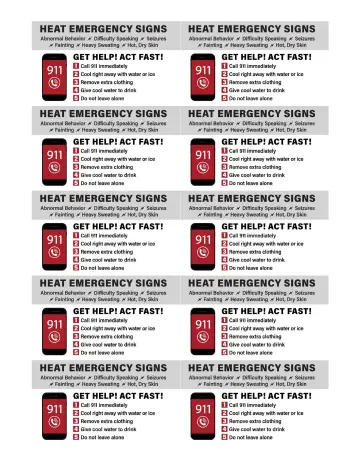
pdf
2 slidesHeat Emergency Wallet Card (OSHA 4403)
OSHA card or poster, for General Industry classes.
U.S. Department of Labor, OSHAPublic domain
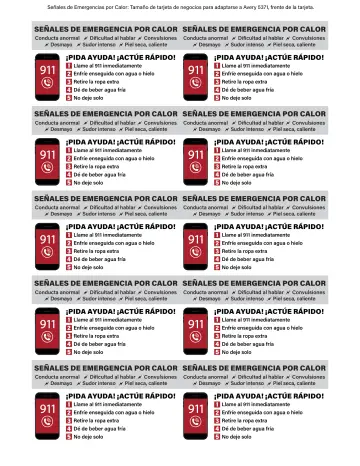
pdfes
2 slidesHeat Emergency Wallet Card (OSHA 4404) (en español)
OSHA card or poster, in Spanish, for General Industry classes.
U.S. Department of Labor, OSHAPublic domain
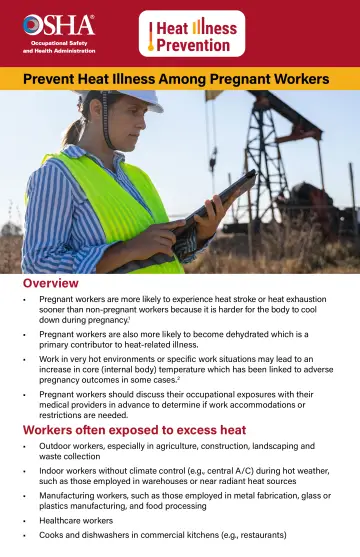
pdf
4 slidesHeat Illness Prevention: Prevent Heat Illness Among Pregnant Workers Fact Sheet (OSHA 4376)
OSHA fact sheet or bulletin, for General Industry classes.
U.S. Department of Labor, OSHAPublic domain