1 / 13Use ← → to flip
Hazard Communication Guidance for Combustible Dusts (OSHA 3371)
OSHA booklet, for General Industry classes.
Page text
· 12 of 13 pages · by U.S. Department of Labor, OSHA
The words on each page as the author wrote them, read from the file by software so they can be searched. Layout, pictures and tables are not shown here, and long pages are shortened: the pages above and the download are the original.
- Page 1
Combustible Dusts
- Hazard Communication Guidance for
- OSHA 3371-08 2009
- Page 2
Combustible Dusts
- Hazard Communication Guidance for
- U.S. Department of Labor
- Occupational Safety and Health Act of 1970
- “To assure safe and healthful working conditions for working men and women; by authorizing enforcement of the standards developed under the Act; by assisting and encouraging the States in their efforts to assure safe and healthful working conditions; by providing for research, information, education, and training in the field of occupational safety and health.”
- This publication provides a general overview of a particular standards-related topic. This publication does not alter or determine compliance responsibilities which are set forth in OSHA standards, and the Occupational Safety and Health Act. Moreover, because interpretations and enforcement policy may change over time, for additional guidance on OSHA compliance requirements, the reader should consult current administrative interpretations and decisions by the Occupational Safety and Health Review Commission and the courts.
- Material contained in this publication is in the public domain and may be reproduced, fully or partially, without permission. Source credit is requested but not required.
- This information will be made available to sensory impaired individuals upon request. Voice phone: (202) 693-1999; teletypewriter (TTY) number: 1-877-889-5627.
- Occupational Safety and Health Administration
- OSHA 3371-08
- 2009
- Page 3
Contents
- This guidance document is not a standard or regulation, and it creates no new legal obligations. It is advisory in nature, informational in content, and is intended to assist employers, manufacturers and importers to comply with OSHA’s Hazard Communication Standard.
- Introduction...3
- OSHA’s Hazard Communication
- Standard...4
- Identifying and Controlling the Potential for Dust Explosions...5
- MSDS Preparation...10
- Product Labels...13
- Training and Information...14
- Additional Information...14
- References...15
- OSHA Assistance...17
- Regional Offices...20
- Introduction
- Combustible dusts are fine particles that present an explosion hazard when suspended in air under certain conditions. A dust explosion can cause catastrophic loss of life, injuries, and destruction of buildings. The U.S. Chemical Safety and Hazard Investigation Board (CSB) identified 281 combustible dust incidents between 1980 and 2005 that led to the deaths of 119 workers, injured 718, and extensively damaged numerous industrial facilities. More recently, additional incidents have occurred. On February 7, 2008, a sugar dust explosion and subsequent fire at a sugar refinery in Port Wentworth, Georgia, caused 14 deaths and left many other workers seriously injured with severe burns.
- In many of these incidents, workers and managers were unaware of the potential for dust explosions, or failed to recognize the serious nature of dust explosion hazards. The CSB reviewed Material Safety Data Sheets (MSDS) of 140 known substances that produce combustible dusts and found poor or inadequate transmittal of information regarding potential dust hazards; 41% of the MSDSs reviewed by the CSB did not warn users about potential explosion hazards. Of the remaining 59% of MSDSs sampled, most of the information was either not stated in a place or manner clearly recognized by workers, or was not specific to hazards related to combustible dusts (CSB, 2006). 1
- The Hazard Communication Standard comprehensively addresses the evaluation of the potential hazards of chemicals and the communication of hazard information to workers (29 CFR 1910. 1200(a)(2)). It is a performance-oriented standard that applies to any chemical known to be present in the workplace in such a manner that workers may be exposed under normal conditions of use or in a foreseeable emergency (29 CFR 1910.1200 (b)(2)). Regarding dusts and other particulates, a
- Investigation Report No. 2006-H-1 Combustible Dust Hazard Study.
- Page 4
Identifying and Controlling the Potential for Dust Explosions
- hazard evaluation must be conducted taking into consideration all discernible hazards, including that of explosibility. It is incumbent upon manufacturers and importers to provide information on the potential for and control of combustible dusts. (See CPL 02-02-038 Inspection Procedures for the Hazard Communication Standard (updated in 1998); CPL 03-00-008 Combustible Dust National Emphasis Program and letters of interpretation (Mattingly, 1986; English,1987)).
- This document is intended to help manufacturers and importers of chemicals recognize the potential for dust explosions and to identify appropriate protective measures as part of their hazard determination under the Hazard Communication Standard (HCS). This evaluation of hazards ensures that downstream employers and workers are provided MSDSs with complete and accurate information regarding dust explosion hazards, appropriate information is included on labels, and that workers are properly trained regarding workplace combustible dust hazards. Adequate communication of hazard information is essential to ensuring that both employers and workers are aware of dustrelated hazards and measures that can be taken to prevent dust explosions.
- OSHA’s Hazard Communication
- Standard
- The purpose of the HCS is to ensure that the hazards of all chemicals produced or imported are evaluated and that information concerning their hazards is transmitted to employers and workers.
- The HCS has three main components:
- First, chemical manufacturers and importers must review available scientific evidence concerning the physical and health hazards of the chemicals they produce or import to determine if they are hazardous (Paragraph (d)). This is called a hazard determination or hazard evaluation;
- Second, for every chemical found to be hazardous, the chemical manufacturer or importer must develop MSDSs and container labels to be transmitted to downstream users of the chemicals. Employers are required to maintain an MSDS in the workplace for each hazardous chemical that they use (Paragraphs (f), (g));
- Third, all employers must develop a written hazard communication program and provide information and training to workers about the hazardous chemicals in their workplace (Paragraphs (e), (h)).
- The information components of this program – labels, MSDSs, and employee training – are all essential to the effective functioning of a hazard communication program.
- …
- Page 5
Examples of dust explosions under normal conditions of use
- Example 1: Plastic pellets shipped from a polyethylene plant rarely pose a combustible dust hazard until they are processed downstream where they produce dust particles. In 1991 in Littleton, New Hampshire an employee was injured due to a dust explosion while he was feeding 400 pounds of granular polyalphamethyl styrene (CAS 25014-31-7) through a micropulverizer (equipped with a .032-inch screen) into a dust collector. The dust collector had no provision for explosion relief or venting. Apparently, a piece of metal got past the magnet in the micropulverizer, ignited the dust in the system, and caused a fire and explosion that blew open the access door to the dust collector.
- Example 2: An aqueous solution of a combustible dust material can dry to produce combustible dust. In 2003 in Kinston, North Carolina 6 people were killed and more than 30 others were injured due to an explosion caused by the buildup of dust above suspended ceilings generated from the drying process of aqueous polyethene solution during the production of rubber stoppers.
- Source: CSB, Dust Incident Data Files
- Fire and Explosions (www.osha.gov/dts/shib/ shib073105.html), dust particles with an effective diameter of less than 420 microns (those passing through a U.S. No. 40 standard sieve) should be deemed to meet the criterion of the definition. However, larger particles can still pose a deflagration hazard (for instance, as larger particles are moved, they can abrade each other, creating smaller particles). In addition, particles can stick together (agglomerate) due to electrostatic charges accumulated through handling, causing them to become explosible when dispersed. Types of dusts include, but are not limited to: metal dust, such as aluminum and magnesium; wood dust; plastic or rubber dust; biosolids; coal dust; organic dust, such as flour, sugar, paper, soap, and dried blood; and dusts from certain textiles. OSHA’s Combustible Dust poster provides examples of products or materials from which combustible dust explosions could occur if they are processed in powdered form. This poster can be accessed at www.osha.gov/Publications/combustibledustposter.pdf.
- Five elements are necessary to initiate a dust explosion, often referred to as the “Dust
- Explosion Pentagon”. 2
- The first three elements are those needed for a fire, i.e., the familiar “fire triangle”:
- 1. Combustible dust (fuel);
- …
- Page 6
- An initial (primary) dust explosion in processing equipment may shake loose accumulated dust, or damage a containment system (such as a duct, vessel, or collector). This causes the dust to become airborne and this additional airborne dust, if ignited, may cause one or more secondary explosions. These can be more destructive than a primary explosion due to the increased quantity and concentration of dispersed combustible dust and the larger ignition source.
- The ease of ignition and the severity of a combustible dust explosion are typically influenced by particle size. Other factors that influence the explosiveness of dusts include moisture content, ambient humidity, oxygen available for combustion, the shape of dust particles, and the concentration of dust in the air. Physical properties used to measure combustible dusts include:
- MIE, the minimum ignition energy, which predicts the ease and likelihood of ignition of a dispersed dust cloud.
- MEC, the minimum explosible concentration, which measures the minimum amount of dust dispersed in air required to spread an explosion. (The MEC is analogous to the Lower Flammable Limit (LFL) or Lower Explosive Limit (LEL) for gases and vapors in air).
- K st , the dust deflagration index, measures the relative explosion severity compared to other dusts. The larger the value for K st , the more severe the explosion (See Table, below). K st provides the best “single number” estimate of the anticipated behavior of a dust deflagration.
- Different dusts of the same chemical material can have different ignitability and explosibility characteristics, depending upon physical characteristics such as particle size, shape, and moisture content. These physical characteristics can change during manufacturing, use or while the material is being processed. Any combustible dust with a K st value greater than zero can be subject to dust deflagration. Even weak explosions can cause significant damage, injury and death. For example, sugar has a relatively low K st but it fueled a tragic explosion in 2008 that killed 14 workers.
- Specific guidance measures to prevent explosions can be found in OSHA’s SHIB Combustible Dust in Industry: Preventing and Mitigating the Effects of Fire and Explosions, which lists measures to control dusts, eliminate ignition sources, and limit the effects of explosions to minimize injuries. …
- …
- Page 7
MSDS Preparation
- should be removed through a routinely implemented housekeeping program. Areas or equipment potentially subject to explosions, including the dust collection system, should also be designed to relieve pressure in a safe manner, or be provided with proper suppression, explosion prevention systems, or an oxygen-deficient atmosphere.
- The following MSDS requirements are applicable to combustible dust hazards:
- The chemical and common name(s) of the hazardous chemical or the chemical and common names of all ingredients which have been determined to present a physical hazard when present in a mixture (1910.1200(g)(2)(i) (C)(1));
- Physical and chemical characteristics of the hazardous chemical (for example, vapor pressure or flash point) including the potential for fire, explosion, and reactivity (if known, K st , MIE, MEC and particle size are combustible dust characteristics) (1910.1200(2)(g)(ii) and (iii));
- Any generally applicable precautions for safe handling and use, which are known to the chemical manufacturer, importer or employer preparing the MSDS, including appropriate hygienic practices, protective measures during repair and maintenance of contaminated equipment, and procedures for cleanup of spills and leaks (1910.1200(g)(2)(viii)); and
- Any generally applicable control measures, which are known to the chemical manufacturer, importer or employer preparing the MSDS, such as appropriate engineering controls, work practices, or personal protective equipment (1910.1200(g)(2)(ix)).
- The HCS requires chemical manufacturers and importers to develop an MSDS for each hazardous chemical they produce or import. Chemical manufacturers and importers must provide any generally applicable precautions for safe handling and use on the MSDS (29 CFR 1910.1200(g)(2)(viii)). They must also determine generally applicable control measures such as appropriate engineering controls, work practices, or personal protective equipment, and include that information on the MSDS (29 CFR 1910.1200(g)(2)(ix)). Employers, in turn, must retain an MSDS in the workplace for each hazardous chemical that they use and ensure that MSDSs are readily accessible to workers.
- MSDSs provide comprehensive hazard information, and serve as the key reference document for exposed workers and others, such as health professionals providing services to those workers. New information regarding chemical hazards or protective measures must be added to the MSDS when the preparer becomes aware of this…
- …
- Page 8
Product Labels
- Examples of combustible dust warning information on the MSDS
- (Presented in the ANSI (Z400.1) Format)
- Section 2. Hazard Identification:
- Emergency Overview
- WARNING! MAY FORM COMBUSTIBLE DUST
- CONCENTRATIONS IN AIR (DURING PROCESSING)
- Section 5. Fire Fighting Measures:
- Explosion: Avoid generating dust; fine dust dispersed in air in sufficient concentrations, and in the presence of an ignition source is a potential dust explosion hazard.
- Section 6. Accidental Release Measures:
- Dust Deposits should not be allowed to accumulate on surfaces, as these may form an explosive mixture if they are released into the atmosphere in sufficient concentration.
- Avoid dispersal of dust in the air (i.e., clearing dust surfaces with compressed air).
- Nonsparking tools should be used.
- Section 7. Handling and Storage:
- Minimize dust generation and accumulation.
- Routine housekeeping should be instituted to ensure that dusts do not accumulate on surfaces.
- Dry powders can build static electricity charges when subjected to the friction of transfer and mixing operations. Provide adequate precautions, such as electrical grounding and bonding, or inert atmospheres.
- Section 8. Exposure controls/personal protection:
- It is recommended that all dust control equipment such as local exhaust ventilation and material transport systems involved in handling of this product contain explosion relief vents or an explosion suppression system or an oxygendeficient environment.
- Ensure that dust-handling systems (such as exhaust ducts, dust collectors, vessels, and processing equipment) are designed in a manner to prevent the escape of dust into the work area (i.e., there is no leakage from the equipment).
- Use only appropriately classified electrical equipment and powered industrial trucks:
- Section 16. Other Information
- Refer to NFPA 654, Standard for the Prevention of Fire and Dust Explosions from the Manufacturing, Processing, and Handling of Combustible Particulate Solids, for safe handling. 3
- NFPA 654 is one of several potential references that discuss preventative measures for combustible dusts. Please see the references section, below, for additional resources.
- Containers of material with HCS physical and health hazards are subject to the labeling requirements of the HCS (29 CFR 1910.1200(f)). Manufacturers, importers and distributors are required to assess available evidence regarding a product's hazards and must consider exposures under normal conditions of use or in foreseeable…
- …
- Page 9
Training and Information
- The purpose of the HCS is to provide information so that workers and employers can take the appropriate steps to protect themselves. When workers are trained to recognize and prevent hazards they can be instrumental in recognizing unsafe conditions, taking preventative action, and/or alerting management.
- The HCS requires employers to inform workers about the general requirements of the standard, operations where hazardous chemicals are present, and the location of the written HCS program, MSDSs, and hazardous chemical inventory (29 CFR 1910.1200(h)(2)).
- In addition, employers are required to specifically train workers in the methods used to detect the presence or release of a hazardous chemical, the physical and health hazards of the chemical, and control measures (including work practices, emergency procedures, and personal protective equipment) (29 CFR 1910.1200(h)(3)).
- The first two components of the HCS (evaluation of hazards and provision of hazard information via labels and MSDSs) provide the foundation for the worker training. The MSDSs/labels provide the necessary baseline information for worker training regarding physical and health hazards, personal protective equipment, and emergency procedures. Employers who use materials capable of producing combustible dusts must evaluate those operations and tasks where dusts are present or may be generated and provide the required information and training to workers.
- Program (NEP) Instruction (2008); developed a Combustible Dust Fact Sheet and poster, a Safety and Health Information Bulletin (Combustible Dust in Industry: Preventing and Mitigating the Effects of Fire and Explosions) and a Combustible Dust Safety and Health Topics web page (www.osha.gov/ dsg/combustibledust/index.html). In addition, OSHA’s Combustible Dust NEP will increase enforcement activities and focus on specific industry groups that have experienced frequent combustible dust incidents.
- References
- OSHA
- Combustible Dust Safety and Health Topics Page (www.osha.gov/dsg/combustibledust/index.html): Combustible Dust National Emphasis Program Instruction, OSHA Directive CPL 03-00-008, (2008).
- Safety and Health Information Bulletin (SHIB) (07-31-2005) Combustible Dust in Industry: Preventing and Mitigating the Effects of Fire and Explosions.
- OSHA Fact Sheet, (March 2008), Hazard Alert: Combustible Dust Explosions.
- OSHA Poster (2008), Combustible Dust.
- …
- Page 10
OSHA Assistance
- §1910.272 Grain handling facilities
- §1910.307 Hazardous (classified) locations
- §1910.1200 Hazard Communication
- Letters of Interpretation:
- Jan. 16, 1986 - Application of the Hazard
- Communication standard to a nuisance particulate, Honorable Mack Mattingly.
- November 20, 1987 - Applicability of the revised
- Hazard Communication Standard to the grain industry, Honorable Glenn English.
- ANSI:
- ANSI Z129.1 American National Standard for Hazardous Industrial Chemicals - Precautionary
- Labeling
- ANSI Z400.1 American National Standard for Hazardous Industrial Chemicals – Material
- Safety Data Sheets – Preparation
- U.S. Chemical Safety and Hazard Investigation Board:
- Investigation Report No. 2006-H-1 Combustible Dust Hazard Study, November 2006.
- Dust Incident Data File at www.csb.gov.
- The primary National Fire Protection Association consensus standards and documents related to this hazard (see www.nfpa.org to view NFPA standards):
- NFPA 61, Standard for the Prevention of Fires and Dust Explosions in Agricultural and Food Processing Facilities
- NFPA 68, Standard on Explosion Protection by Deflagration Venting
- NFPA 69, Standard on Explosion Prevention Systems
- NFPA 484, Standard for Combustible Metals NFPA 499, Recommended Practice for the Classification of Combustible Dusts and of Hazardous (Classified) Locations for Electrical Installations in Chemical Process Areas
- NFPA 654, Standard for the Prevention of Fire and Dust Explosions from the Manufacturing, Processing, and Handling of Combustible
- Particulate Solids
- NFPA 655, Standard for the Prevention of Sulfur Fires and Explosions
- NFPA 664, Standard for the Prevention of Fires and Explosions in Wood Processing and Woodworking Facilities
- NFPA Fire Protection Handbook, 19th Edition
- Other:
- FM 7-76, “Prevention and Mitigation of Combustible Dust Explosions and Fires,” Loss Prevention Data Sheet 7-76. FM Global, 2001.
- OSHA can provide extensive help through a variety of programs, including technical assistance about effective safety and health programs, state plans, workplace consultations, and training and education.
- Safety and Health Program
- Management System Guidelines
- Effective management of worker safety and health protection is a decisive factor in reducing the extent and severity of work-related injuries and illnesses and their related costs. In fact, an effective safety and health management system forms the basis of good worker protection, can save time and money, increase productivity and reduce employee…
- …
- Page 11
- safety and health management system. The Federal Register notice is available online at www.osha.gov.
- State Programs
- The Occupational Safety and Health Act of 1970 (OSH Act) encourages states to develop and operate their own job safety and health plans. OSHA approves and monitors these plans. Twenty-four states, Puerto Rico and the Virgin Islands currently operate approved state plans: 22 cover both private and public (state and local government) employment; Connecticut, New Jersey, New York and the Virgin Islands cover the public sector only. States and territories with their own OSHA-approved occupational safety and health plans must adopt standards identical to, or at least as effective as, the Federal OSHA standards.
- Consultation Services
- Consultation assistance is available on request to employers who want help in establishing and maintaining a safe and healthful workplace. Largely funded by OSHA, the service is provided at no cost to the employer. Primarily developed for smaller employers with more hazardous operations, the consultation service is delivered by state governments employing professional safety and health consultants. Comprehensive assistance includes an appraisal of all mechanical systems, work practices, and occupational safety and health hazards of the workplace and all aspects of the employer’s present job safety and health program. In addition, the service offers assistance to employers in developing and implementing an effective safety and health program. No penalties are proposed or citations issued for hazards identified by the consultant. OSHA provides consultation assistance to the employer with the assurance that his or her name and firm and any information about the workplace will not be routinely reported to OSHA enforcement staff. For more information concerning consultation assistance, see OSHA’s website at www.osha.gov.
- building cooperative relationships with groups of employers and workers. These partnerships are voluntary relationships between OSHA, employers, worker representatives, and others (e.g., trade unions, trade and professional associations, universities, and other government agencies).
- For more information on this and other agency programs, contact your nearest OSHA office, or visit OSHA’s website at www.osha.gov.
- OSHA Training and Education
- OSHA area offices offer a variety of information services, such as technical advice, publications, audiovisual aids and speakers for special engagements. …
- …
- Page 12
OSHA Publications OSHA has an extensive publications program.
- walk you through challenging safety and health issues and common problems to find the best solutions for your workplace.
- For a listing of free items, visit OSHA’s website at www.osha.gov or contact the OSHA Publications Office, U.S. Department of Labor, 200 Constitution Avenue, NW, N-3101, Washington, DC 20210; telephone (202) 693-1888 or fax to (202) 693-2498.
- Contacting OSHA
- To report an emergency, file a complaint, or seek OSHA advice, assistance, or products, call (800) 321- OSHA or contact your nearest OSHA Regional or Area office listed below. The teletypewriter (TTY) number is (877) 889-5627.
- Written correspondence can be mailed to the nearest OSHA Regional or Area Office listed below or to OSHA’s national office at: U.S. Department of Labor, Occupational Safety and Health Administration, 200 Constitution Avenue, N.W., Washington,
- DC 20210.
- By visiting OSHA’s website at www.osha.gov, you can also:
- File a complaint online;
- Submit general inquires about workplace safety and health electronically; and
- Find more information about OSHA and occupational safety and health.
- OSHA Regional Offices
- Region I
- (CT,* ME, MA, NH, RI, VT*)
- JFK Federal Building, Room E340
- Boston, MA 02203
- (617) 565-9860
- Region II
- (NJ,* NY,* PR,* VI*)
- 201 Varick Street, Room 670
- New York, NY 10014
- (212) 337-2378
- Region III
- (DE, DC, MD,* PA, VA,* WV)
- The Curtis Center
- 170 S. Independence Mall West, Suite 740 West
- Philadelphia, PA 19106-3309
- (215) 861-4900
- Region IV
- (AL, FL, GA, KY,* MS, NC,* SC,* TN*)
- 61 Forsyth Street, SW, Room 6T50
- Atlanta, GA 30303
- (404) 562-2300
- Region V
- (IL, IN,* MI,* MN,* OH, WI)
- 230 South Dearborn Street, Room 3244
- Chicago, IL 60604
- (312) 353-2220
- Region VI
- (AR, LA, NM,* OK, TX)
- 525 Griffin Street, Room 602
- Dallas, TX 75202
- (972) 850-4145
- Region VII
- (IA,* KS, MO, NE)
- Two Pershing Square
- 2300 Main Street, Suite 1010 Kansas City, MO 64108-2416 (816) 283-8745
- Region VIII
- (CO, MT, ND, SD, UT,* WY*)
- 1999 Broadway, Suite 1690
- PO Box 46550
- Denver, CO 80202-5716
- (720) 264-6550
- Region IX
- (AZ,* CA,* HI,* NV,* and American Samoa, Guam and the Northern Mariana Islands)
- 90 7th Street, Suite 18-100
- San Francisco, CA 94103
- (415) 625-2547
- Region X
- (AK,* ID, OR,* WA*)
- 1111 Third Avenue, Suite 715
- Seattle, WA 98101-3212
- (206) 553-5930
- These states and territories operate their own OSHA-approved job safety and health programs and cover state and local government workers as well as private sector personnel. …
- …
More on HazCom
pptx
50 slidesHazard Communication (OSHA 10-Hour General Industry Outreach)
OSHA's outreach deck on the Hazard Communication Standard: labels, pictograms, SDSs and training (2017).
U.S. Department of Labor, OSHAPublic domain
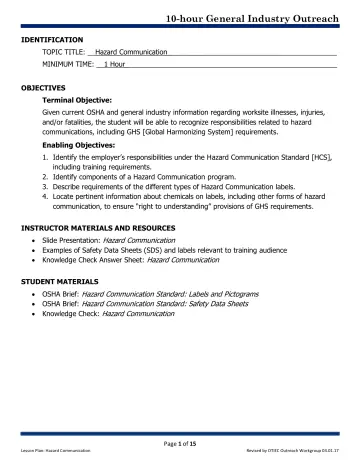
pdf
15 slidesHazard Communication: Lesson Plan (OSHA 10-Hour General Industry Outreach)
Instructor lesson plan (objectives, timing, teaching steps) for the OSHA General Industry hazard communication outreach deck.
U.S. Department of Labor, OSHA (with the OTIEC Outreach Workgroup)Public domain
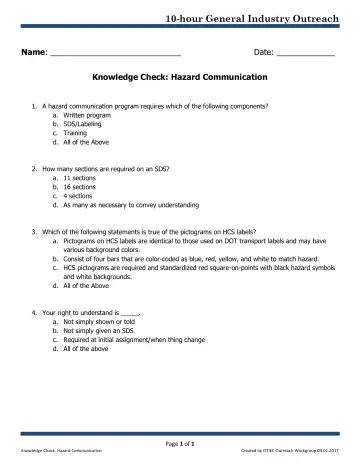
pdf
1 slidesHazard Communication: Knowledge Check (OSHA 10-Hour General Industry Outreach)
Student knowledge-check quiz for the OSHA General Industry hazard communication outreach deck.
U.S. Department of Labor, OSHA (with the OTIEC Outreach Workgroup)Public domain