1 / 15Use ← → to flip
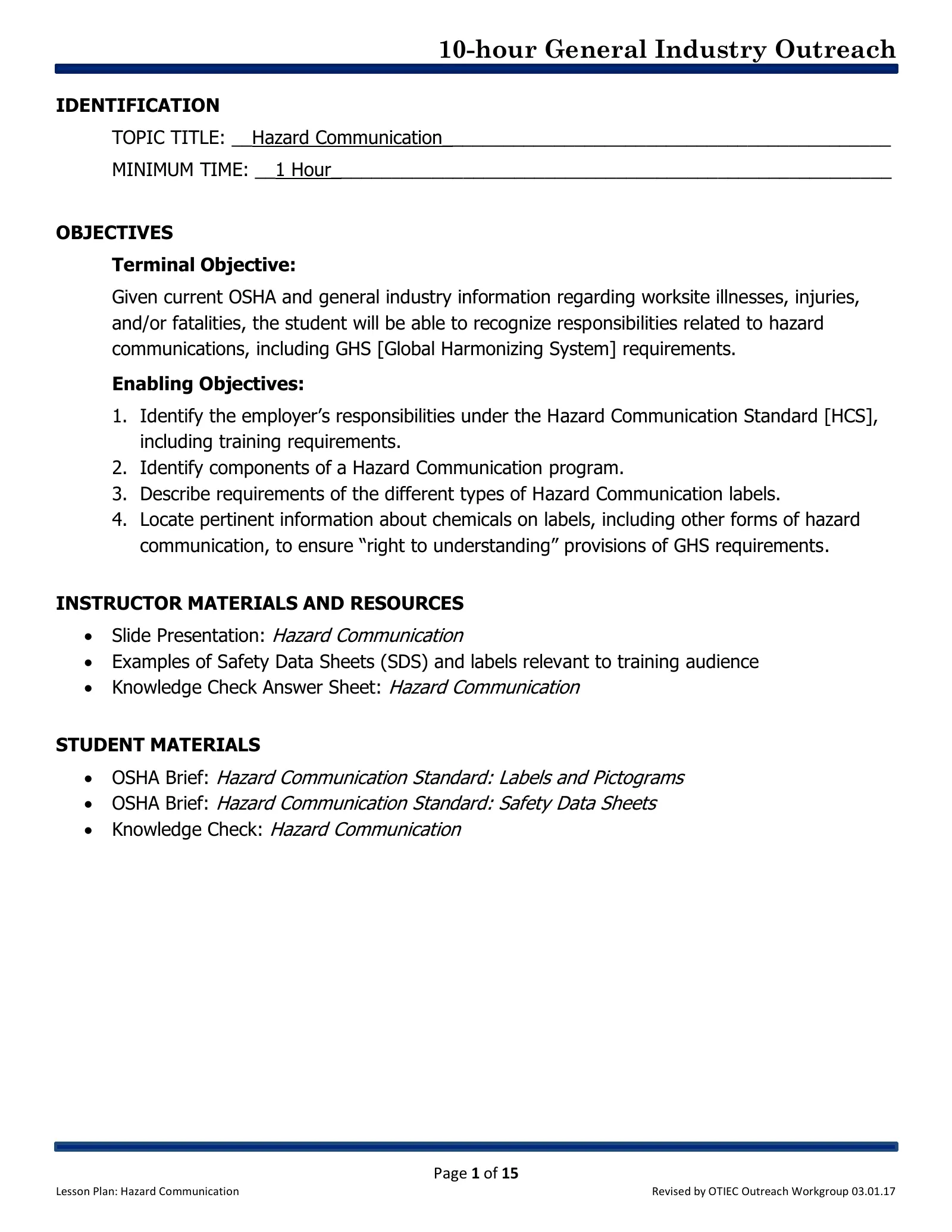
Hazard Communication: Lesson Plan (OSHA 10-Hour General Industry Outreach)
Instructor lesson plan (objectives, timing, teaching steps) for the OSHA General Industry hazard communication outreach deck.
Page text
· 15 pages · by U.S. Department of Labor, OSHA (with the OTIEC Outreach Workgroup)
The words on each page as the author wrote them, read from the file by software so they can be searched. Layout, pictures and tables are not shown here: the pages above and the download are the original.
- Page 1
IDENTIFICATION
- TOPIC TITLE: __Hazard Communication___
- MINIMUM TIME: __1 H our___
- OBJECTIVES
- Terminal Objective:
- Given current OSHA and general industry information regarding worksite illnesses, injuries, and/or fatalities, the student will be able to recognize responsibilities related to hazard communications, including GHS [Global Harmonizing System] requirements.
- Enabling Objectives:
- 1. Identify the employer’s responsibilities under the Hazard Communication Standard [HCS], including training requirements.
- 2. Identify components of a Hazard Communication program.
- 3. Describe requirements of the different types of Hazard Communication labels.
- 4. Locate pertinent information about chemicals on labels, including other forms of hazard communication, to ensure “right to understanding” provisions of GHS requirements.
- INSTRUCTOR MATERIALS AND RESOURCES
- Slide Presentation: Hazard Communication
- Examples of Safety Data Sheets (SDS) and labels relevant to training audience Knowledge Check Answer Sheet: Hazard Communication
- STUDENT MATERIALS
- OSHA Brief: Hazard Communication Standard: Labels and Pictograms OSHA Brief: Hazard Communication Standard: Safety Data Sheets Knowledge Check: Hazard Communication
- Page 2
TEACHING PROCEDURES ---Preparation, Presentation, Application, & Evaluation
- Anticipatory Set (Focus Attention/Gain Interest)
- Estimated Time: ??mins
- Key Points
- Methods
- “The Right to Understand
- Case Study
- Workers have sometimes had difficulty understanding information presented on safety data sheets (SDSs). In some cases the length and complexity of the documents have made it difficult for workers to locate important safety information. In one testimony, a hospital safety director described a situation in which a worker was unable to find critical information on an SDS in an emergency situation:
- PPT Slides #1 - #5
- https://www.osha.gov/as/opa/quicktakes/qtGHS032120 12.html#11
- ". . . two gallons of the chemical xylene spilled in the lab of my hospital. By the time an employee had noticed the spill, the ventilation had already sucked most of the vapors into the HVAC. This, in turn, became suspended in the ceiling tile over our radiology department. Twelve employees were sent to the emergency room. To make the matter worse, the lab employee was frantically searching through the binder in her area for [the SDS for] xylene. Once she found it, she had difficulty locating the spill response section. After notifying our engineering department, she began to clean up the spill with solid waste rags, known for spontaneous combustion, and placing the rags into a clear plastic bag for disposal. She did not know that xylene has a flash point of 75 degrees Fahrenheit. She then walked the bag down to our incinerator room and left it there, basically creating a live bomb. Twelve people were treated from this exposure. The lab employee was very upset and concerned about the safety of the affected employees and visitors, and hysterically kept stating that she could not find the necessary spill response information."
- OSHA's harmonized standard will ensure that workers have access not only to labels and safety data sheets, but also to information that is easier to find and understand through the use of standardized formats and label elements: signal words, pictograms, hazard statements, and precautionary statements.” (OSHA 2012)
- HCS/GHS saves lives and saves money. In 2012, major changes were made to the Hazard Communication Standard, to align with components of the Globally Harmonized System (GHS), including:
- Hazard classification
- Labels
- Safety Data Sheets
- Information and training
- Page 3
Presentation (Instruction)___
- Estimated Time: ??mins
- Key Points
- Methods
- I. Employer responsibilities; employer shall:
- PPT Slides #6 - #7
- A. Ensure that labels on incoming containers of hazardous chemicals are not removed or defaced
- B. Maintain copies of SDS received with incoming shipments
- C. Obtain SDS as soon as possible for chemicals received without an SDS if employee requests the SDS
- 29 CFR 1910.1200
- https://www.osha.gov/pls/oshaweb/owadisp.show_docu ment?p_table=STANDARDS &p_id=10099
- D. Ensure that SDS are readily accessible during each work shift to employees when they are in their work area(s)
- E. Ensure that each container of hazardous chemicals in the workplace is labeled, tagged, or marked properly
- F. Ensure that employees are provided information and training to the extent necessary to protect them in the event of a spill or leak of a hazardous chemical from a sealed container
- G. In multi-employer workplaces, ensure that employees of other employer(s) will have on-site access to SDSs for each hazardous chemical they may be exposed to while working, are informed of any precautionary measures needed to protect themselves under normal operating conditions or in foreseeable emergencies, and are informed of the labeling system used in the workplace
- H. Develop, implement, and maintain a written hazard communication program
- II. Hazard Communication Program Components
- A. Written hazard communication program
- 1. 29 CFR 1910.1200(e)
- PPT Slide #8
- https://www.osha.gov/Publications/OSHA3695.pdf
- 2. Develop, implement, and maintain a written hazard communication program
- 3. Ensure compliance with standard in a systematic way that coordinates all elements
- Page 4
B. Components of written program
- 1. List of hazardous chemicals in the workplace
- a. Use product identifier
- i. May be listed by product name, common name, or chemical name
- ii. Name used must be the same term as identifier on SDS and label for cross-referencing
- b. Inventory of all chemicals
- i. Employer must have an SDS available for each hazardous chemical listed
- ii. Covers chemicals in all forms—liquids, solids, gases, vapors, fumes, and mists—whether they are “contained” or not
- iii. Nature of chemical and potential for exposure are the factors that determine whether a chemical is covered
- iv. Identify chemicals in containers, including pipes, and chemicals generated during work operations (such as welding fumes, dusts, and exhausts)
- 2. Safety Data Sheets (SDSs)
- a. Available and accessible to workers
- i. Required for all hazardous chemicals used
- ii. Do not use hazardous chemicals if there is no
- SDS available
- PPT Slides #11 - #15
- https://www.osha.gov/Publications/OSHA3514.html
- b. Written program should document:
- i. Designated person(s) responsible for obtaining and maintaining SDSs
- ii. How SDSs are maintained in workplace (e.g., notebooks in the work area(s) or electronically); how workers obtain access to them when during the work shift
- iii. Procedures to follow when SDS is not received at time of the first shipment
- iv. SDS for each chemical in the workplace and training of workers that includes review of SDS format and use
- Page 5
- c. Sixteen sections (uniform format must be used)
- i. Section 1: Identification – identifies the chemical on the SDS and its recommended uses; provides contact information of the supplier
- ii. Section 2: Hazard(s) Identification – identifies the hazards of the chemical and appropriate warning information
- iii. Section 3: Composition/Information on Ingredients – identifies ingredient(s) contained in product, including impurities and stabilizing additives; includes information on substances, mixtures, and all chemicals where a trade secret is claimed
- iv. Section 4: First-Aid Measures – describes initial care that should be given by untrained responders to an individual who has been exposed to the chemical
- v. Section 5: Fire-Fighting Measures – provides recommendations for fighting a fire caused by the chemical
- vi. Section 6: Accidental Release Measures – provides recommendations on appropriate response to spills, leaks, or releases, including containment and cleanup to prevent or minimize exposure to people, properties, or the environment
- vii. Section 7: Handling and Storage – provides guidance on safe handling practices and conditions for safe storage of chemicals
- viii. Section 8: Exposure Controls/Personal Protection – indicates exposure limits, engineering controls, and PPE measures that can be used to minimize worker exposure
- ix. Section 9: Physical and Chemical Properties – identifies physical and chemical properties associated with the substance or mixture
- x. Section 10: Stability and Reactivity – describes reactivity hazards of chemical and chemical stability information; broken into three parts: reactivity, chemical stability, and other
- Page 6
- xi. Section 11: Toxicological Information – identifies toxicological and health effects information or indicates that such data is not available
- xii. Section 12: Ecological Information – provides information to evaluate the environmental impact of the chemical(s) if it were released into the environment
- xiii. Section 13: Disposable Considerations – provides guidance on proper disposal practices, recycling, or reclamation of the chemical(s) or its container, and safe handling practices
- xiv. Section 14: Transport Information – provides guidance on classification information for shipping and transporting of hazardous chemical(s) by road, air, rail, or sea
- xv. Section 15: Regulatory Information – identifies safety, health, and environmental regulations specific for the product that is not indicated anywhere else on SDS
- xi. Section 16: Other Information – indicates when SDS was prepared/revised; may state where changes have been made to previous versions; other useful information
- PPT Slides #16 - #19
- 3. Labeling
- a. Must be on the immediate container of every hazardous chemical https://www.osha.gov/Publications/OSHA3636.pdf
- i. Immediate type of warning; snapshot of hazards and protective information
- ii. More detailed information available on SDS
- b. Written program should document:
- i. Designated person(s) responsible for ensuring compliant labeling of shipped and in-plant containers
- ii. Description of written alternatives to labeling of stationary process containers (if used)
- iii. Appropriate labels on all workplace containers, including those received from a supplier, secondary containers, and stationary process containers
- Page 7
- iv. Description and explanation of labels on both shipped and workplace containers included in the employee training program
- v. Procedures to review and update workplace label information when necessary
- c. Required elements on shipping label for hazardous chemical
- i. Name, address, and telephone number of the chemical manufacturer, importer, or other responsible party
- ii. Product
- iii. Signal word
- iv. Hazard statement(s)
- v. Precautionary statement(s)
- vi. Pictograms
- d. Workplace labels
- i. Employers can create own labeling system that works for their workplace and employees
- ii. Can choose same label required for shipped containers or alternative labels as long as they provide general information about hazards
- iii. Provide training to employees so they understand specific hazards of chemical presents
- PPT Slide #20
- 4. Training programs
- a. Before initial assignment and when new hazards are introduced, employees must be trained in their work areas on requirements of standard, hazards of chemicals, appropriate protective measures, and where/how to obtain additional information.
- b. To comply with HazCom 2012, training must address:
- i. Methods and observations used to detect presence or release of chemical in work area, such as:
- 1 . Monitoring – conducted by employer;
- continuous monitoring devices
- 2 . Visual appearance or odor of hazardous chemical when being released
- Page 8
ii. Hazards of chemicals in the work area, including:
- 1 . Physical hazards
- 2 . Health hazards
- 3 . Simple asphyxiation
- 4 . Combustible dust
- 5 . Pyrophoric gas
- 6 . Other hazards not otherwise classified
- iii. Measures employees can take to protect themselves from hazards, including
- 1 . Specific procedures employer has implemented to protect employees from exposure to hazardous chemicals
- 2 . Examples – Appropriate work practices, emergency procedures, PPE to be used
- iv. Details of hazard communication program developed by employer
- 1 . Explanation of labels received on shipped containers and the workplace labeling system used by the employer
- 2 . SDS, including format (where each type of information is located)
- 3 . How employees can obtain and use the appropriate hazard information
- III. Types of Labels
- PPT Slides #21 - #28
- A. HCS Shipping Labels
- 1. Required elements on label for hazardous chemical
- a. Name, address, and telephone number of the chemical manufacturer, importer, or other responsible party https://www.osha.gov/Publications/OSHA3695.pdf
- b. Product identifier – how the hazardous chemical is identified
- i. Can be chemical name, code number, or batch number as decided by manufacturer/importer/ distributor as to what is appropriate
- ii. Must match Section 1 of SDS
- Page 9
- c. Signal word
- i. Indicates the relative level of severity of the hazard and alert reader to potential hazard on label
- ii. Only two signal words: “Danger” for more severe hazards; “Warning” for less severe hazards
- iii. If multiple hazards, use word indicating highest level of severity that exists
- d. Hazard statement(s)
- i. Describes nature of hazard(s), including degree of hazard (if appropriate)
- ii. All applicable hazard statements must appear
- iii. Specific to hazard classification categories; same statement for same hazard no matter the chemical or who produces it
- e. Precautionary statement(s)
- i. Describes recommended measures to take to minimize or prevent adverse effects resulting from exposure to hazardous chemical or improper storage or handling
- ii. Four types: prevention (to minimize exposure); response (in case of accidental spillage or exposure emergency response); storage; and, disposal
- f. Pictograms
- i. Graphic symbols used to communicate specific information about hazards of chemical
- ii. Red square frame set at a point with a black hazard symbol on a white background
- iii. Does not replace DOT-required labels for transportation of chemicals
- (49 CFR 172, Subpart E)
- iv. Must be legible, in English, and prominently displayed
- PPT Slides #29 - #30
- B. HCS Workplace Labels
- 1. Can either provide all of the required information that is on the label from the chemical manufacturer or, the product identifier and words, pictures, symbols or combination thereof https://www.osha.gov/dsg/hazcom/hazcom-faq.html
- Page 10
- 2. Workplace labeling system may include signs, placards, process sheets, batch tickets, operating procedures, or other such written materials to identify hazardous chemicals
- 3. Alternative workplace labels
- a. Permitted for workplace labels
- b. Must provide at least the same general information regarding hazards of chemicals
- c. Hazard warnings or pictograms that conflict with HCS label elements cannot be used
- d. Examples: NFPA 704 and HMIS
- C. Other labels
- 1. National Fire Protection Association (NFPA) 704 labeling
- a. Used primarily for storage t anks a nd small containers
- indicates ha zards a ssociated with contents; universally accepted
- PPT Slides #31 - #41
- http://www.nfpa.org/Assets/files/AboutTheCodes/704/704_FAQs.pdf
- b. NFPA Fire Diamond
- i. Overall diamond shape made up of four smaller diamonds (square-on-point), each a different color and representing a different type of hazard
- ii. Numbers within smaller diamond shapes represent severity of hazard
- iii. Red – represents fl ammability hazards
- 0 = will not burn
- 1 = flashpoint above 200°F
- 2 = flashpoint between 100-200°F
- 3 = flashpoint below 100°F
- 4 = flashpoint less t han 73°F
- iv. Blue – represents he alth hazards
- 0 = normal material that poses no health hazard
- 1 = slight hazard
- 2 = moderate ha zard
- 3 = extreme ha zard
- 4 = deadly hazard
- Page 11
v. Yellow – represents instability hazards
- 0 = normally stable
- 1 = can become un stable (t emperature, pressure)
- 2 = undergoes vi olent chemical change
- (temperature, pressure, water, shock)
- 3 = shock or heat may detonate (w ater reactivity)
- 4 = rapidly capable of detonation or explosion at normal temperatures a nd pressures
- vi. White – used to identify other special hazards
- W with line through it = indicates re activity to water and that no water should be us ed
- OX = indicates t hat the material is a n oxidizer
- SA = simple asphyxiant
- 2. Hazardous Materials Information System (HMIS)
- a. Uses colors, red, blue, and orange, to indicate flammability, health, and reactivity/physical hazards, respectively, and uses white for personal protection needs; uses numbering scale, 0 to 4, to indicate levels of hazards
- b. Uses bars (instead of diamonds)
- Blue = health
- https://www.uwosh.edu/ehs/campus-health-andsafety/lab-shop-and-studiosafety/chemicalsafety/hazardcommunication-1/022bHazardComLabelingHMIS1.pdf
- Red = flammability
- Orange = physical hazard
- White = personal protection
- c. White space for personal protection, where letters
- A = safety glasses
- B = safety glasses and gloves
- C = safety glasses, gloves, and apron
- D = face shield, gloves, and apron
- E = safety glasses, gloves, and dust respirator
- F = safety glasses, gloves, apron, and dust respirator
- G = safety glasses, gloves, and vapor respirator
- H = splash goggles, gloves, apron, and vapor respirator
- Page 12
I = safety glasses, gloves, dust and vapor respirator
- J = splash goggles, gloves, apron, dust and vapor respirator
- K = air-line hood or mask, gloves, full suit, and boots
- X = ask supervisor or safety specialist about special handling requirements
- 3. Department of Transportation Shipping Containers – Marking, Labeling, and Placarding
- a. DOT Classification – groups hazardous materials based on dangers posed in transportation; 9 classes i.
- Class 1: Explosives
- ii. Class 2: Gases
- iii. Class 3: Flammable Liquid and Combustible Liquid https://www.fmcsa.dot.gov/regulations/hazardousmaterials/how-complyfederal-hazardousmaterials-regulations
- iv. Class 4: Flammable Solid, Spontaneously
- Combustible, and Dangerous When Wet
- v. Class 5: Oxidizer and Organic Peroxide
- vi. Class 6: Poison (Toxic) and Poison Inhalation
- Hazard
- vii. Class 7: Radioactive
- viii. Class 8: Corrosive
- ix. Class 9: Miscellaneous
- b. Uses graphic elements (p ictograms) on square-onpoint (diamond-shaped) placards or labels t o identify shipments of hazardous materials.
- http://phmsa.dot.gov/staticfiles/PHMSA/DownloadableFiles/Files/Hazmat/Regulations/chart%2015.pdf
- i. Hazardous materials warning labels – required on hazardous materials packaging
- ii. Hazardous materials warning placards – required on transport vehicles, freight containers, and bulk packaging
- iii. Backgrounds of square-on-point have various colors
- iv. Where shipping container is also container used in workplace, workers must be made aware of DOT pictograms https://www.osha.gov/Publications/OSHA3695.pdf
- v. Hazardous materials markings – package orientation, keep away from heat, fumigant marking, biological substances, etc.
- Page 13
- c. Refer to DOT Hazardous Materials Regulations for details 49 CFR, Parts 100 – 185.
- IV. Locating Pertinent Information to Ensure Understanding
- PPT Slides #42 - #45
- A. Locate information on shipping label
- B. Locate information on workplace label
- C. Locate information on SDS
- Application (How students apply what they learn) __
- Estimated Time: ??mins
- Key Points
- Methods
- Utilize a current SDS, label, or a suitable substitute to aid worker locating and understanding the pictograms, signal words, hazard statements, and precautionary statements.
- Student Activity
- Evaluation/Summary
- Key Points
- Methods
- Summarize key points
- PPT Slide #46
- Knowledge Che ck: Hazard Communication
- PPT Slides #47 - #50
- Page 14
References
- OSHA Standard
- 1910.1200 - Hazard Communication.
- 1910.1200 App A - Health Hazard Criteria (Mandatory)
- 1910.1200 App B - Physical Criteria (Mandatory)
- 1910.1200 App C - Allocation Of Label Elements (Mandatory)
- 1910.1200 App D - Safety Data Sheets (Mandatory)
- 1910.1200 App E - Definition of "Trade Secret" (Mandatory)
- 1910.1200 App F - Guidance for Hazard Classifications Re: Carcinogenicity (Non- Mandatory)
- 1910.1201 - Retention of DOT markings, placards and labels.
- OSHA Publications
- Hazard Communication
- Hazard Communication Guidance for Combustible Dusts
- Hazard Communication Guidelines for Compliance
- Hazard Communication Safety Data Sheets
- Hazard Communication Safety Data Sheets QuickCard™
- Hazard Communication Standard Labels QuickCard™
- Hazard Communication Standard Pictogram QuickCard™
- Hazard Communication Standard: Comparison of NFPA 704 and HazCom 2012 Labels QuickCard™
- (OSHA 3084 - 1998) (English: HTML PDF*)
- (OSHA 3371 - 2009) (English: HTML PDF*)
- (OSHA 3111 - 2000) (English: HTML PDF*)
- (OSHA 3518 - 2012) (Spanish: HTML PDF*)
- (OSHA 3493 - 2013) (English: HTML PDF*)
- (OSHA 3492 - 2012) (English: PDF*) (OSHA 3492 - 2012) (Spanish: PDF*)
- (OSHA 3491 - 2012) (Spanish: PDF*)
- (OSHA 3491 - 2012) (English: PDF*)
- (OSHA 3678 - 2013) (English: PDF*)
- Page 15
- Hazard Communication Standard: Dec. 1st, 2013 Training Requirements for the Rev. Standard Fact Sheet (OSHA FS 3642 - 2013) (English: HTML PDF*)
- Hazard Communication Standard: Labels and Pictograms - Brief
- Hazard Communication Standard: Safety Data Sheets - Brief
- Hazard Communication: Hazard Classification Guidance for Manufacturers, Importers, and Employers (OSHA 3844 - 2016) (English: PDF*)
- Hazard Communication: Hazard Communication in the Maritime Industry Fact Sheet
- Hazard Communication: Hazard Communication Wallet Card
- Hazard Communication: Small Entity Compliance Guide for Employers That Use Hazardous Chemicals (OSHA 3695 - 2014) (English: PDF*)
- Hazard Communication: Steps to an Effective Hazard Communication Program for Employers That Use Hazardous Chemicals Fact Sheet (OSHA FS 3696 - 2014) (English: PDF*)
- Temporary Worker Initiative (TWI) Bulletin No. 5 -Hazard Communication
- (OSHA BR-3636 - 2013) (English: PDF*)
- (OSHA BR-3514 - 2013) (English: HTML PDF*)
- (OSHA FS 3694 - 2013) (English: HTML PDF*)
- (OSHA 3658 - 2013) (English: PDF*)
- (OSHA 3860 - 2016) (English: PDF*)
- OSHA References/Resources
- Hazard Communication Standard (2012), OSHA video,
- Hazard Communication (n.d.), OSHA webpage, https://www.osha.gov/dsg/hazcom/index.html https://www.osha.gov/video/hazcom/index.html
More on HazCom
pptx
50 slidesHazard Communication (OSHA 10-Hour General Industry Outreach)
OSHA's outreach deck on the Hazard Communication Standard: labels, pictograms, SDSs and training (2017).
U.S. Department of Labor, OSHAPublic domain
pdf
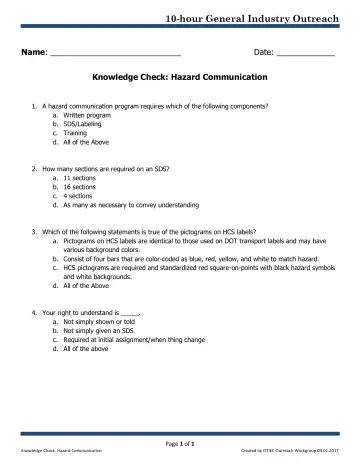
1 slidesHazard Communication: Knowledge Check (OSHA 10-Hour General Industry Outreach)
Student knowledge-check quiz for the OSHA General Industry hazard communication outreach deck.
U.S. Department of Labor, OSHA (with the OTIEC Outreach Workgroup)Public domain
pdfes
50 slidesComunicación de peligros (Capacitación de Extensión de 10 horas de OSHA, Industria General)
Spanish edition of OSHA's 10-hour General Industry Outreach deck on hazard communication (PDF slides; OSHA does not publish an editable Spanish PowerPoint).
U.S. Department of Labor, OSHA (with the OTIEC Outreach Workgroup)Public domain