1 / 1Use ← → to flip
Combustible Dust Explosions - Poster
OSHA card or poster, for General Industry classes.
Page text
· 1 page · by U.S. Department of Labor, OSHA
The words on each page as the author wrote them, read from the file by software so they can be searched. Layout, pictures and tables are not shown here: the pages above and the download are the original.
- Page 1
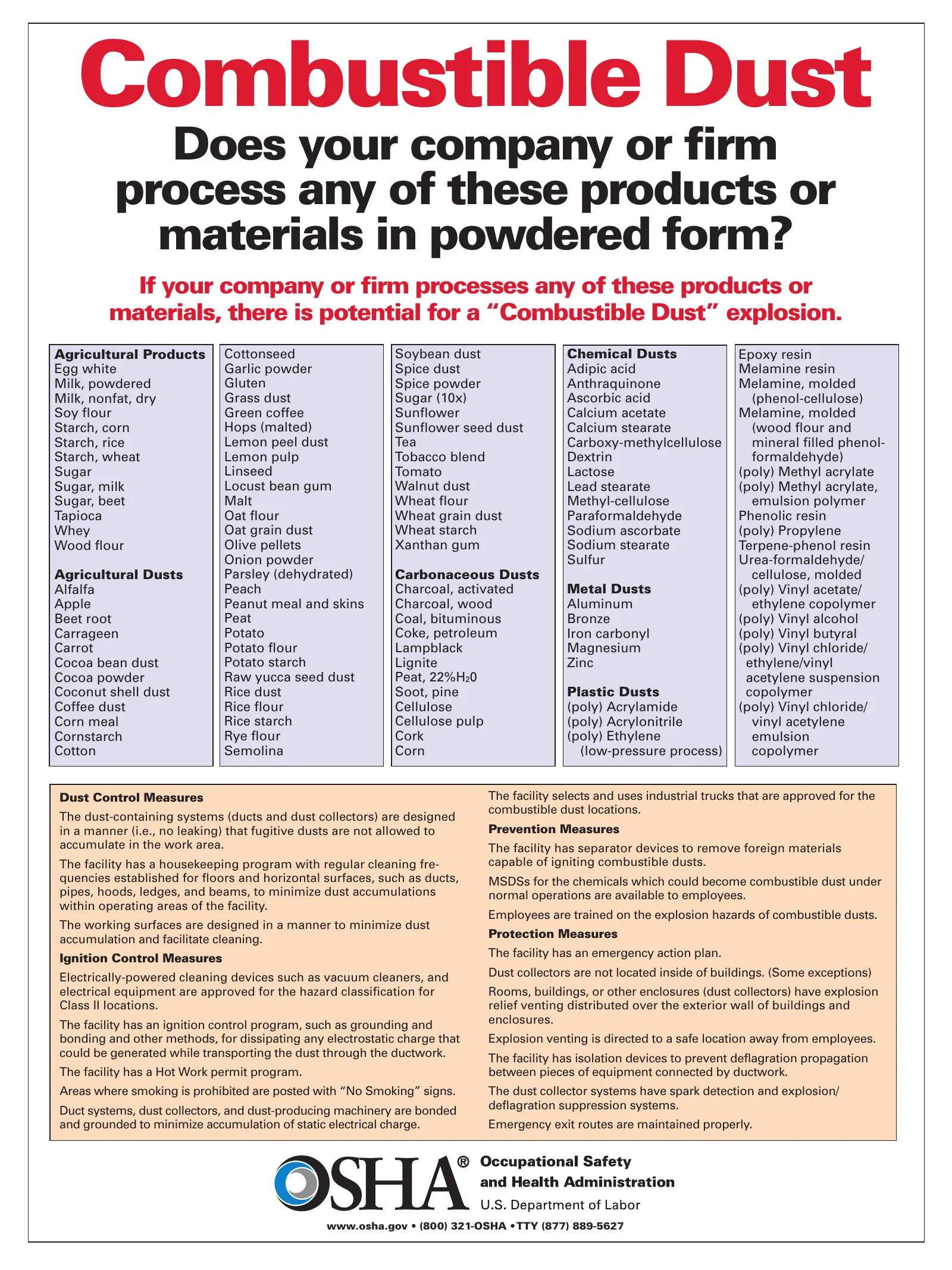
Combustible Dust
- Does your company or firm process any of these products or materials in powdered form?
- If your company or firm processes any of these products or materials, there is potential for a “Combustible Dust” explosion.
- Agricultural Products
- Egg white
- Milk, powdered
- Milk, nonfat, dry
- Soy flour
- Starch, corn
- Starch, rice
- Starch, wheat
- Sugar
- Sugar, milk
- Sugar, beet
- Tapioca
- Whey
- Wood flour
- Agricultural Dusts
- Alfalfa
- Apple
- Beet root
- Carrageen
- Carrot
- Cocoa bean dust
- Cocoa powder
- Coconut shell dust
- Coffee dust
- Corn meal
- Cornstarch
- Cotton
- Cottonseed
- Garlic powder
- Gluten
- Grass dust
- Green coffee
- Hops (malted)
- Lemon peel dust
- Lemon pulp
- Linseed
- Locust bean gum
- Malt
- Oat flour
- Oat grain dust
- Olive pellets
- Onion powder
- Parsley (dehydrated)
- Peach
- Peanut meal and skins
- Peat
- Potato
- Potato flour
- Potato starch
- Raw yucca seed dust
- Rice dust
- Rice flour
- Rice starch
- Rye flour
- Semolina
- Soybean dust
- Spice dust
- Spice powder
- Sugar (10x)
- Sunflower
- Sunflower seed dust
- Tea
- Tobacco blend
- Tomato
- Walnut dust
- Wheat flour
- Wheat grain dust
- Wheat starch
- Xanthan gum
- Carbonaceous Dusts
- Charcoal, activated
- Charcoal, wood
- Coal, bituminous
- Coke, petroleum
- Lampblack
- Lignite
- Peat, 22%H 2 0
- Soot, pine
- Cellulose
- Cellulose pulp
- Cork
- Corn
- Dust Control Measures
- Chemical Dusts
- Adipic acid
- Anthraquinone
- Ascorbic acid
- Calcium acetate
- Calcium stearate
- Carboxy-methylcellulose
- Dextrin
- Lactose
- Lead stearate
- Methyl-cellulose
- Paraformaldehyde
- Sodium ascorbate
- Sodium stearate
- Sulfur
- Metal Dusts Aluminum Bronze
- Iron carbonyl Magnesium Zinc
- Plastic Dusts
- (poly) Acrylamide
- (poly) Acrylonitrile
- (poly) Ethylene
- (low-pressure process)
- Epoxy resin
- Melamine resin Melamine, molded (phenol-cellulose) Melamine, molded (wood flour and mineral filled phenolformaldehyde)
- (poly) Methyl acrylate (poly) Methyl acrylate, emulsion polymer Phenolic resin
- (poly) Propylene Terpene-phenol resin Urea-formaldehyde/ cellulose, molded (poly) Vinyl acetate/ ethylene copolymer (poly) Vinyl alcohol (poly) Vinyl butyral (poly) Vinyl chloride/ ethylene/vinyl acetylene suspension copolymer
- (poly) Vinyl chloride/ vinyl acetylene emulsion copolymer
- The facility selects and uses industrial trucks that are approved for the combustible dust locations.
- The dust-containing systems (ducts and dust collectors) are designed in a manner (i.e., no leaking) that fugitive dusts are not allowed to accumulate in the work area.
- Prevention Measures
- The facility has a housekeeping program with regular cleaning frequencies established for floors and horizontal surfaces, such as ducts, pipes, hoods, ledges, and beams, to minimize dust accumulations within operating areas of the facility.
- MSDSs for the chemicals which could become combustible dust under normal operations are available to employees.
- The working surfaces are designed in a manner to minimize dust accumulation and facilitate cleaning.
- The facility has separator devices to remove foreign materials capable of igniting combustible dusts.
- Employees are trained on the explosion hazards of combustible dusts.
- Protection Measures
- Ignition Control Measures
- The facility has an emergency action plan.
- Electrically-powered cleaning devices such as vacuum cleaners, and electrical equipment are approved for the hazard classification for Class II locations.
- Dust collectors are not located inside of buildings. (Some exceptions)
- The facility has an ignition control program, such as grounding and bonding and other methods, for dissipating any electrostatic charge that could be generated while transporting the dust through the ductwork.
- The facility has a Hot Work permit program.
- Areas where smoking is prohibited are posted with “No Smoking” signs.
- Duct systems, dust collectors, and dust-producing machinery are bonded and grounded to minimize accumulation of static electrical charge.
- Rooms, buildings, or other enclosures (dust collectors) have explosion relief venting distributed over the exterior wall of buildings and enclosures.
- Explosion venting is directed to a safe location away from employees.
- The facility has isolation devices to prevent deflagration propagation between pieces of equipment connected by ductwork.
- The dust collector systems have spark detection and explosion/ deflagration suppression systems.
- Emergency exit routes are maintained properly.
- www.osha.gov • (800) 321-OSHA • TTY (877) 889-5627
More on Other

pptx
137 slidesAerial Lift Safety
Tree Care Industry Association aerial lift safety deck: inspection, setup, fall protection and electrical hazards.
Tree Care Industry AssociationOSHA Harwood grant
pdf
1 slidesAerial Lifts: Using Aerial Lifts Fact Sheet
OSHA fact sheet on using aerial lifts safely, written for cleanup and recovery work.
U.S. Department of Labor, OSHAPublic domain
pdf
4 slidesScissor Lifts: Working Safely with Scissor Lifts Hazard Alert (OSHA HA 3842)
OSHA Hazard Alert on fall protection, stabilization and positioning of scissor lifts.
U.S. Department of Labor, OSHAPublic domain