1 / 137Use ← → to flip
Aerial Lift Safety
Tree Care Industry Association aerial lift safety deck: inspection, setup, fall protection and electrical hazards.
Slide text
· 137 slides · by Tree Care Industry Association
The words on each slide as the author wrote them, read from the file by software so they can be searched. Layout, pictures and tables are not shown here: the slides above and the download are the original.
- Slide 1
Aerial Lift Safety
- Slide 2
Introduction
- About this Power Point Presentation
- This PPT was financed 100 percent through federal funds. It is offered to affected employees and owners of small businesses, including limited- English, low-literacy and hard-to-reach workers.
- Affected employees, small business owners, and their trainers may request a free copy of this PPT by contacting TCIA, Inc. at 800-733-2622.
- This material was produced under grant number SH-26301-SH4 from the Occupational Safety and Health Administration, U.S. Department of Labor. It does not necessarily reflect the views or policies of the U.S. Department of Labor, nor does mention of trade names, commercial products, or organizations imply endorsement by the U.S. Government.
- Slide 3
Introduction
- An aerial lift, for the purpose of this training, is any work platform that has an articulating boom with a bucket.
- Only qualified employees can operate aerial lifts. Only your employer can certify that you are qualified operator.
- This training program is based on OSHA and ANSI Z133 safety standards for arboricultural operations.
- This manual presents general safety awareness, industry safety standards, and some operational guidelines for aerial lifts.
- It is your responsibility to know and comply with your company’s policies. If unsure, ask your supervisor. This manual is not intended to replace or supersede company policies and procedures.
- Slide 4
Aerial Device (ANSI Z133 Definition)
- Any one of the following types of vehicle-mounted apparatus used to elevate personnel to jobsites above ground:
- Extensible boom platform
- Aerial ladder
- Articulating boom platform
- Vertical tower
- A combination of any of the above
- Slide 5
Chapter 1: Aerial Lift Safety
- Objectives:
- The employee will:
- Name the most common types of accidents involving aerial lift devices.
- Interpret the meaning of common warning signs and labels.
- Identify appropriate personal protective equipment.
- Slide 6
Only qualified employees can operate aerial lift devices.
- Slide 7
OSHA Definition
- OSHA DEFINITION of a "Qualified person" - a person who possesses a recognized degree, certificate, professional standing, or skill and who, by knowledge, training, and experience, has demonstrated the ability to deal with problems relating to the subject matter, the work, or the project.
- Slide 8
Industry Statistics 2014 Fatalities
- Struck-by’s - 42%
- Falls - 31%
- Electrocution - 16% (harmful environment)
- Transportation - 11%
- Assaults 1%
- Courtesy of Dr. John Ball, 2014 data
- Slide 9
A Closer Look at Struck-by’s
- 42% of total fatalities (OSHA –Contact with an object)
- Limb
- Tree
- Chipper
- Saw
- Palm
- Stump Grinder
- Courtesy of Dr. John Ball, 2014 data
- Slide 10
A Closer Look at Falls
- 31% of total fatalities
- From or with tree
- ½ from
- ½ with
- Often fall into tree
- From or with aerial lift
- ½ from
- ½ with
- Misc.
- Truck (Rack/body)
- Ladder
- Courtesy of Dr. John Ball, 2014 data
- Slide 11
A Closer Look at Falls - Aerial Lift
- Working without fall protection/fall restraint of any kind
- Misuse of the lift
- Tree parts falling on the booms/basket
- Failure to inspect/maintain the lift
- Falls from headache rack
- Slide 12
Exposure to Harmful Environment
- 16% of total fatalities
- Most working aloft
- Some working on ground
- Twice as many Indirect as Direct
- Courtesy of Dr. John Ball, 2014 data
- Slide 13
Aerial Lift Procedures
- Bucket Operator Warnings
- The bucket does not keep you free from risk of electrocution
- Insulation provides only a measure of safety
- You can be electrocuted through other paths to ground:
- If you contact the conductor and the tree at the same time
- If you contact two conductors at the same time
- Slide 14
Electrical Shocks
- Slide 15
Indirect, phase-to-phase contact, bucket operator
- Slide 16
Indirect, phase-to-ground contact, bucket operator
- Slide 17
Failure to observe safety precautions may result in serious injury or death
- Slide 18
Aerial Lift Safety
- The triangle shape is the symbol for:
- Caution, Warning, Danger
- the Exclamation Point Means “Pay Attention!”
- The manufacturer puts
- important
- messages on the equipment. It is our job to read, know, and understand them!!
- Slide 19
CAUTION, WARNING
- DANGER!
- Indicates a hazardous situation. Know what each word means!
- Slide 20
Symbol Meanings
- CAUTION
- means you need to be careful. Follow the directions on the sign or you could get hurt.
- The triangle with the exclamation point and a picture to show you what you are supposed to use Caution for .
- The triangle with an exclamation point will always remain the same for caution, but the picture may change .
- Slide 21
Symbol Meanings
- WARNING more
- Serious than CAUTION! Follow directions or injury and possibly death.
- The triangle with the exclamation point and a picture to show and warn you - WARNING. The triangle with an exclamation point will always remain the same for warning, but the picture may change.
- Slide 22
Symbol Meanings
- DANGER – the most
- Serious safety message!
- Serious injury or death may occur if you do not follow directions!
- The triangle with the exclamation point and a picture to show you DANGER is present. The triangle with an exclamation point will always remain the same for danger, but the picture may change.
- Slide 23
Aerial Lift Safety Personal
- Protective Equipment
- Slide 24
Aerial Lift Safety
- Personal Protective Equipment (PPE)
- 1. Fall Protection – full body harness or body belt with appropriate lanyard connected to designated anchor point. (OSHA)
- 2. Helmet – Class E for line clearance, commercial Arborists can wear ventilated. All helmets must meet ANSI Z89.1
- 3. Eye Protection – goggles or safety glasses, including prescription safety glasses, must meet ANSI Z87.
- Slide 25
Aerial Lift Safety
- PPE (cont)
- 4. Hearing protection – ear muffs of plugs (Chain Saw use).
- 5. Leg Protection – may be worn, but is not required in a bucket.
- 6. Face Shield – may be worn, but does not substitute for safety glasses.
- 7. Sturdy, non-slip boots
- 8. Close fitting clothing and no jewelry. Nothing to get caught in equipment.
- Slide 26
Chapter 2:
- Aerial Lift Inspection, Preparation and Driving
- Objectives:
- The employee will:
- Indicate parts to be inspected before and after operation.
- Learn start-up procedures.
- Understand daily, weekly, monthly and annual inspection requirements.
- Slide 27
Chapter 2 Aerial Lift Inspection
- Component Identification
- Slide 28
PRE-USE INSPECTION PROCESS
- 7-step process to ensure safe operation of a bucket truck
- Slide 29
Inspection: Step 1
- Check oil level in hydraulic reservoir
- Outriggers are up
- Vehicle parked on level surface
- The need to add oil on a regular basis may indicate a leak
- Inspection: Step 2
- Conduct visual inspection of the unit
- Slide 30
Step 3 :
- Check visual and audible safety devices
- Slide 31
Step 4:
- Inspect the fiberglass lower and upper boom insulator for dirt and damage caused by rubbing wires, tree sap etc.
- Slide 32
Step 5:
- Test the outrigger interlock system (if equipped)
- Put truck on level surface and attempt to raise and lower booms without putting outriggers down
- Slide 33
Inspection Step 6:
- While setting the outriggers make sure they are working properly
- No leaks
- No signs of wear due to rubbing against outrigger weldment
- CAUTION: when testing the operation of the interlock system the platform and booms should be in such a position that no damage can result from unexpected movement
- Slide 34
Inspection Step 7:
- With no one in the platform, operate the functions from the lower controls
- If functions are operating normally, move to upper controls
- Test the interlock system for the upper controls
- First, try to operate booms with upper controls with the hydraulic stop pushed in
- Next, for trucks with interlock trigger, try to operate booms without squeezing trigger
- If boom movement occur, interlock system has failed – do not operate until problem is corrected
- While the unit is operating, look for leakage from hydraulic lines and components **
- Slide 35
Inspection Step 8:
- Test station selector at the lower control station
- When the station selector is set to the override position, the upper controls should not work
- The lower controls must always override the upper control
- Slide 36
Inspection Step 9:
- If the unit is equipped with a secondary stowage system, remote throttle system, stop/start system, or battery powered electrical drive, check these systems for proper operation
- Slide 37
Vehicle
- Inspection
- Slide 38
The Federal DOT Requires At Least The Following To Be Covered
- Tires
- Service brakes, including trailer brake • Horn connections
- Windshield wipers
- Parking brake
- Rear vision mirrors
- Steering mechanism • Coupling devices
- Lighting devices and • Wheels and rims reflectors
- Emergency equipment
- Slide 39
Aerial Lift Preparation
- Shop Start-Up Procedures
- Check which equipment is scheduled for use.
- Check oil and coolant levels before starting the engine.
- Start engine as soon as possible for full warm-up.
- Perform visual inspection.
- Perform operational inspection of controls and outriggers.
- Inform supervisor if you find any broken items.
- Check truck storage boxes for all safety devices (i.e.: flags, vests, signs, cones, chocks, pads) and any other equipment needed.
- Be sure there are no loose tools on top of the lift or in the buck- et.
- Be sure all equipment doors are shut and locked.
- Before leaving your shop, be sure you have your DOT med. exam card (if applicable), driver’s license, work orders, directions to location(s), emergency numbers, and all co-workers you need to transport before leaving.
- Wear your seat belt.
- Be sure all passengers are wearing their seat belt.
- Slide 40
Aerial Lift Preparation
- Fueling the Vehicle
- Use correct fuel for equipment
- Never smoke or have an open flame
- Touch the nozzle to machine before removing the fuel cap to prevent static spark
- Keep nozzle or funnel in contact with fuel tank.
- Wipe up all spills immediately, before starting Engine.
- Slide 41
Aerial Lift Safety
- Daily, Weekly, Monthly, and Annual Lift Inspections
- Consult manufacturer’s instructions for what is to be included in “daily,” “weekly,” monthly and annual inspections. Your DVIR form covers standard items inspected on a daily basis to meet USDOT Federal Motor Carrier Safety Regulations (FMCSR) for the vehicle on which the aerial lift is mounted. Lift manufacturers have additional inspection items for the lift itself, based on the specific model you are operating.
- In general, “daily” inspections are conducted by aerial lifts specialists (qualified operators). Depending on your company, “weekly” inspections may be conducted by an aerial lift specialist or a qualified maintenance technician. Aerial Lift Specialists, at a minimum, should be aware of the items that are checked on a “weekly” basis.
- Monthly and annual inspections are conducted by qualified maintenance technicians. “Daily” inspections are actually based on 8 hours of operation and “weekly” inspections are based on 40 hours of operation.
- Slide 42
An Example of “Daily” and “Weekly” Inspection
- Slide 43
Aerial Lift Safety - driving
- While driving, parking at job, and returning…
- Know the height clearance of your vehicle!
- Drive defensively – not offensively!
- No tailgating – maintain the right following distance!
- Park your vehicle properly
- Conduct post trip inspection
- Unload equipment properly and Check equipment storage – locking them always.
- Turn in completed DVIR when back to office.
- Slide 44
Aerial Lift Safety – driving
- Slide 45
Aerial Lift Safety - Driving
- Use a spotter when backing vehicles
- Slide 46
Aerial Lift Backing
- Slide 47
Chapter 3 –
- General Standards and Guidelines
- Objectives:
- The employee will:
- Learn safety standards for working with an aerial lift
- Learn work-site traffic control procedures
- Learn aerial lift positioning and set-up procedures
- Identify good work-site set-up position
- Slide 48
What standard(s) apply to you?
- (More on this in Chapter 5)
- Slide 49
GENERAL STANDARDS AND GUIDELINES – ANSI Z133
- Slide 50
ANSI Z133 Key Sections for Aerial Lift Operations
- 3.2 Traffic Control
- 3.3 Emergency Procedures and Readiness
- 3.4 Personal Protective Equipment (PPE)
- 4 Electrical Hazards (All)
- 5.1 Vehicles and Mobile Equipment
- 5.2 Aerial Devices
- Slide 51
ANSI 5.2.2
- 5.2.2 Aerial devices shall be provided with an approved point of attached on which to secure a full-body harness with an energy-absorbing lanyard or body belt and lanyard which shall be worn when aloft.
- Slide 52
ANSI 5.2.4 and .5
- 5.2.4 Aerial devices or aerial ladders shall not be used as cranes or hoists to lift or lower material or tree parts, unless they were specifically designed by the manufacturer to do so
- 5.2.5 Wheel chocks shall be set before using an aerial device unless the device has no wheels on the ground or is designed for use without chocks
- Slide 53
ANSI 5.2.3
- 5.2.3
- Booms, buckets, or any other part of the aerial device shall not be allowed to make contact or violate minimum approach distances with energized
- electrical
- conductors, poles or similar conductive objects.
- Slide 54
ANSI 5.2.6 and .7
- 5.2.6
- Units equipped with outriggers or a stabilizing system shall be operated in a manner consistent with manufacturer’s requirements
- 5.2.7
- The operator shall ensure adequate clearance exists and give warning prior to lowering outriggers. Pads shall be placed under outrigger feet when they are needed to ensure stable footing.
- Slide 55
ANSI 5.2.8 – 5.2.10
- 5.2.8
- When operating aerial devices, the operator shall look in the direction the bucket is traveling and be aware of the location of the booms in relation to all other objects and hazards
- 5.2.9
- Clearances from passing vehicles shall be maintained, or traffic control shall be provided when booms or buckets are operated over roads
- 5.2.10 One-person buckets shall not have more than one person in them during operations
- Slide 56
ANSI 5.2.11 – 5.2.15
- 5.2.11 Hydraulic/pneumatic tools shall be disconnected when they are being serviced or adjusted, except where manufacture’s procedure require otherwise.
- 5.2.12 To avoid flying particles or shipping hydraulic/pneumatic hoses, pressure shall be released before connections are broken, except where quick-acting connectors are used. Hydraulic pneumatic hoses shall never be kinked in order to cut off pressure
- 5.2.13 No part of the body shall be used to locate or stop hydraulic leaks
- 5.2.14 Hoses affecting dielectric characteristics of equipment shall meet manufacturer’s requirement
- 5.2.15 The flash point of hydraulic fluid shall meet the minimum set by the manufacturer
- Slide 57
ANSI 5.2.16 – 5.2.19
- 5.2.16 Combine loads shall not exceed rated lift capacities. Load ratings shall be conspicuously and permanently posted on aerial devices in accordance with ANSI A92.2.
- 5.2.17 Electric cables/cords used with electrics saws or lights, or other conductive material shall not be run from the vehicle to the bucket when arborists are working in proximity to energized electrical conductors.
- 5.2.18 aerial devices shall not be moved with an arborist in the platform (for example, a bucket) except when equipment is specifically designed for such a operation.
- 5.2.19
- Holes shall not be drilled in buckets or liners.
- Slide 58
ANSI 5.2.20
- 5.2.20
- During aerial device operations, arborists and other workers who are not qualified line clearance arborists shall maintain a minimum approach distance from energized electrical conductors in accordance with Table 2.
- Only a qualified line-clearance arborists or qualified line-clearance arborist trainees using an insulated aerial device may operate in accordance with minimum approach distances provided in Table 1.
- Slide 59
ANSI 5.2.21 - .22
- 5.2.21 Arborists and other workers shall be instructed that insulated aerial buckets do not protect them from other electric paths to the ground, such as paths through trees, guy wires, or from one phase were to the second phase wire, any one of which can be fatal.
- 5.2.22 All underground hazards shall be located proper to operating aerial lift devices off-road. These hazards could include natural gas tanks, underground oil tanks and septic systems.
- Slide 60
Chapter 3 - Guidelines
- Aerial Lifts
- Need to be tested annually for dielectric insulating ability
- Inspected and operationally checked prior to use
- Maintenance done as recommended by manufacturer
- Slide 61
Guidelines
- Aerial Lifts . . .
- Insulating parts should be cleaned with non-filming agents
- Never drill holes in the bottom of the bucket, if water can drain out, electricity can get in!
- Slide 62
Safe Work Practices
- Job Briefing
- You are required to make sure that all workers understand the hazards associated with their work as well as their individual responsibilities
- This is required by OSHA and ANSI Z133
- Slide 63
Safe Work Practices
- Job Briefing should include:
- Job steps
- Potential hazards
- Specific work assignments
- Action steps needed to avert the hazards
- What PPE is required
- Any new hazard or change in job site needs to be addressed
- Slide 64
- Temporary Traffic Control Stds.
- Federal Regulations - All traffic control devices used for TTC shall conform to the U.S. Dept. of Transportation MUTCD
- Slide 65
Working Near Traffic
- Slide 66
Avoid Being Struck-by a Vehicle
- 1st Sign—Attracts the driver’s attention.
- 2nd Sign—Shows what the driver is approaching.
- 3rd Sign—Shows the driver what must be done.
- Why do you need to know this? This will help the aerial lift avoid being struck-by a vehicle!!!! Cones and signage are important for safety!
- Slide 67
Distracted Drivers
- Distracted drivers are a hazard to workers in work zones.
- Setting up proper advanced warning signs, taper, channelizing devices and buffer space may give a distracted driver time to react
- Slide 68
Aerial Lift and highline wires
- Slide 69
Hi-Visibility Clothing
- Slide 70
Chapter 3 - TTC Standards
- The primary function of TTC is to provide reasonably safe and efficient movement of road users through or around TTC while providing reasonable protection for the workers, equipment and emergency responders.
- Employers must train their employees who are involved in TTC.
- Slide 71
Five Parts of a Traffic Control Zone
- The traffic control zone is the area between the first advanced warning sign and the point beyond the work space where traffic is no longer affected.
- Slide 72
Chapter 3 - Aerial Lift Setup
- Slide 73
Aerial Lifts Should be Right-Side up!
- Slide 74
Aerial Lift Safety
- http://www.youtube.com/watch?v=IgDn8f27xvQ
- Aerial Lift Accident
- Slide 75
Chapter 3 - Work Site Procedures
- Work-Site Set Up Procedures
- 1. Ensure the vehicle is positioned on level ground.
- 2. Set the parking brake.
- 3. Chock the wheels.
- 4. Engage the power supply.
- 5. Set the outriggers. When working on soft ground, place outrigger pads beneath outriggers to prevent sinking (according to the operator’s manual instructions).
- 6. Ensure the vehicle is stable before entering the bucket/platform and raising or lowering the boom.
- 7. Check the operator’s manual for additional procedures.
- Slide 76
Aerial Lift Procedures
- Always know where the conductors are
- Face the direction of bucket travel
- Do not work with your back to the conductors
- NEVER move the bucket between to conductors
- Inspect and maintain the bucket
- Slide 77
Drawing on hazards
- Slide 78
Aerial Lift Procedures
- The bucket, boom, tools, and the operator shall never contact the conductors or violate the Minimum Approach Distances (more on this later)
- The truck and any attached equipment shall be considered energized if contact is made
- If a worker on the ground contacts an energized vehicle, electrocution may occur
- Slide 79
Aerial Lift Procedures
- Upper insulator/isolator
- Lower insulator/isolator
- Slide 80
Aerial Lift Procedures
- Dielectric protection is only within arrows (Left side only shown here)
- Slide 81
Aerial Lift Procedures
- Any electrical contacts below the lower isolator will energize the truck, ground around the truck and any towed equipment.
- Lower insulator/isolator
- Slide 82
Workers On The Ground Can Be Electrocuted If The Boom Comes Into
- Contact With An Energized Line…
- Slide 83
Drawing on Energized lift
- Slide 84
Chapter 3 - Aerial Lift Guidelines
- Read the Guidelines For Aerial Lifts, adapted from ANSI Z133
- Safety Standards.
- Make sure you and your co-workers follow the standards!!!!!!!
- Slide 85
Chapter 3 - Aerial Lift Guidelines
- Never modify any part of the lift without permission from the manufacturer
- A must – a grounder worker must be present, trained and qualified to make an Aerial rescue from the lower controls.
- Never allow unauthorized users or pedestrians around lift or job site.
- Stop working if a pedestrian approaches or enters the work zone.
- Stop working if there is a malfunction – call your supervisor.
- Stop working if you realize that you cannot complete the job safely or efficiently With the Aerial lift – call your supervisor.
- Once a bucket operator is aloft, the lower controls should only be operated by a Ground person in case of an emergency and with permission by the operator aloft.
- Slide 86
Chapter 3 - Aerial Lift Guidelines
- When raising or lowering the boom, avoid:
- Jerking the controls.
- Obstacles, tree limbs, power lines, etc.
- Don’t get crushed
- between bucket and object.
- Secure tools before moving bucket.
- Refer to owner’s manual for crush points on your equipment.
- Slide 87
Aerial Lift Guidelines
- Conduct a work-site and hazard assessment.
- Conduct a job briefing – all employees must understand the assessment and work plan.
- Discuss voice command and response system to be used – agree upon it – all of you.
- Use this communications system while working.
- Ensure that all workers on ground stay out from under the boom and bucket.
- Slide 88
Chapter 3 - Shut Down Procedures
- Slowly lower the boom to rest on is supports
- Secure the boom according to the operator’s manual.
- Raise the outriggers.
- Shut off the power supply.
- Depress the parking brake.
- Remove the key.
- Slide 89
Shut Down Procedures . . .
- Stow the outrigger pads (if applicable).
- Remove and stow the wheel chocks before leaving the work site.
- Return all equipment and traffic control devices to tools boxes.
- Slide 90
Chapter 4 – Preventing Common Accidents
- Objectives:
- The employee will:
- Identify steps to secure yourself in the bucket of the lift.
- Recognize safe operating procedures to avoid falling from an aerial lift.
- Identify safe work procedures to avoid being cut by a chain saw operated from a bucket.
- Indicate how to avoid being struck by objects while operating the bucket.
- Slide 91
Chapter 4 – Common accidents
- Common Types of Accidents for Aerial Lift Operators
- 1. Falls from Bucket – failure to secure yourself in bucket with a full body harness. Falls over 35 feet usually result in death. Many times an operator is knocked out of a bucket from being struck by another vehicle or a section of wood hitting the boom.
- 2. Chain Saw Cuts – failure to use two hands while operating a Chain Saw.
- 3. Struck-Bys – you and co-worker injured by branches. Create a work plan before going aloft. Use voice command or hand signals.
- 4. Contact Energized Conductors – Always maintain minimum approach distances.
- 5. Equipment Failure – inspect and maintain your boom. breakage of cables.
- Most common failure is
- 6. Lift Overturns – not as common, but it does happen. Don’t forget to outriggers.
- use the
- Slide 92
Preventing Falls from Aerial Lifts
- Slide 93
Fall Protection
- Aerial Lifts
- Personal fall arrest system, or…
- Fall restraint system
- 1910.269(g)(2)(vi)(C)
- Slide 94
Fall Protection*
- Fall restraint - system that prevents the user from falling any
- distance, or from reaching “unprotected edge” of a horizontal surface
- Work positioning - s ystem rigged to allow an employee (lineman)
- to be supported on an elevated vertical surface (pole, tower) and work with both hands free while leaning
- Fall arrest - system used to arrest a fall from a working level, limits
- free fall to 6 feet, rigged so that worker cannot contact lower level
- Fall protection requirements vary depending on which OSHA regulations apply. More in Chapter 5…
- Slide 95
Do Gear Inspection
- Do gear inspection prior to entering the bucket. Make sure you are properly positioned and attached with a properly fitted and worn harness and appropriate lanyard.
- Slide 96
Compliance Issues/Deadlines
- Fall Protection in Aerial Lifts - March 31, 2015
- Personal fall arrest systems must meet the requirements of Subpart M of OSHA’s construction standards Part 1926
- Slide 97
Compliance Issues/Deadlines
- 1926.502(d)(16) Personal fall arrest systems, when stopping a fall, shall:
- (i) limit maximum arresting force on an employee to 900 pounds (4 kN) when used with a body belt;
- (ii) limit maximum arresting force on an employee to 1,800 pounds (8 kN) when used with a body harness;
- (iii) be rigged such that an employee can neither free fall more than 6 feet (1.8 m), nor contact any lower level;
- Lanyard length, shock absorbing?
- Free fall distance is defined as the total vertical displacement, measured at the dorsal attachment, from its starting point to its stopping point
- Whatever system you choose must also meet the
- “arresting force” (AF) requirement.
- Combined tool and body weight of 310 pounds
- Slide 98
Compliance Issues/Deadlines
- Conductors and tree branches do not constitute a “lower level” for purposes of enforcement
- Lower level stipulation does not kick in during ascent to or descent from the working position.
- In enforcement, six-foot “free fall” restriction cannot reasonably anticipate worker being ejected…going UP before going DOWN. Employer must take reasonable precautions to prevent ejection, may use lanyards longer than 3’ (4 to 4 ½ ’ recommended).
- Slide 99
Staying Secure Aloft
- General Rules
- Inspect:
- Site
- Trees
- Truck
- Equipment
- PPE
- Slide 100
Safe Work Procedures Prevent Falls
- Slide 101
Safe Work Procedures
- Prevent Saw Cuts
- Use two hands while operating a chain saw
- Use a hand saw, “should” be carrying one in bucket with you
- Slide 102
Avoid Struck-by Injuries from Falling
- Objects
- Slide 103
Safe Work Procedures Prevent Struck by Injuries
- This includes injuries to you, the bucket operator, and anyone on the ground.
- A work zone, controlled with flaggers, signs and cones should be set up as appropriate.
- Keep co-workers from going underneath the bucket.
- Use a command/response communication system before making the final cut and dropping branches.
- Use Electronic Communication Systems
- Slide 104
Keep Pedestrians at a Safe Distance
- Slide 105
Identify Electrical Hazards
- Slide 106
Minimum Approach Distance (MAD)
- Two components of actual distance
- MAID (Minimum Air Insulation Distance)
- Ergonomic Factor-allows for inadvertent movement
- OSHA and ANSI tables
- Distances based on training, voltage and elevation
- Slide 107
Minimum Approach Distance
- Slide 108
Minimum Approach/Separation Distances
- Minimum approach distance listed in the ANSI Z133 table
- Based on maximum nominal operating voltage in the energized conductors.
- Line clearance arborist or line clearance arborists trainees
- Slide 109
Safe Work Practices
- Work planning when there is an electrical hazard:
- Inspect trees to determine proximity to all wires
- Consider all wires to be energized with potentially fatal voltages, this includes;
- Electric
- Fire alarm
- Communication
- Street light
- Slide 110
Safe Work Practices
- Coating on wires is weather proofing, not insulation
- Designed to protect the wire, not you
- Never touch any electrical conductor, apparatus or any conductive object in contact with an electrical conductor
- Slide 111
Objectives:
- Chapter 5 - Additional Recommended Training: Qualified Line-Clearance Arborists (Tree Trimmers) and Aerial Rescue
- The employee will:
- Identify what defines line-clearance tree trimming.
- Define the term line-clearance arborist.
- Understand who is and who is not “qualified” to perform line-clearance tree trimming.
- Understand that Aerial Lift Safety training does not include aerial rescue training.
- Slide 112
Which Standards Apply to Arborists’ Work?
- Start
- Is any part of the tree/brush being worked on closer than 10’ horizontally to electric supply lines or equipment?
- Yes
- Is the work being done for a utility, and directly associated with electric power generation, transmission, or distribution lines or equipment?
- No
- No
- OSHA General
- Industry standards and ANSI Z133 apply.
- OSHA Subpart S applies.
- Yes
- OSHA §1910.269 applies.
- Slide 113
Aerial Lift Safety
- Line-Clearance Tree Trimming
- Definition – The pruning, trimming, repairing, maintaining, removing or clearing of trees, or cutting brush that is within 10 feet of electric supply lines and equipment.
- Slide 114
Aerial Lift Safety
- It’s line clearance when any part of the tree is closer than 10’ horizontally to the electric supply lines or equipment AND work is on behalf of a utility.
- Slide 115
Chapter 5
- Qualified Line-Clearance Arborist
- Slide 116
Non Line Clearance Arborists
- Slide 117
Aerial Rescue
- This manual does not address aerial rescue training. Aerial rescue requires complex training that includes decision-making and knowledge of various techniques.
- Possible aerial rescue scenarios involving Aerial Lifts
- Aerial Lift Specialists who are qualified to climb may need to use an aerial lift to access a tree when
- trying to reach a victim in the tree.
- Aerial Lift Specialists may need to use an aerial lift to rescue a rescue victim in a tree.
- Aerial Lift Specialists may need to rescue a victim in a bucket rescue another lift operator using the lower controls.
- Slide 118
Chapter 6 –
- Electrical and Environmental Hazards
- Objectives:
- The employee will:
- Identify electrical hazards.
- Understand how electrocution occurs.
- Identify environmental hazards.
- Identify procedures during lightning or storm emergencies
- Slide 119
Aerial Lift Safety
- Did You Look for Electrical Hazards?
- Slide 120
Aerial Lift Procedures – Electrical Hazards Safe Work Practices
- Bucket Operator Warnings
- The bucket does not keep you free from risk of electrocution
- Insulation provides only a measure of safety
- You can be electrocuted through other paths to ground:
- If you contact the conductor and the tree at the same time
- If you contact two conductors at the same time
- Slide 121
Chapter 6 – Electrical and Environmental Hazards
- Slide 122
Drawing on Line Clearing
- Slide 123
General Precautions To Avoid Being Electrocuted
- Use extreme caution when operating aerial lifts and tree trimming equipment around utility lines.
- You must call the utility if there is an electrical hazard, such as a tree limb, closer to the line than your minimum approach distance.
- Plan ahead to have power lines de-energized or shielded if possible.
- Never use a non-insulated lift device around utility lines.
- Keep far enough away from the utility lines to allow for sway of the boom and sway of the lines.
- Never drill holes in the bucket or bucket liner; this will decrease the effectiveness of insulation, if equipped.
- Insulated booms must be dielectrically tested at least once a year.
- Never rely on boom insulation to protect you. An insulated boom may or may not work based on environmental factors, voltage involved, nature of the contact, condition of boom, etc. Workers on the ground should not touch, lean on, and/or jump on and off the aerial lift when it is in use around utility lines.
- Slide 124
Aerial Lift Safety
- Current passing through the body can cause electrocution or severe burns.
- Slide 125
Aerial Lift Safety
- Electrical Current and the Human Body
- How muc h is too muc h?
- 1 mA c an be felt
- 3-10 mA , mus c le c ontra c tion a nd pain 10-40 mA is ‘ let go’ thres hold
- 30-75 mA , res piratory paralys is * 100-20 0 mA , heart c lamps tight* 1500 mA , tiss ue and organs burn*
- Slide 126
How Electrocutions Occur
- Slide 127
Direct Contact
- Slide 128
Indirect Contact
- Slide 129
Environmental Hazards
- Heat exhaustion
- Heat stroke
- Cold exposure
- Stinging and biting insects
- Animals and mammals
- Lightning
- Make sure your First Aid and CPR are up to date.
- Slide 130
Heat Illness
- Heat exhaustion is one form of heat illness Symptoms include*:
- Dizziness
- Headaches
- Sweaty skin
- Weakness
- Cramps
- Nausea, vomiting
- Fast heart beat
- People react differently to heat, you may have only a few, or all, of these symptoms
- Slide 131
Heat Illness
- Heat stroke is another form of heat illness Symptoms may include*:
- Red, hot, dry skin
- High temperature
- Confusion
- Convulsions
- Fainting
- People react differently to heat, you may have only a few, or all, of these symptoms
- Slide 132
Heat Illness Prevention
- Drink water every 15 minutes
- Use a water bottle or bladder system when aloft
- Wear light clothing
- Take breaks in the shade
- Keep an eye on each other
- For more resources see OSHA’s website https://www.osha.gov/SLTC/heatillness/index.html
- Slide 133
Lightning
- Lightning strikes injure and kill hundreds of people each year. Follow these precautions to stay safe:
- If you hear thunder, suspend work and lower the bucket. Shut off the aerial lift and move indoors if possible. Remember that any time you hear thunder, you may be struck by lightning. Lightning can strike even when it’s not raining.
- The cab of an enclosed vehicle provides some protection from lightning but a sturdy building provides the best protection.
- Listen to the radio for weather updates and storm warnings. If you can’t take cover inside…
- Get to a low space. Lightning strikes the tallest objects.
- Crouch down, but minimize contact with the ground.
- Do not lie flat on the ground. This makes you a larger target.
- Slide 134
Lightning (cont.)
- Keep Away From:
- Large, lone trees and towers, fences, telephone poles and utility lines.
- Rivers, lakes, pools and other bodies of water.
- Metal objects, tools, equipment, wire fences
- Lightning Facts:
- A person that is struck by lightning DOES NOT retain an electric charge that can shock you.
- Lightning can spread as far as 60 feet or more after striking the ground.
- Lightning can travel at speeds of 100,000 mph.
- The temperature of a bolt of lightning can be as high as 50,000° F.
- Lightning CAN strike the same place twice.
- Slide 135
Emergency Response
- Aerial Rescue
- Make sure you are practicing and demonstrating aerial rescue at least once a year – ANSI Standards.
- The more you practice though, the more you are prepared – panic kills!
- Prepare to respond now, so you don’t freak out later!
- Slide 136
Safety Begins with Preparation
- Slide 137
Grantee’s Website Address
- http://www.tcia.org/training/
More on Other
pdf
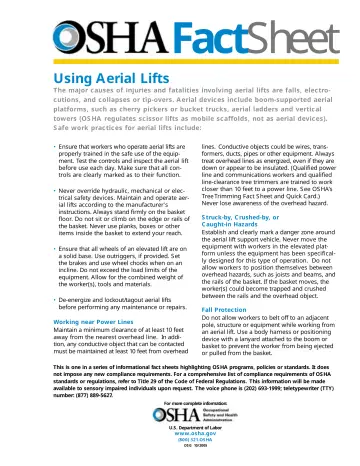
1 slidesAerial Lifts: Using Aerial Lifts Fact Sheet
OSHA fact sheet on using aerial lifts safely, written for cleanup and recovery work.
U.S. Department of Labor, OSHAPublic domain
pdf
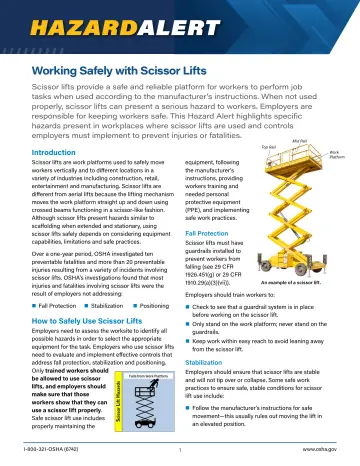
4 slidesScissor Lifts: Working Safely with Scissor Lifts Hazard Alert (OSHA HA 3842)
OSHA Hazard Alert on fall protection, stabilization and positioning of scissor lifts.
U.S. Department of Labor, OSHAPublic domain

pdf
15 slidesConcrete Manufacturing - Pocket Guide (OSHA 3221)
OSHA pocket guide to hazards in concrete work: cement dust, wet concrete, machine guarding, vehicles.
U.S. Department of Labor, OSHAPublic domain