
1 / 42Use ← → to flip
HazCom and GHS: Chemical Hazards
Hazard communication and GHS deck from the Sustainable Workplace Alliance: labels, pictograms and SDSs.
Slide text
· 42 slides · by The Sustainable Workplace Alliance
The words on each slide as the author wrote them, read from the file by software so they can be searched. Layout, pictures and tables are not shown here: the slides above and the download are the original.
- Slide 1
- HAZCOM
- and
- G.H.S.
- (Chemical Hazards)
- Slide 2
Disclaime
- HAZCOM and G.H.S.
- This material was produced under grant number SH-05073-SH8 from the Occupational Safety and Health Administration, U.S. Department of Labor.
- It does not necessarily reflect the views or policies of the U.S. Department of Labor, nor does mention of trade names, commercial products, or organizations imply endorsement by the U.S. Government.
- Slide 3
HAZCOM and G.H.S. Welcome
- What is HAZCOM?
- What changes came with
- G.H.S.
- Pictograms, what are they?
- Chemical hazards.
- Slide 4
Module- 1
- HAZCOM and G.H.S.
- What is HAZCOM?
- What changes came with
- G.H.S.
- Pictograms, what are they?
- Chemical hazards.
- Slide 5
HAZCOM and G.H.S.
- What is HAZCOM?
- Hazard Communication Standard,
- Also known as the Right-to-Know Law and more commonly as HAZCOM, is a federal regulation designed to protect workers from hazardous chemicals in the workplace.
- The goal of HAZCOM is to help employers and employees recognize dangerous materials in their work environment and the hazards these materials present.
- Slide 6
OSHA HCS Activity
- Phase-in period for the new standard
- Date
- Requirement(s)
- December 1, 2013
- Train employees on the new label elements and SDS format.
- June 1, 2015
- Transition
- Period
- Comply with all modified provisions of this final rule
- Comply with either 29 CFR 1910.1200 (this final standard), or the current standard, or both.
- Slide 7
HAZCOM and G.H.S.
- Top OSHA Violations of 2018
- 1. Fall Protection (1926.501)
- 2. Hazard Communication (1910.1200)
- 3. Scaffolding - General Requirements (1926.451)
- 4. Respiratory Protection (1910.134)
- 5. Control of Hazardous Energy - Lockout/Tagout (1910.147)
- 6. Ladders (1926.1053)
- 7. Powered Industrial Trucks (1910.178)
- 8. Fall Protection – Training Requirements (1926.503)
- 9. Machine Guarding– General Requirement (1910.212)
- 10. Personal Protective and Lifesaving Equipment – Eye and Face Protection (1926.102)
- Slide 8
Module- 2
- HAZCOM and G.H.S.
- What is HAZCOM?
- What changes came with
- G.H.S.
- Pictograms, what are they?
- Chemical hazards.
- Slide 9
HAZCOM and G.H.S. – Part 2
- What is G.H.S.?
- "Globally Harmonized System of Classification and Labeling of Chemicals," commonly referred to as The Purple Book.
- The purpose of classification under the GHS is to provide harmonized information to users of chemicals with the goal of enhancing protection of human health and the environment.
- Slide 10
HAZCOM and G.H.S. – Part 3
- Globally Harmonized
- System
- Harmonized classification criteria for health, physical, and environmental hazards of chemicals
- Standardized labelling
- Signal words, pictograms, precautionary statements
- A standardized order of information for safety data sheets,
- SDS
- Slide 11
HAZCOM and G.H.S. – Part 4
- Globally Harmonized
- System
- GHS establishes:
- Harmonized definitions of hazards
- Physical , health, environmental
- Specific criteria for labels
- Pictograms, signal words, hazard and precautionary statements
- Harmonized format for safety data sheets
- 16 sections (ANSI format)
- Slide 12
HAZCOM and G.H.S. – Part 5
- Harmonized definitions of hazards:
- Physical,
- health,
- environmental
- Slide 13
HAZCOM and G.H.S. – Part 6
- Specific criteria for
- labels:
- Pictograms,
- Signal words,
- Hazard
- precautionary statements
- Slide 14
Unlabeled bottles
- Slide 15
Unlabeled bottles – Part 2
- Slide 16
HAZCOM and G.H.S. – Part 7
- Specific criteria for labels:
- Slide 17
HAZCOM and G.H.S. – Part 8
- Harmonized format for
- safety data sheets:
- 16 sections (ANSI format)
- Slide 18
HAZCOM and G.H.S. – Part 9
- 16 sections (ANSI Format)
- Section 1, Identification includes the product identifier; manufacturer or distributor name, address, and phone number, along with an emergency phone number.
- Section 2, Hazard(s) identification includes all hazards regarding the chemical and required label elements.
- Section 3, Composition/information on ingredients includes information on chemical ingredients, along with trade secret claims.
- Section 4, First-aid measures includes important symptoms—including effects, acute, and delayed— and required treatments.
- Section 5, Fire-fighting measures lists suitable extinguishing techniques and equipment; it includes chemical hazards from fire.
- Section 6, Accidental release measures lists emergency procedures; protective equipment; and proper methods of containment and cleanup.
- Section 7, Handling and storage lists precautions for safe handling and storage, including incompatibilities.
- Slide 19
HAZCOM and G.H.S. – Part 10
- 16 sections (ANSI Format)
- Section 8, Exposure controls/personal protection lists OSHA’s Permissible Exposure Limits (PELs); Threshold Limit Values (TLVs); appropriate engineering controls; and personal protective equipment (PPE).
- Section 9, Physical and chemical properties lists the chemical’s characteristics.
- Section 10, Stability and reactivity lists chemical stability and possibility of hazardous reactions.
- Section 11, Toxicological information includes routes of exposure; related symptoms, acute and chronic effects; and numerical measures of toxicity.
- Section 12, Ecological information*
- Section 13, Disposal considerations*
- Section 14, Transport information*
- Section 15, Regulatory information*
- Section 16, Other information includes the date of preparation or last revision.
- Slide 20
Module- 3
- HAZCOM and G.H.S.
- What is HAZCOM?
- What changes came with
- G.H.S.
- Pictograms, what are they?
- Chemical hazards.
- Slide 21
HAZCOM and G.H.S. – Part 11
- Slide 22
Carcinogen
- Mutagenicity
- Reproductive Toxicity
- Respiratory Sensitizer
- Target Organ Toxicity
- Aspiration Toxicity
- Health Hazard
- Slide 23
Flammables
- Pyrophorics
- Self-Heating
- Emits Flammable Gas
- Self-Reactives
- Organic Peroxides
- Fire
- Slide 24
For gases Under Pressure
- May exploded if heated
- punctured or dropped
- Liquefied gases
- Dissolved gases
- Gas Cylinder
- Slide 25
Skin Corrosion/Burns
- Eye Damage
- Corrosive to Metals
- Corrosion
- Slide 26
Explosives
- Self-Reactives
- Organic Peroxides
- Exploding Bomb
- Slide 27
Acute Toxicity
- (fatal or toxic)
- Deadly
- (oral, dermal, inhalation)
- Skull and Crossbones
- Slide 28
Acute toxicity
- Skin irritation
- Eye irritation
- Skin sensitization
- Harmful
- Slide 29
Oxidizers
- Reacts w/ Oxygen
- Flame Over Circle
- Slide 30
Aquatic Toxicity
- Environment (Non-Mandatory)
- Slide 31
HAZCOM and G.H.S. – Part 12
- Labels:
- Chemical manufacturers and importers will be required to provide a label that includes a harmonized signal word, pictogram, and hazard statement for each hazard class and category.
- Understanding the Danger ensure you correctly pair the correct P.P.E.
- Safety Data Sheets:
- Will now have a specified 16-section format.
- Information and training: Employers were required to train workers by December 1, 2013 on the new label's elements and safety data sheets format to facilitate recognition and understanding.
- Slide 32
Module- 4
- HAZCOM and G.H.S.
- What is HAZCOM?
- What changes came with
- G.H.S.
- Pictograms, what are they?
- Chemical hazards.
- Slide 33
HAZCOM and G.H.S. – Part 13
- How has chemical hazard evaluation changed under the revised Hazard Communication Standard?
- The revised HCS has specific criteria for each health and physical hazard.
- It provides detailed instructions for hazard evaluation and determinations for classifying chemical substances and mixtures. Hazard classes and hazard categories—for most of the effects, the classes are divided into categories that reflect the relative severity of the effect. Chemical manufacturers and importers are responsible for classifying the hazards of the chemicals they manufacture or import.
- Slide 34
During an inspection, you will be asked to produce:
- HAZCOM and G.H.S. – Part 14
- Written HCS / HAZCOM Plan
- List / Inventory of Chemicals Used in the Workplace
- Evidence of Proper Labeling of Chemicals
- SDS / MSDS Documents & Details about Employee Access
- Information about Employee HazCom Training
- Slide 35
HAZCOM and G.H.S. – Review
- Slide 36
Knowledge Check
- 1. What is HAZCOM?
- Hazard Communication Standard,
- Also known as the Right-to-Know Law and more commonly as HAZCOM.
- The goal is to Communicate the Hazards to the Workers.
- Slide 37
Knowledge Check – Part
- 2
- 2. What is G.H.S.?
- "Globally Harmonized System of Classification and Labeling of Chemicals"
- The purpose is to provide harmonized information to users of chemicals with the goal of enhancing protection of human health and the environment..
- Slide 38
Knowledge Check – Part
- 3
- 3. What is a PICTOGRAM?
- A pictogram consists of a symbol on a white background framed within a red border and represents a distinct hazard(s).
- GHS Pictograms graphically represent a chemical’s hazards. And is determined by the chemical hazard classification.
- Slide 39
Knowledge Check – Part
- 4
- 4. What are the two signal Words that must appear on a label?
- WARNING
- or
- DANGER
- Slide 40
Knowledge Check – Part
- 5
- 5. Besides the Pictograms, and the Signal Words… what else must appear on the labels?
- Hazard statements
- Precautionary statements
- See last page.
- Slide 41
Knowledge Check – Part 6
- OSHA maintains the approach in the current HCS that allows employers to use workplace-specific labeling systems as long as they provide the required information and make sure the information is consistent with the new classifications.
- Slide 42
Additional Resources
- OSHA website: http://www.osha.gov and OSHA offices: Call or
- Write (800-321-OSHA)
- OSHA’s website on GHS
- http://www.osha.gov/dsg/hazcom/global.html
- National Institute for Occupational Safety and Health (NIOSH) –
- OSHA’s sister agency
- OSHA Training Institute Education Centers
- Public libraries
More on HazCom
pptx
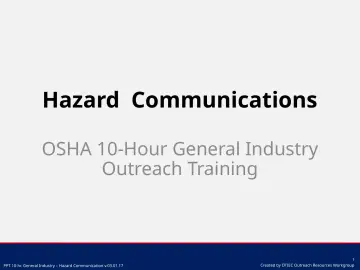
50 slidesHazard Communication (OSHA 10-Hour General Industry Outreach)
OSHA's outreach deck on the Hazard Communication Standard: labels, pictograms, SDSs and training (2017).
U.S. Department of Labor, OSHAPublic domain
pdf
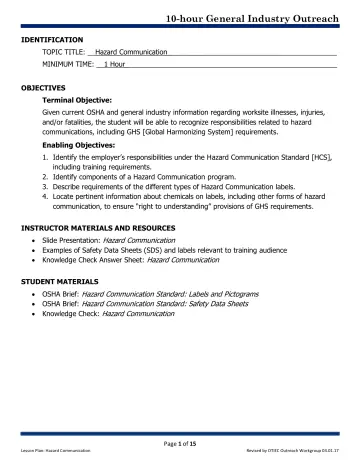
15 slidesHazard Communication: Lesson Plan (OSHA 10-Hour General Industry Outreach)
Instructor lesson plan (objectives, timing, teaching steps) for the OSHA General Industry hazard communication outreach deck.
U.S. Department of Labor, OSHA (with the OTIEC Outreach Workgroup)Public domain
pdf
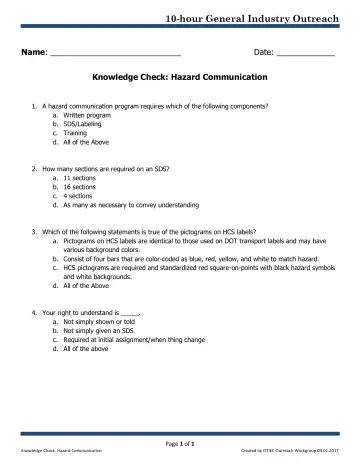
1 slidesHazard Communication: Knowledge Check (OSHA 10-Hour General Industry Outreach)
Student knowledge-check quiz for the OSHA General Industry hazard communication outreach deck.
U.S. Department of Labor, OSHA (with the OTIEC Outreach Workgroup)Public domain