1 / 55Use ← → to flip
Chemical Hazards and the Globally Harmonized System
Chemical hazards and the Globally Harmonized System from the University of Utah (examples drawn from oil and gas work).
Slide text
· 55 slides · by University of Utah
The words on each slide as the author wrote them, read from the file by software so they can be searched. Layout, pictures and tables are not shown here: the slides above and the download are the original.
- Slide 1
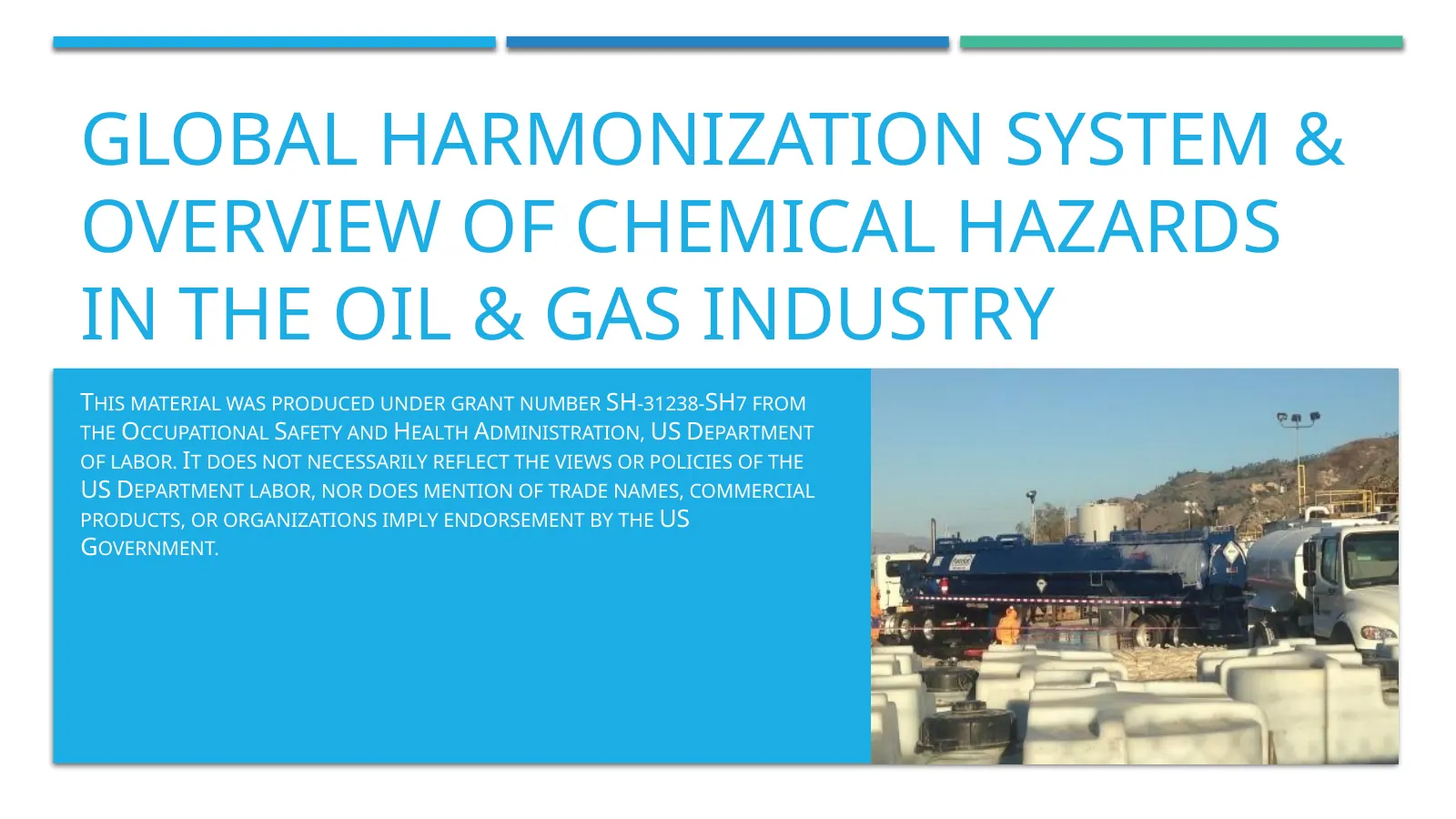
GLOBAL HARMONIZATION SYSTEM & OVERVIEW OF CHEMICAL HAZARDS IN THE OIL & GAS INDUSTRY
- T HIS MATERIAL WAS PRODUCED UNDER GRANT NUMBER SH -31238- SH 7 FROM THE OCCUPATIONAL SAFETY AND HEALTH ADMINISTRATION, US DEPARTMENT OF LABOR. I T DOES NOT NECESSARILY REFLECT THE VIEWS OR POLICIES OF THE US D EPARTMENT LABOR, NOR DOES MENTION OF TRADE NAMES, COMMERCIAL PRODUCTS, OR ORGANIZATIONS IMPLY ENDORSEMENT BY THE US
- G OVERNMENT.
- Slide 2
TRAINING PRE-ASSESSMENT
- How much do you already know about chemical hazards?
- True or False:
- Hazard communication programs tell you about chemical hazards in your workplace.
- Hazard communication only tells you about health hazards for a chemical.
- GHS is a system for classifying & labeling chemicals.
- What are the ways a chemical can enter your body?
- Slide 3
- OVERVIEW OF CHEMICAL HAZARDS
- Slide 4
CHEMICAL HAZARD COMMUNICATION
- Hazcom is a company-specific program
- Tells employees about:
- Workplace chemical hazards in their work areas
- Effects of chemicals
- How to protect yourself
- Source: Globally Harmonized system of Classification and Labelling of Chemicals. Available at: https://en.wikipedia.org/wiki/GHS_hazard_pictograms
- Slide 5
HEALTH HAZARDS
- Any chemical that can do harm to your body
- Most industrial/commercial chemicals can harm you, depends on
- How much gets into your body (dose)
- How the chemical enters the body (pathway)
- Physical form of the chemical (state of matter)
- How toxic the chemical is (poisonous)
- Toxicit y
- Dos e
- Slide 6
HOW CHEMICALS CAN ENTER THE BODY
- Slide 7
CHEMICAL TOXICITY
- Dose
- The seriousness of the effect depends on how much gets into the body
- Acute toxicity
- The chemical causes effects quickly with/after exposure
- Chronic toxicity
- The chemical causes effects after repeated or long-term exposure
- Target
- The chemical can cause effects in the whole body or to a specific organ or system
- Kidney, liver, brain, heart, lungs, & circulatory system
- Slide 8
TYPES OF TOXICITY
- Carcinogen
- Chemicals that are known or suspected to cause cancer
- Mutagenicity
- Chemicals that cause changes in genes
- Can lead to cancer or genetic changes could be passed onto children
- Reproductive toxicity
- Chemicals can affect fertility and/or harm developing babies and can lead to birth defects or death
- Sensitizers
- With repeated exposure smaller amounts can cause a reaction and the reaction can become more serious, possibly producing allergic type reaction
- Target organ toxicity
- Chemical causes damage to a specific organ or system in the body
- Slide 9
Question
- QUESTION / RESPONSE
- / Response 1
- Which of the following does not effect how hazardous a chemical is:
- A. How much gets into your body
- (dose)
- B. How the chemical enters your body (pathway)
- 60%
- 50%
- 50%
- 40%
- 20%
- 0%
- 0%
- 0%
- C. Color of the chemical
- (appearance)
- D. How toxic the chemical is
- (poisonous)
- Slide 10
ANSWER 1
- Slide 11
Can cause burns and/or irritation
- PHYSICAL HAZARDS – CORROSIVES
- Skin
- Eyes
- Lungs & respiratory tract if inhaled
- Seriousness of burn depends on
- Time exposed
- Concentration of chemical
- Can breakdown storage container if stored incorrectly
- Slide 12
PHYSICAL HAZARDS – FLAMMABLES & EXPLOSIVES
- Chemicals that can burn or explode
- Concentration must be in explosive range
- Above the Lower Explosive Limit (LEL — too lean to burn)
- Below the Upper Explosive Limit (UEL — too rich to burn)
- Be aware that in rich atmospheres, incomplete ventilation may result in lowering the flammable concentration to the explosive range
- Explosive Range (5-
- 17%)
- LE UEL
- Non-Explosive
- (too
- lean)
- Non-Explosive (too rich)
- Slide 13
PHYSICAL HAZARDS – OXIDIZERS
- Chemicals that increase flammability or explosiveness of other chemicals
- Produce or release oxygen
- May or may not be flammable/explosive themselves, but greatly accelerate the flammability or explosiveness of another substance
- Ignition
- Oxygen
- Dispersio n
- Confinement
- Fuel
- Slide 14
PHYSICAL FORM OF CHEMICAL
- Effects on health & physical hazards
- How chemical enters body
- How chemical reacts with itself & its surroundings
- Solid
- Can be broken down into dusts
- Can form fumes or fibers when heated or abraded
- Liquid
- Can be broken down into vapors, fogs, and mists
- Gas
- In gaseous state naturally or upon application of heat and/or pressure
- Slide 15
Question / Response 2
- QUESTION / RESPONSE
- 2
- Based on the chart shown for natural gas (methane), will it explode if the concentration in air is 50%?
- 120%
- 1. Yes
- 2. No
- 100%
- 100%
- 80%
- Explosive Range (5-17%)
- 0%
- 60%
- 40%
- Non-Explosive (too rich)
- 100%
- 20%
- 0%
- LEL
- UEL
- Non-Explosive (too lean)
- 0%
- Yes
- No
- Slide 16
ANSWER 2
- Slide 17
- GLOBAL HARMONIZATION SYSTEM
- Slide 18
WHAT IS GHS
- Globally Harmonized System of Classification & Labeling of Chemicals
- Communicates
- Health hazards
- Physical hazards
- Environmental hazards
- Requirements for
- Product label
- Product Safety Data Sheet (SDS)
- Worker training
- Slide 19
PRODUCT LABEL: REQUIRED ELEMENTS
- Name or product identifier
- Signal word
- Danger or Warning
- Hazard statement
- Pictogram(s)
- Precautionary statement
- Contact information of manufacturer
- Name, address, telephone
- Slide 20
SAMPLE LABEL
- Slide 21
PICTOGRAMS
- Slide 22
PICTOGRAMS (CONT.)
- PHYSICAL HAZARDS
- Slide 23
PICTOGRAMS (CONT.)
- Slide 24
PICTOGRAMS (CONT.)
- Slide 25
PICTOGRAMS (CONT.)
- Slide 26
PICTOGRAMS (CONT.)
- Slide 27
PICTOGRAMS (CONT.)
- Slide 28
PICTOGRAMS (CONT.)
- HEALTH HAZARDS
- Slide 29
PICTOGRAMS (CONT.)
- Slide 30
PICTOGRAMS (CONT.)
- Slide 31
PICTOGRAMS (CONT.)
- Slide 32
PICTOGRAMS (CONT.)
- Slide 33
Question / Response 3
- 14
- Which
- of the following pictograms means health hazard?
- 1. A
- 2. B
- 3. C
- 4. D
- 120%
- 100%
- 100%
- 80%
- 60%
- 40%
- 20%
- 0%
- 0%
- 0% 0%
- Slide 34
ANSWER 3
- Slide 35
SIGNAL WORD
- Only one signal word on label
- Picked based upon the most serious hazard
- Danger
- More serious hazards
- Warning
- Less serious hazards
- Slide 36
Hazard Statement(s)
- STATEMENTS
- Type of hazard from chemical
- Level of hazard
- Precautionary Statement(s)
- Prevention
- Ways to minimize exposure
- Ways to minimize hazards
- Response
- Spills, first-aid
- Storage
- Disposal
- Slide 37
PRODUCT SAFETY DATA SHEETS (SDS) REQUIRED & OPTIONAL SECTIONS
- 1. Identification
- 9. Physical & chemical properties
- 2. Hazard identification
- 10. Stability & reactivity
- 3. Information on ingredients
- 4. First-aid measures
- 5. Fire-fighting measures
- 6. Accidental release measures
- 7. Handling & storage
- 8. Exposure controls/Personal protection
- 11. Toxicological information
- 12. Ecological information (Optional)
- 13. Disposal considerations
- (Optional)
- 14. Transport information (Optional)
- 15. Regulatory information
- (Optional)
- 16. Other information
- Slide 38
HOW CAN YOU USE AN SDS?
- Ingredients: Section 3
- What chemicals are in the product
- How much of each chemical is there
- Chemical Hazards: Section 2
- Hazards associated with the chemical(s)
- Safe Handling of Chemicals: Sections 7-8
- What Personal Protective Equipment (PPE) you should wear
- Other instructions on how to protect yourself
- Slide 39
QUESTION
- Which of the following pieces of information are found in an SDS?
- A. Ingredients
- B. Chemical hazards
- C. Safe handling of chemicals
- D. First-aid measures
- E. All of the above
- Slide 40
QUESTION / Question
- RESPONSE 4
- / Response 4
- Which of the following pieces of information are found in an 60% 50%
- SDS?
- 50%
- A. Ingredients
- B. Chemical hazards
- 40%
- C. Safe handling of chemicals
- 20%
- D. First-aid measures
- 0%
- 0%
- 0%
- 0%
- E. All of the above
- Slide 41
ANSWER 4
- Slide 42
- CHEMICAL HAZARDS & GHS IN OIL & GAS
- Slide 43
TYPES OF HAZARDOUS CHEMICALS IN OIL & GAS
- Acids
- Volatile Organic Carbons (VOCs)
- Condensate, produced water, benzene
- Toxic Gases
- Hydrogen sulfide
- Naturally Occurring Radioactive Material (NORM)
- Other Chemicals
- Silica
- Methanol
- Glycols (ethylene glycol, triethylene glycol)
- Heavy metals
- Slide 44
ACIDS
- Corrosive/caustic chemicals
- Irritants
- Ways to protect yourself
- Skin protection – gloves & protective clothing
- Eye protection – goggles or face shield
- Example:
- Hydrochloric Acid (HCl)
- Slide 45
VOLATILE ORGANIC COMPOUNDS (VOCS)
- Usually are flammable
- Can cause acute and chronic health effects
- Ways to protect yourself
- Skin protection – gloves & protective clothing
- Eye protection – goggles or face shield
- Respiratory protection – ventilation &/or respirator (chemical specific)
- Examples:
- Produced water
- BTEX: benzene, toluene, ethylbenzene, xylene
- Petroleum distillates & condensate
- Petrochemicals
- Slide 46
TOXIC GASES
- Can be flammable
- Can cause acute health effects
- Ways to protect yourself
- Monitor for gas (multi-gas meter)
- Ventilate area
- Respiratory protection – chemical specific respirator
- Example:
- Hydrogen sulfide (sour gas) or benzene (sweet gas)
- Slide 47
NATURALLY OCCURRING RADIOACTIVE MATERIAL (NORM)
- Potential for carcinogenic health effects
- Inhaled or ingested particles
- Can be released from oil & gas formations
- At-risk activities:
- Handling pipes or equipment contaminated with sludge, drilling mud, and pipe scale
- Cutting and reaming oilfield pipe
- Removing solids from tanks and pits
- Refurbishing gas processing equipment
- Slide 48
OTHER CHEMICALS – SILICA
- Health hazards
- Cancer, lung, and kidney damage
- Ways to protect yourself
- Ventilate area
- Respiratory protection – respirator (high efficiency particulate)
- Slide 49
OTHER CHEMICALS: HEAVY METALS
- Can be flammable in some forms
- Can cause acute & chronic health effects
- Ways to protect yourself
- Respiratory protection – ventilation &/or respirator (high efficiency dust, fume, mist)
- Practice good hygiene – wash hands & face before eating or drinking
- Examples:
- Barium
- Cadmium
- Chromium
- Lead
- Mercury
- Slide 50
OTHER CHEMICALS: METHANOL & GLYCOLS
- Can be flammable
- Can cause acute and chronic health effects
- Ways to protect yourself
- Skin protection – gloves & protective clothing
- Eye protection – goggles or face shield
- Respiratory protection – ventilation &/or respirator (chemical specific)
- Slide 51
Question Response 5
- QUESTION / RESPONSE 5
- You are working around a new chemical that can be inhaled. Which of the following pictograms would make you think about using a respirator?
- 120%
- 1. A
- 2. B
- 100%
- 100%
- 80%
- 60%
- 3. C
- 40%
- 4. D
- 20%
- 0%
- 0%
- 0% 0%
- Slide 52
ANSWER 5
- Slide 53
- QUESTIONS?
- Slide 54
REFERENCES & RESOURCES
- Oil & Gas Industry:
- OSHA. Oil and Gas Extraction. Accessed November 2017. Available at: https:/
- /www.osha.gov/SLTC/oilgaswelldrilling/index.html
- OSHA. Oil and Gas Well Drilling, Servicing and Storage—Storage Tanks. Accessed November 2017. Available at: https://www.osha.gov/SLTC/storagetank/index.html
- GHS:
- UNECE. Globally harmonized System of Classification and Labelling of
- Chemicals (GHS). Seventh revised edition. Accessed November 2017. Available at: https://pubchem.ncbi.nlm.nih.gov/ghs/
- OSHA. Hazard Communication. Accessed November 2017. Available at: https ://www.osha.gov/SLTC/oilgaswelldrilling/safetyhazards.html
- Slide 55
TRAINING POST-ASSESSMENT
- How much do you already know about chemical hazards?
- True or False:
- Hazard communication programs tell you about chemical hazards in your workplace.
- Hazard communication only tells about health hazards for a chemical.
- GHS is a system for classifying & labeling chemicals.
- What are the ways a chemical can enter your body?
More on HazCom
pptx
50 slidesHazard Communication (OSHA 10-Hour General Industry Outreach)
OSHA's outreach deck on the Hazard Communication Standard: labels, pictograms, SDSs and training (2017).
U.S. Department of Labor, OSHAPublic domain
pdf
15 slidesHazard Communication: Lesson Plan (OSHA 10-Hour General Industry Outreach)
Instructor lesson plan (objectives, timing, teaching steps) for the OSHA General Industry hazard communication outreach deck.
U.S. Department of Labor, OSHA (with the OTIEC Outreach Workgroup)Public domain
pdf
1 slidesHazard Communication: Knowledge Check (OSHA 10-Hour General Industry Outreach)
Student knowledge-check quiz for the OSHA General Industry hazard communication outreach deck.
U.S. Department of Labor, OSHA (with the OTIEC Outreach Workgroup)Public domain