OSHA card or poster, for General Industry classes.
Page text
· 2 pages · by U.S. Department of Labor, OSHA
The words on each page as the author wrote them, read from the file by software so they can be searched. Layout, pictures and tables are not shown here: the pages above and the download are the original.
- Page 1
QUICK CARD
- TM
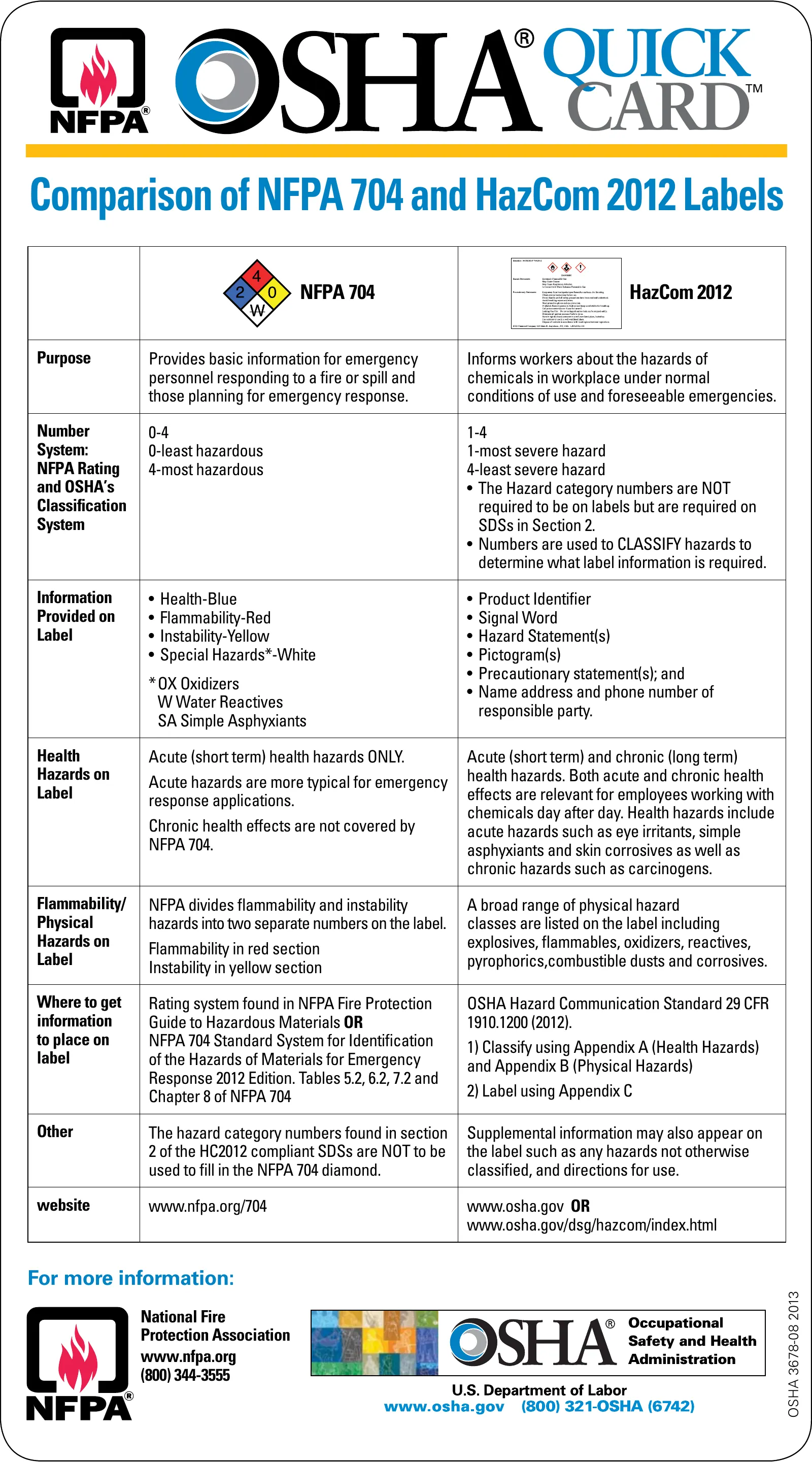
- Comparison of NFPA 704 and HazCom 2012 Labels
- NFPA 704
- HazCom 2012
- Purpose
- Provides basic information for emergency personnel responding to a fire or spill and those planning for emergency response.
- Informs workers about the hazards of chemicals in workplace under normal conditions of use and foreseeable emergencies.
- Number System: NFPA Rating and OSHA’s Classification System
- 0-4
- 0-least hazardous 4-most hazardous
- 1-4
- 1-most severe hazard 4-least severe hazard
- • The Hazard category numbers are NOT required to be on labels but are required on SDSs in Section 2.
- • Numbers are used to CLASSIFY hazards to determine what label information is required.
- Information Provided on Label
- • Health-Blue
- • Flammability-Red
- • Instability-Yellow
- • Special Hazards*-White
- • Product Identifier
- • Signal Word
- • Hazard Statement(s)
- • Pictogram(s)
- • Precautionary statement(s); and
- • Name address and phone number of responsible party.
- OX Oxidizers
- W Water Reactives
- SA Simple Asphyxiants
- Health
- Hazards on Label
- Acute (short term) health hazards ONLY.
- Acute hazards are more typical for emergency response applications.
- Chronic health effects are not covered by NFPA 704.
- Acute (short term) and chronic (long term) health hazards. Both acute and chronic health effects are relevant for employees working with chemicals day after day. Health hazards include acute hazards such as eye irritants, simple asphyxiants and skin corrosives as well as chronic hazards such as carcinogens.
- Flammability/
- Physical
- NFPA divides flammability and instability hazards into two separate numbers on the label.
- Flammability in red section
- Instability in yellow section
- A broad range of physical hazard classes are listed on the label including explosives, flammables, oxidizers, reactives, pyrophorics,combustible dusts and corrosives.
- Where to get information to place on label
- Rating system found in NFPA Fire Protection Guide to Hazardous Materials OR
- NFPA 704 Standard System for Identification of the Hazards of Materials for Emergency Response 2012 Edition. Tables 5.2, 6.2, 7.2 and Chapter 8 of NFPA 704
- OSHA Hazard Communication Standard 29 CFR 1910.1200 (2012).
- 1) Classify using Appendix A (Health Hazards) and Appendix B (Physical Hazards)
- 2) Label using Appendix C
- Other
- The hazard category numbers found in section 2 of the HC2012 compliant SDSs are NOT to be used to fill in the NFPA 704 diamond.
- Supplemental information may also appear on the label such as any hazards not otherwise classified, and directions for use.
- website
- www.nfpa.org/704
- www.osha.gov OR www.osha.gov/dsg/hazcom/index.html
- National Fire
- Protection Association www.nfpa.org
- (800) 344-3555
- OSHA 3678-08 2013
- For more information:
- Page 2
QUICK CARD
- TM
- The substance: “NOMIXUP 7042012”
- To create an OSHA label per HazCom 2012:
- Step 1: Perform the classification in accordance with Appendix A: Health Hazards & Appendix B Physical Hazards of 29 CFR 1910.1200 — this is where you find the criteria for each hazard class and hazard category.
- Class: Flammable Gas, Category 1
- Class: Carcinogen, Category 1B
- Class: Specific Target Organ Toxicity
- (Single Exposure), Category 3
- Class: Substances and Mixtures
- Which, in Contact with Water, Emit
- Flammable Gases, Category 3
- Step 2: Gather labeling information
- (Pictograms, Signal Word, Hazard
- Statements) from Appendix C of 29
- CFR 1910.1200 based on the chemical’s hazard class and category.
- Step 3: Create the Label
- To Create NFPA 704 label:
- Step 1: Collect information on hazards from applicable sections of SDS. Some SDSs may provide the NFPA diamond symbol with hazard rating numbers filled in already. Note: Do NOT use the hazard category numbers given in section 2 of HazCom 2012 compliant SDS on 704 label!
- If the diamond is not provided on the SDS you can obtain the information under the following sections of the SDS. Note that additional information may be provided in other sections of the SDS.
- Health hazard information under Section 11
- Flammability information under Section 9
- Instability information under Section 10
- Special information under Section 9, 10, 11
- Step 2: Obtain current edition copy of NFPA 704 or view on line at www.nfpa.org/704.Compare the criteria on the SDS sections as shown above with the criteria shown in Tables 5.2 (Health), 6.2 (Flammability), 7.2 (Instability) and 8.2 (Special Hazards).
- Step 3: Place numbers for the degree of hazard associated with the criteria obtained in Step 2 in the correct quadrant of NFPA 704 placard.
- National Fire
- Protection Association www.nfpa.org
- (800) 344-3555
- OSHA 3678-08 2013
- For more information: