1 / 48Use ← → to flip
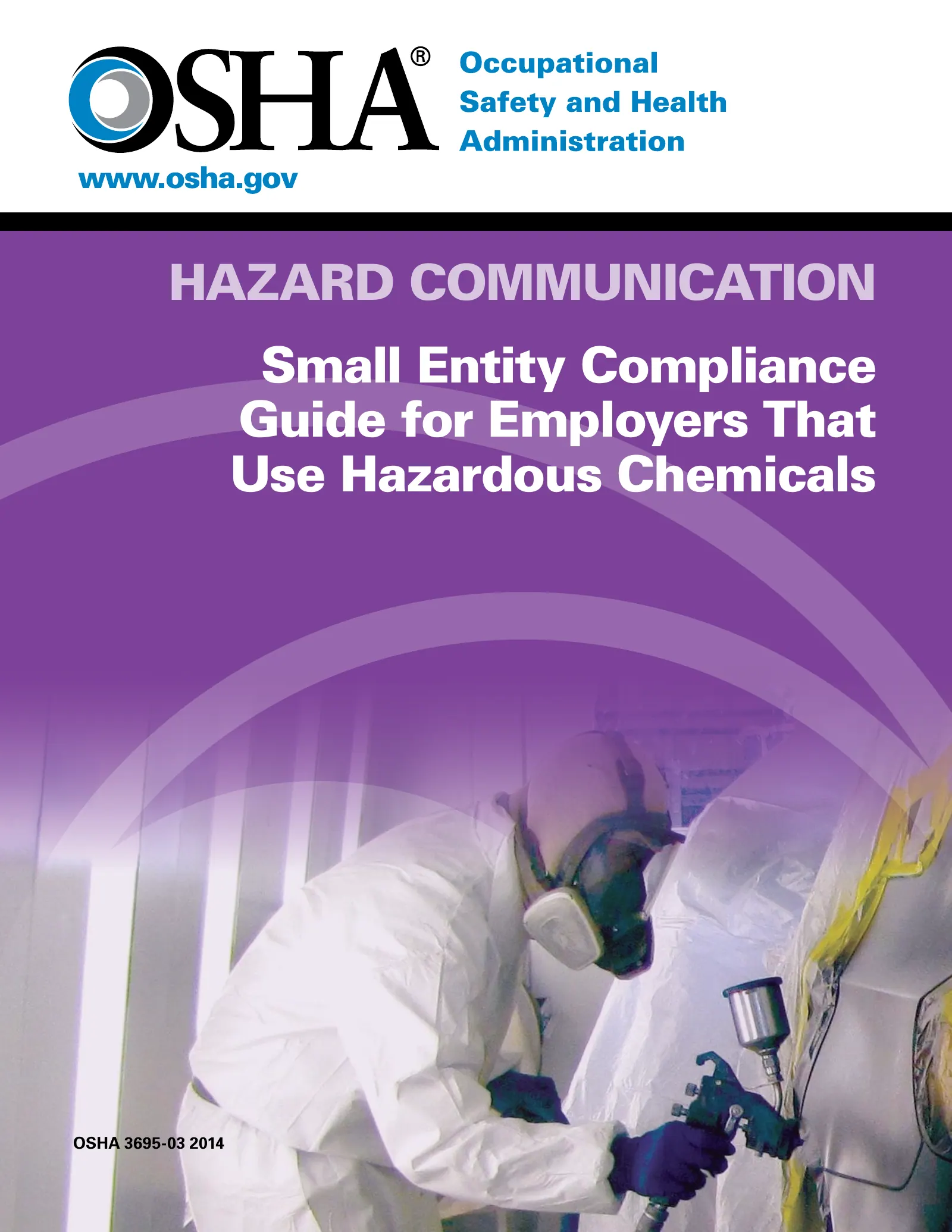
Hazard Communication: Small Entity Compliance Guide for Employers That Use Hazardous Chemicals (OSHA 3695)
OSHA booklet, for General Industry classes.
Page text
· 46 of 48 pages · by U.S. Department of Labor, OSHA
The words on each page as the author wrote them, read from the file by software so they can be searched. Layout, pictures and tables are not shown here, and long pages are shortened: the pages above and the download are the original.
- Page 1
HAZARD COMMUNICATION
- Small Entity Compliance Guide for Employers That Use Hazardous Chemicals
- OSHA 3695-03 2014
- Page 2
Occupational Safety and Health Act of 1970
- “To assure safe and healthful working conditions for working men and women; by authorizing enforcement of the standards developed under the Act; by assisting and encouraging the States in their efforts to assure safe and healthful working conditions; by providing for research, information, education, and training in the field of occupational safety and health.”
- Material contained in this publication is in the public domain and may be reproduced, fully or partially, without permission. Source credit is requested but not required.
- …
- Page 3
HAZARD COMMUNICATION Small Entity Compliance Guide for Employers That Use Hazardous Chemicals
- Occupational Safety and Health Administration
- U.S. Department of Labor
- OSHA 3695-03 2014
- Page 5
TABLE OF CONTENTS
- I.
- Introduction … 1
- II. Steps to an Effective Hazard Communication Program … 7
- 1. Learn the Standard/Identify Responsible Staff … 9
- 2. Prepare and Implement a Written Hazard Communication Program … 11
- 3. Ensure Containers are Labeled … 14
- 4. Maintain Safety Data Sheets … 20
- 5. Inform and Train Employees … 25
- 6. Evaluate and Reassess Your Program … 28
- III. Conclusion … 29
- Appendix A: Sample Written Hazard Communication Program … 30
- Appendix B: Quick Guide to Hazard Communication Training … 33
- Workers’ Rights … 36
- OSHA Assistance, Services and Programs … 36
- NIOSH Health Hazard Evaluation Program … 38
- OSHA Regional Offices … 39
- …
- Page 6
- vi
- Page 7
I. INTRODUCTION
- Chemicals have become an important element of almost every aspect of modern life. All of these chemicals—from cleaning fluids to pharmaceuticals, pesticides, and paints—are produced in workplaces, and may be used in workplaces downstream. While these chemicals have utility and benefits in their applications, they also have the potential to cause adverse effects. These adverse effects include both health hazards (such as carcinogenicity and sensitization), and physical hazards (for example, flammability and reactivity properties). …
- …
- Page 8
- The revised Hazard Communication Standard is expected to build on the success of the original Hazard Communication Standard and prevent an estimated additional 585 injuries and illnesses and
- 43 fatalities annually. It will reduce trade barriers and result in estimated annualized benefits in productivity improvements for American businesses that regularly handle, store and use hazardous chemicals, as well as cost savings for American businesses when revising safety data sheets and labels for chemicals covered under the standard.
- In 2012, the HCS was modified to align its provisions with the United Nations’ Globally Harmonized System of…
- …
- Page 9
Figure 1: How Hazard Communication Works
- “Employee” means a worker who may be exposed to hazardous chemicals under normal operating conditions or in foreseeable emergencies. Workers such as office workers or bank tellers who encounter hazardous chemicals only in non-routine, isolated instances are not covered.
- “Exposure or exposed” means that an employee is subjected, in the course of employment, to a chemical that is a physical or health hazard, and includes potential (e.g., accidental or possible) exposure. “Subjected” in terms of health hazards includes any route of entry (e.g., inhalation, ingestion, skin contact or absorption.)
- …
- Page 10
Organization of the Regulatory Requirements for Hazard Communication
- In order to understand the requirements of HazCom 2012 as applied to your workplace, it is useful to have a general familiarity with the organization of the standard. It is divided into regulatory paragraphs that describe requirements, which are further supplemented by appendices that contain specific details.
- Paragraphs
- of the Standard
- Appendices
- to the Standard
- (a) Purpose
- Appendix A, Health
- Hazard Criteria
- (Mandatory)
- (b) Scope and Application
- (c) Definitions
- (d) Hazard Classification
- (e) Written Hazard
- Communication Program
- (f) Labels and Other
- Forms of Warning
- …
- Page 11
- HazCom 2012 refers to each of the defined hazards as a “hazard class.” Most of these hazard classes are subsequently divided into one or more “hazard category(ies).” This classification is done by the chemical manufacturer or importer, and is based on the severity of the effect, and the type of data available to indicate each effect. This is important to employers because it leads directly to the information that is subsequently provided on labels and SDSs for the chemical. For example, there are four categories in the hazard class for flammable liquids. …
- …
- Page 12
HazCom 2012 – Complete Schedule of Effective Dates
- Effective Completion Date
- Requirement(s)
- Who
- December 1, 2013
- Train employees on the new label elements and SDS format.
- Employers
- June 1, 2015
- Comply with all modified provisions of HazCom 2012, except:
- Chemical manufacturers, importers, distributors and employers
- December 1, 2015
- Distributors may ship products labeled by the manufacturer or importer under the old system until December 1, 2015.
- June 1, 2016
- Update alternative workplace labeling and hazard communication program as necessary, and provide additional employee training for newly-identified physical or health hazards.
- Employers
- …
- Page 13
II. STEPS TO AN EFFECTIVE HAZARD COMMUNICATION PROGRAM
- All workplaces where workers are exposed to hazardous chemicals must have a written hazard communication program that describes how the HazCom standard is implemented in that facility. When hazard communication is implemented effectively, it has significant benefits for both the employer and the workers in a workplace. Employers need the information provided to them in order to assess the safety and health aspects of their workplace appropriately, and to select needed control measures for the chemicals that are present. …
- …
- Page 14
Figure 2: Six Steps to an Effective Hazard Communication Program
- Obtain a copy of OSHA’s Hazard Communication Standard.
- 1. Learn the Standard/Identify Responsible Staff
- Become familiar with its provisions.
- Make sure that someone has primary responsibility for coordinating implementation.
- Identify staff for particular activities (e.g., training).
- 2. Prepare and Implement a Written Hazard Communication Program
- Prepare a written plan to indicate how hazard communication will be addressed in your facility.
- 3. Ensure Containers are Labeled
- Keep labels on shipped containers.
- 4. Maintain Safety
- Data Sheets
- 5. Inform and Train
- Employees
- …
- Page 15
- Obtain a copy of OSHA’s Hazard Communication Standard.
- 1. Learn the Standard/Identify Responsible Staff
- Become familiar with its provisions.
- Make sure that someone has primary responsibility for coordinating implementation.
- Identify staff for particular activities (e.g., training).
- You are already on your way to accomplishing Step 1 by reading this guide. It is always best to review the actual provisions of the standard to ensure you are in full compliance. OSHA provides online access to the standard, as well as guidance, interpretations, and other relevant materials on its hazard communication web page: www.osha.gov/dsg/hazcom. …
- …
- Page 16
- for on-the-job training sessions. Early identification of the responsible workers, and their involvement in the development of your plan of action, will result in a more effective program design.
- In order to ensure you have an effective program and address all of the necessary components, responsibility for implementation of hazard communication should be assigned to someone to coordinate. While different people may be responsible for certain parts of implementation, there should nevertheless
- be someone who has overall responsibility. Approaching compliance consistently, and comprehensively, is the key to success.
- …
- Page 17
2. Prepare and Implement a Written Hazard Communication Program
- Prepare a written plan to indicate how hazard communication will be addressed in your facility.
- Prepare a list or inventory of all hazardous chemicals in the workplace.
- Paragraph (e), Written Hazard Communication Program, requires employers to prepare and implement a written hazard communication program. This does not need to be lengthy or complicated. The main intent of the requirement is to help ensure that compliance with the standard is done in a systematic way and that all elements are coordinated. …
- …
- Page 18
- the factors that determine whether a chemical is covered. If the chemical is not hazardous, it is not covered by the standard. If there is no potential for exposure (e.g., the chemical is inextricably bound and cannot be released), the chemical is not covered by the standard.
- Look around. Identify chemicals in containers, including pipes, but also think about chemicals that are generated during work operations. For example, welding fumes, dusts, and exhaust fumes are all sources of chemical exposures. Read the labels provided by suppliers for hazard information. Make a list of all chemicals in the workplace that are potentially hazardous. …
- …
- Page 19
- In summary, if you are not a new employer, you should already have a written hazard communication program for your workplace. Review your written program to ensure that it is consistent with the HazCom 2012 requirements. It may need to be updated; for example, you may have to add or delete chemicals from the list in the program, or change your description of the approach to workplace labeling.
- If your workers’ job assignment requires travel between various geographical locations, you may keep the written program at the primary work location.
- Many trade associations and other professional groups have provided sample programs and other assistance…
- …
- Page 20
3. Ensure Containers are Labeled
- Keep labels on shipped containers.
- Label workplace containers where required.
- Labels are the first part (paragraph (f) Labels and Other Forms of Warning) of the three-part approach to communicating information downstream mentioned earlier. A label must be on the immediate container of every hazardous chemical. The label is an immediate type of warning since it is present in the work area, right on the actual container of a hazardous chemical. It is a snapshot of the hazards and protective information related to the chemical, and a summary of the more detailed information available on the SDS.
- …
- Page 21
- The hazard statement(s) for a hazardous chemical describe the hazard(s) in text, in a simple, direct manner. There is a hazard statement for each hazard category of a hazard class, and it will vary depending on the degree of hazard. The example presented above is a hazard statement for acute oral toxicity. The hazard statement conveys that the chemical is severely toxic, and ingestion of the chemical results in death. …
- …
- Page 22
Figure 3: HazCom 2012 Pictograms
- Page 23
Figure 4: Examples of Transport Pictograms
- Page 24
- A precautionary statement is a phrase that describes recommended measures that should be taken to minimize or prevent adverse effects resulting from exposure to a hazardous chemical, or improper storage or handling. Example: Do not eat, drink, or smoke when using this product.
- Precautionary statements are key to helping you decide what you need to do to protect workers and your workplace. There are four types of statements: Prevention, Response, Storage, and Disposal. These have been assigned to hazard classes and categories.
- Therefore, a compliant HazCom 2012 label on a shipped container will have at least the following information as shown in…
- …
- Page 25
- Some employers use third-party workplace label systems, such as those that have numerical ratings to indicate the hazards (e.g., National
- Fire Protection Association (NFPA) or Hazardous Materials Identification System (HMIS)). These may be used in conjunction with the supplemental information on the label to ensure that workers have complete information, as long as the ratings are consistent with the hazard definitions in HazCom 2012, i.e., the criteria used to assign the numerical ratings reflects the hazard categories in each hazard class in HazCom 2012. …
- …
- Page 26
4. Maintain Safety
- Data Sheets
- Maintain safety data sheets for each hazardous chemical in the workplace.
- Ensure that safety data sheets are readily accessible to employees.
- The second part in the approach to communicating information in HazCom 2012 is to maintain
- SDSs (paragraph (g) Safety Data Sheets and Mandatory Appendix D). The SDSs are the source of detailed information on hazardous chemicals. This includes information for many different audiences—employers, workers, safety and health professionals, emergency responders, government agencies, and consumers. …
- …
- Page 27
- distributors are responsible for ensuring that their customers are provided a copy of these SDSs, at the time of the first shipment, and when an SDS is updated with new and significant information. Employers must have an SDS for each hazardous chemical which they use. Employers may rely on the information received from their suppliers unless they know the information is incorrect.
- If you do not receive an SDS automatically, you must request one as soon as possible. If you receive an SDS that is obviously inadequate, with, for example, blank spaces, you must request an appropriately completed one. …
- …
- Page 28
Minimum Information for an SDS
- Heading
- Subheading
- 1. I dentification
- (a) Product identifier used on the label;
- (b) Other means of identification;
- (c) Recommended use of the chemical and restrictions on use;
- (d) Name, address, and telephone number of the chemical manufacturer, importer, or other responsible party;
- (e) Emergency phone number.
- 2. H
- azard(s) identification
- (a) Classification of the chemical in accordance with paragraph (d) of §1910.1200;
- (b) Signal word, hazard statement(s), symbol(s) and precautionary statement(s) in accord with paragraph (f) of §1910.1200. …
- …
- Page 29
Heading
- Subheading
- 4. F
- irst-aid measures
- (a) Description of necessary measures, subdivided according to the different routes of exposure, i.e., inhalation, skin and eye contact, and ingestion;
- (b) Most important symptoms/effects, acute and delayed;
- (c) Indication of immediate medical attention and special treatment needed, if necessary.
- 5. F irefighting measures
- (a) Suitable (and unsuitable) extinguishing media;
- (b) Specific hazards arising from the chemical (e.g., nature of any hazardous combustion products);
- (c) Special protective equipment and precautions for firefighters.
- 6. A ccidental release measures
- …
- Page 30
Heading
- Subheading
- 10. Stability and reactivity
- (a) Reactivity;
- (b) Chemical stability;
- (c) Possibility of hazardous reactions;
- (d) Conditions to avoid (e.g., static discharge, shock, or vibration);
- (e) Incompatible materials;
- (f) Hazardous decomposition products.
- 11. Toxicological information
- Description of the various toxicological (health) effects and the available data used to identify those effects, including:
- (a) Information on the likely routes of exposure (inhalation, ingestion, skin and eye contact);
- (b) Symptoms related to the physical, chemical and toxicological characteristics;
- …
- Page 31
5. Inform and Train
- Employees
- Train employees on the hazardous chemicals in their work area before initial assignment, and when new hazards are introduced.
- Include the requirements of the standard, hazards of chemicals, appropriate protective measures, and where and how to obtain additional information.
- The third part of the hazard communication approach in HazCom 2012 is employee information and training (paragraph (h) Employee Information and Training). The key requirement is in paragraph (h)(1):
- (h)(1) Employers shall provide employees with effective information and training on hazardous chemicals in their work area at the time of their…
- …
- Page 32
- exposure to hazardous chemicals, such as appropriate work practices, emergency procedures, and personal protective equipment to be used; and,
- The details of the hazard communication program developed by the employer, including an explanation of the labels received on shipped containers and the workplace labeling system used by their employer; the SDS, including the format of the SDS (where each type of information is located) and how employees can obtain and use the appropriate hazard information.
- A properly conducted training program will ensure worker comprehension and understanding. It is not sufficient to either just read material to the…
- …
- Page 33
- The standard does not require employers to maintain records of employee training, but many employers choose to do so. This may help you monitor your own program to ensure that all workers are appropriately trained. Keeping records that document who was trained, when the training was conducted, and what was covered is also helpful to document compliance with OSHA’s training requirement in case of an inspection. The standard does not require retraining on a regular schedule, it simply requires retraining if there is a new chemical hazard introduced into the work area. …
- …
- Page 34
6. Evaluate and Reassess Your Program
- Review your hazard communication program periodically to make sure that it is still working and meeting its objectives.
- Revise your program as appropriate to address changed conditions in the workplace (e.g., new chemicals, new hazards, etc.).
- Because your hazard communication program must remain up to date, it will be necessary to periodically evaluate and reassess your program.
- The information in your written program must be accurate. The list of hazardous chemicals required to be maintained as part of the written program will serve as an inventory. As new chemicals are purchased, the list must be updated. …
- …
- Page 35
III. CONCLUSION
- OSHA believes that the Hazard Communication Standard is of critical importance to ensuring that hazardous chemicals are identified, and that proper measures are implemented in workplaces to achieve safe use and handling. By understanding the hazards of the chemicals, and using available information to pick the proper control measures to address these hazards, employers can achieve many benefits for themselves, as well as for their exposed workers. HazCom 2012 provides the framework for building a chemical safety and health management program in a workplace. …
- …
- Page 36
APPENDIX A: SAMPLE WRITTEN HAZARD COMMUNICATION PROGRAM
- The following sample hazard communication program is based on the requirements of the Hazard Communication Standard (HazCom 2012), 29 CFR 1910.1200. The intent of this sample is to provide an easy-to-use format that can be modified to address the specific situation in your workplace. You are free to use whatever format you choose to develop your program—there is no requirement to follow this example. However, if you use this or any other sample program, you must customize it to your specific workplace, otherwise you will not be in compliance with the HCS.
- HAZARD COMMUNICATION PROGRAM
- …
- Page 37
- SDSs will be readily available to all workers in each work area during each work shift. If an SDS is not available, contact (name of responsible person and/ or position).
- the company is taking to reduce the hazards, including ventilation, respirators, the presence of another worker (buddy systems), and emergency procedures.
- When revised SDSs are received, the following procedures will be followed to replace old SDSs:
- 6. Informing Other Employers/Contractors
- (Describe procedures)
- The (name of responsible person and/or position) is responsible for reviewing the SDSs received for safety and health implications, and initiating any needed changes in…
- …
- Page 38
(Identify procedures to be followed)
- The hazardous chemical inventory is compiled and maintained by (Name of responsible person and/ or position and telephone number).
- areas, the worker shall be informed by (Name of responsible person and/or position) about the identity and hazards of the chemicals in the pipe, as well as required precautionary measures required to be followed.
- 8. Chemicals in Unlabeled Pipes
- 9. Program Availability
- Work activities may be performed by workers in areas where chemicals are transferred through unlabeled pipes. Prior to starting work in these
- …
- Page 39
APPENDIX B: QUICK GUIDE TO HAZARD COMMUNICATION TRAINING
- The Hazard Communication Standard (HCS) (29 CFR 1910.1200) requires employers that have hazardous chemicals in their workplaces to implement a hazard communication program.
- The program includes information about labels on containers, safety data sheets (SDSs), and training for workers. Each employer must describe in a written program how it will meet the requirements of the HCS in each of these areas.
- For employers that use chemicals, rather than produce them, labels and SDSs are received with the products they purchase. …
- …
- Page 40
Training Step
- Factors to Consider
- Identifying goals and objectives
- Compliance with the requirements of the Hazard Communication Standard is a primary goal. Compliance will promote a safer workplace by ensuring that the potential hazards of chemicals are known both to you and to your workers. In addition, the measures to follow to prevent adverse health or physical effects resulting from chemical exposures should be familiar to everyone in the workplace. Preparing for the training gives you an opportunity to review the hazards of the chemicals you have in the workplace, and to consider substituting less hazardous chemicals where appropriate. …
- …
- Page 41
Training Step
- Factors to Consider
- Conducting the training
- Preparation: In order to train workers under the Hazard Communication Standard, the trainer must be familiar with:
- the requirements of the standard that apply to the workplace;
- the hazardous chemicals in the workplace to which workers are potentially exposed, as well as the types of hazards they pose;
- the hazard communication program implemented in the workplace; and
- the protective measures being employed in the workplace to prevent adverse effects from occurring.
- In addition to being thoroughly familiar with the material to be covered in the training, the trainer must be aware of the…
- …
- Page 42
WORKERS’ RIGHTS
- Under OSHA law, workers are entitled to working conditions that do not pose a risk of serious harm. To help assure a safe and healthful workplace, the law provides workers with the right to:
- File a confidential complaint with OSHA to have their workplace inspected.
- Receive information and training about hazards, methods to prevent harm, and the OSHA standards that apply to their workplace. The training must be done in a language and vocabulary workers can understand.
- Receive copies of records of work-related injuries and illnesses that occur in their workplace.
- …
- Page 43
Free On-site Safety and Health
- Consultation Services for Small Business
- OSHA’s On-site Consultation Program offers free and confidential advice to small and medium-sized businesses in all states across the country, with priority given to high-hazard worksites. Each year, responding to requests from small employers looking to create or improve their safety and health management programs, OSHA’s On-site Consultation Program conducts over 29,000 visits to small business worksites covering over 1.5 million workers across the nation.
- On-site consultation services are separate from enforcement and do not result in penalties or citations. …
- …
- Page 44
NIOSH HEALTH HAZARD EVALUATION PROGRAM
- OSHA Educational Materials
- OSHA has many types of educational materials in English, Spanish, Vietnamese and other languages available in print or online. These include:
- Brochures/booklets that cover a wide variety of job hazards and other topics;
- Fact Sheets, which contain basic background information on safety and health hazards;
- Guidance documents that provide detailed examinations of specific safety and health issues;
- Online Safety and Health Topics pages;
- Posters;
- Small, laminated QuickCards™ that provide brief safety and health information; and
- …
- Page 45
OSHA REGIONAL OFFICES
- Region I
- Boston Regional Office
- (CT*, ME, MA, NH, RI, VT*)
- JFK Federal Building, Room E340 Boston, MA 02203
- (617) 565-9860 (617) 565-9827 Fax
- Region II
- New York Regional Office
- (NJ*, NY*, PR*, VI*)
- 201 Varick Street, Room 670
- New York, NY 10014
- (212) 337-2378 (212) 337-2371 Fax
- Region III
- Philadelphia Regional Office
- (DE, DC, MD*, PA, VA*, WV)
- The Curtis Center
- 170 S. Independence Mall West
- Suite 740 West
- Philadelphia, PA 19106-3309
- (215) 861-4900 (215) 861-4904 Fax
- Region IV
- Atlanta Regional Office
- (AL, FL, GA, KY*, MS, NC*, SC*, TN*)
- 61 Forsyth Street, SW, Room 6T50
- Atlanta, GA 30303
- (678) 237-0400 (678) 237-0447 Fax
- …
- Page 46
HOW TO CONTACT OSHA
- For questions or to get information or advice, to report an emergency, report a fatality or catastrophe, order publications, sign up for OSHA’s e-newsletter QuickTakes , or to file a confidential complaint, contact your nearest
- OSHA office, visit www.osha.gov or call OSHA at 1-800-321-OSHA (6742), TTY 1-877-889-5627.
- For assistance, contact us. We are OSHA. We can help.
- Page 48
- The hazardous chemical inventory is compiled and maintained by (Name of responsible person and/or position and telephone number).
- 8. Chemicals in Unlabeled Pipes
- Work activities may be performed by workers in areas where chemicals are transferred through unlabeled pipes. Prior to starting work in these areas, the worker shall be informed by (Name of responsible person and/or position) about the identity and hazards of the chemicals in the pipe, as well as required precautionary measures required to be followed.
- 9. Program Availability
- A copy of this program will be made available, upon request, to workers, their designated representatives, and…
- …
More on HazCom
pptx
50 slidesHazard Communication (OSHA 10-Hour General Industry Outreach)
OSHA's outreach deck on the Hazard Communication Standard: labels, pictograms, SDSs and training (2017).
U.S. Department of Labor, OSHAPublic domain
pdf
15 slidesHazard Communication: Lesson Plan (OSHA 10-Hour General Industry Outreach)
Instructor lesson plan (objectives, timing, teaching steps) for the OSHA General Industry hazard communication outreach deck.
U.S. Department of Labor, OSHA (with the OTIEC Outreach Workgroup)Public domain
pdf
1 slidesHazard Communication: Knowledge Check (OSHA 10-Hour General Industry Outreach)
Student knowledge-check quiz for the OSHA General Industry hazard communication outreach deck.
U.S. Department of Labor, OSHA (with the OTIEC Outreach Workgroup)Public domain