1 / 75Use ← → to flip
Improving Hazard Communications in a Rural Workforce
Hazard communication under the 2012 standard: classification, labels, pictograms and the 16-section safety data sheet.
Slide text
· 75 slides · by South Arkansas Community College
The words on each slide as the author wrote them, read from the file by software so they can be searched. Layout, pictures and tables are not shown here: the slides above and the download are the original.
- Slide 1
Improving Hazard
- Communications in a Rural
- Workforce
- Slide 2
Attribution and Disclaimer
- This material was produced under grant SH-05028-SH8 from the Occupational Safety and Health Administration, U.S. Department of Labor. It does not necessarily reflect the views or policies of the U.S. Department of Labor, nor does the mention of trade names, commercial products, or organizations imply endorsement by the U.S. Government.
- This material provides the participant with an overview of hazard communication standards.
- This presentation cannot cover all the applicable material within 2 hours and it is the participant’s responsibility to attend additional training as required.
- Slide 3
OBJECTIVES
- After Completing This Course You Should Be Able To:
- Discuss 5 elements of OSHA’s HAZCOM Standard
- Describe your rights under OSHA’s HAZCOM standard
- Identify the new label symbols and explain what each means.
- Describe the 4 routes of entry for chemicals and give an example of a chemical known to enter the body through each
- State 3 ways to find information about chemicals found on your job site.
- Use a products Safety Data Sheet(SDS), assess what the hazards are concerning a chemical
- Slide 4
Why….?
- Chemicals are everywhere in the environment, including workplaces. Chemicals present a wide range of health hazards (sensitization, skin irritation, mutagenicity, and carcinogenicity) and physical hazards(flammability, corrosiveness and reactivity). This presentation addresses chemicals present in the workplace under OSHA 29 CFR 1910.1200
- Slide 5
Globally
- Harmonized
- System
- There are over 650,000 chemical products in existence today and more are developed each year.
- In 1994, OSHA developed the Hazard Communication Standard (HCS) acknowledging that workers have both a need and a right to know about the hazards and identities of the chemicals to which they are exposed when performing their tasks and duties.
- The Hazard Communication Standard (HCS) is now aligned with the Globally Harmonized System of Classification and Labeling of Chemicals (GHS)
- Slide 6
Hazard Communication
- 29CFR 1910.1200
- June 1, 2015:
- Chemical manufacturers, importers, distributors, and employers must use consistent information on labels and safety data sheets
- Chemical manufacturers and importers must label chemicals with a signal word, pictogram, hazard statement, and precautionary statement for each hazard class and category
- December 2015:
- Distributors may only ship containers meeting the new labeling requirements
- Slide 7
- OSHA’s Safety Standard 29 CFR 1910.1200 is sometimes called the “right to know” law.
- The standard was given this nickname because the law says that employees have the “right to know” the hazards in their workplace and have the “right to know” how to protect themselves.
- Slide 8
Let’s Discuss This….
- Slide 9
New Standard Effective June 2016
- G Globally
- H Harmonized
- S System of Classification and Labeling of Chemicals
- Slide 10
How did we get here ?
- What is…the Globally Harmonized System ?
- Every country had their own system of hazardous chemical classification. This caused confusion, trade barriers and hazardous incidents. A new system was needed, that would be globally. Many countries committed to the preamble to the final standard in 1983. After years of bilateral trade negotiations, an international mandate was adopted in 1992. The United States supported the process and actively participated along with multiple international organizations, resulting in the Globally Harmonized System.
- Slide 11
What does the GHS Do ?
- Defines physical, health and environmental hazards of chemicals and harmonizes classification criteria
- Standardizes the content and format of Safety Data Sheets and Chemical Labels
- Slide 12
Change under the Globally Harmonized System
- This update provides:
- GHS offers better protection to workers and users and facilitates international chemical trade, by reducing barriers
- International consistency of identifying and labeling of chemicals
- Productivity improvements
- Easy to understand pictograms
- A uniform approach to the classification and hazard information
- Slide 13
What Are The Five Key Elements In The OSHA HAZCOM Standard?
- 1. Employers must have a written HAZCOM Program.
- 2. Containers must be labeled and labels must follow a consistent format.
- 3. SDSs must be available for hazardous substances in the workplace.
- 4. Workers must be trained.
- 5. Employers must have an updated chemical inventory
- Slide 14
HAZCOM PROGRAM
- The written HAZCOM program must be available at the job site and must include the following information:
- A list of the hazardous chemicals known to be present onsite.
- The methods the employer will use to inform workers about labels and SDSs
- The methods the employer will use to inform employees of the hazards of non-routine tasks
- Methods the employer will use to provide the other employers on-site access to SDSs on multi-employer sites
- Slide 15
Two Significant Training Requirements
- New labeling elements for chemicals
- Standardized format for Safety Data Sheets (SDS)
- Slide 16
How to Determine if a Chemical is “Hazardous”
- Under the HCS, any chemical that is classified as a physical hazard, a health hazard, a simple asphyxiant, combustible dust, pyrophoric gas, or hazard not otherwise classified is considered a hazardous chemical.
- Slide 17
Hazardous Materials
- Hazardous and toxic materials are those chemicals with the properties that can harm individuals or the environment. This can be fuels, solvents, dusts, mixtures and vapors.
- A hazardous substance is any substance which can cause injury (a physical hazard) or cause an illness (a health hazard) in a person.
- Slide 18
Health Hazards Can Be Either Chronic Or Acute.
- Chronic health hazards create conditions or symptoms that do not go away in the body, such as cancer or mesothelioma.
- Acute health hazards create conditions or symptoms that cause sudden and often intense reactions which will go away after a time, such as nausea and vomiting.
- Slide 19
ROUTES OF ENTRY
- Absorption- soaks through skin
- Inhalation- you breath it; most common
- Ingestion- you eat it
- Injection- puncture wound
- Slide 20
RATES OF ABSORPTION
- Slide 21
What If You Have Been Exposed To A Chemical?
- 1. Let your supervisor and union know.
- 2. Find out which chemical(s) were involved.
- 3. Follow the first aid directions in the SDS.
- 4. Get medical attention as needed.
- 5. Call health and safety to evaluate situation and cause of exposure before returning to work
- Slide 22
GHS Hazard Class, Hazard Category and Hazard Pictogram
- GHS describes the nature and severity of a chemical hazard by Hazard class and Hazard category.
- GHS also assigns standard pictograms representing different types of hazards.
- Slide 23
Hazard Class:
- The nature of a chemical hazard, i.e., flammable liquids, carcinogen.
- Slide 24
Physical Hazards
- Explosives
- Flammable Gases
- Aerosols
- Oxidizing Gases
- Gases Under Pressure
- Flammable Liquids
- Flammable Solids
- Self-Reactive Substances
- Pyrophoric Liquids
- Pyrophoric Solids
- Self-Heating Substances
- Substances which, in contact with water emit flammable gases
- Oxidizing Liquids
- Oxidizing Solids
- Organic Peroxides
- Corrosive to Metals
- Desensitized explosives
- Slide 25
Health Hazards
- Acute Toxicity (Oral/Dermal/Inhalation)
- Skin Corrosion/Irritation
- Serious Eye Damage/Eye Irritation
- Respiratory or Skin Sensitization
- Germ Cell Mutagenicity
- Carcinogenicity
- Reproductive Toxicology
- Target Organ Systemic Toxicity - Single Exposure
- Target Organ Systemic Toxicity - Repeated Exposure
- Aspiration Toxicity
- Slide 26
Environmental Hazards
- Hazardous to Aquatic Environment (Acute/Chronic)
- Hazardous to the Ozone Layer
- Slide 27
GHS Hazard Class and Hazard Category
- Slide 28
Hazard Category:
- The division of criteria within each hazard class. For example, flammable liquids have 4 categories among which flammable liquids category 1 represents the most severe hazard.
- Slide 29
Hazard Pictogram:
- There are 9 pictograms conveying different types of health, physical and environmental hazards
- Slide 30
Oxidizing
- Slide 31
Flammable
- Slide 32
Explosive
- Slide 33
Toxic
- Slide 34
Corrosive
- Slide 35
Compressed Gas
- Slide 36
Health Hazard
- Slide 37
Toxic To Aquatic Environment
- Slide 38
Harmful Substance
- Slide 39
Labeling Hazardous Chemicals
- Slide 40
Basic parts of a GHS-compliant label
- Slide 41
Label Elements
- Labels will be located on chemical packaging. Labels must contain these elements: Product Identifier
- Signal Word
- Pictogram
- Hazard Statement
- Precautionary Statements
- Name, address, phone of manufacturer, distributor, importer
- Slide 42
1. Product Identifier
- Chemical Name
- Code number or batch number
- Manufacturer, importer or distributor can decide the appropriate product identifier
- Product identifier must be both on the label and in Section 1 of the SDS (Identification)
- Slide 43
2. Signal Word
- Used to indicate the relative level of severity of hazard and alert the reader to a potential hazard on the label.
- Two Words: "Danger" and "Warning."
- "Danger" is used for more severe hazards.
- "Warning" is used for less severe hazards.
- There will only be one signal word on the label no matter how many hazards a chemical may have.
- If one of the hazards warrants a "Danger" signal word and another warrants the signal word "Warning," then only "Danger" should appear on the label
- Slide 44
Self-Reactive Chemicals
- There Are Two (2) Broad Categories Of Self-Reactives :
- Those That Will Explode
- Those That Will Just Burn.
- If heating may cause an explosion, the signal word must be DANGER. If the signal word Is WARNING, the chemical can still catch on fire with enough heating, but will not explode.
- Slide 45
3. Pictogram
- Slide 46
4. Hazard Statement
- Describe the nature of the hazard(s) of a chemical.
- For example: "Causes damage to kidneys through prolonged or repeated exposure when absorbed through the skin."
- All of the applicable hazard statements must appear on the label.
- Hazard statements may be combined where appropriate to reduce redundancies and improve readability.
- Hazard statements are specific to the hazard classification categories.
- Chemical users should always see the same statement for the same hazards, no matter what the chemical is or who produces it.
- Slide 47
5. Precautionary Statement
- Phrase that describes recommended measures that should be taken to minimize or prevent adverse effects resulting from exposure to a hazardous chemical or improper storage or handling.
- EXAMPLE:
- “ Keep away from heat/sparks/open flames/hot surfaces. No Smoking. Avoid breathing fumes/mists/vapors/spray. Wear protective gloves/protective clothing/ eye protection/face protection. IF IN EYES: Rinse cautiously with water for 15 minutes. Remove contact lenses if present. Continue Rinsing .”
- Slide 48
6. Name, Address, Phone Of Manufacturer, Distributor, Importer
- Slide 49
NFPA’s 704 M
- Diamond
- (National Fire
- Protection
- Association)
- Slide 50
Color-coded HMIS
- Ranks Hazards And Recommends PPE
- (Hazardous
- Material
- Identification
- System)
- Slide 51
- All secondary containers must be labeled.
- Which of these are labeled correctly?
- Slide 52
How the Elements Work Together on a Label
- Where a chemical has multiple hazards, different pictograms are used to identify the various hazards.
- Employees should expect to see the appropriate pictogram for the corresponding hazard class.
- When there are similar precautionary statements, the one providing the most protective information will be included on the label.
- Slide 53
Take Notice Of These Changes !
- NFPA / HMIS
- 4= Severe
- 3= Serious
- 2= Moderate
- 1=Slight
- 0= Minimal
- GHS Nomenclature
- Cat 1 Severe hazard
- Cat 2 Serious hazard
- Cat 3 Moderate hazard
- Cat 4 Slight hazard
- Cat 5 Minimal hazard
- Slide 54
What To Do In The Event Of Hazardous Chemical Exposure
- Eyes Immediately
- Body Immediately flush at eyewash station flush at safety shower for 15 minutes
- for 15 minutes minimum
- minimum and remove clothes
- Slide 55
Standard GHS Label
- Slide 56
Standard GHS Label for Drum with DG Symbols
- Slide 57
GHS Labels for Inner and Outer Packaging
- Slide 58
GHS Labels for Drum with NFPA Ratings (for US)
- Slide 59
Fold-out GHS Label for Small Containers
- Slide 60
FAO Recommendations for GHS Label for End Use Pesticides
- Slide 61
You Must Make A Label !
- If you are pouring a chemical into a smaller container you must make a GHS Compliant label !
- That Means You Must Transfer All Of The Information From The Original Container Or The SDS To The New Container Label!
- Slide 62
- With the implementation of the GHS standards a key term has changed from material safety data sheet to safety data sheet
- Safety
- Data Sheet
- (SDS)
- Slide 63
Training
- Requirements
- Standardized 16-section format, including the type of information found in the various sections
- Slide 64
Changes
- In the past there were many different formats for the way you found the information that was on a “MSDS” or Material Safety .
- The original MSDSs had only eight sections of information
- MSDSs were basically an informal requirement that could be quite confusing to read.
- MSDSs had no standardized order for finding information
- At times the MSDSs did not match the label on the chemical
- There was nothing to truly get your attention like a signal word or pictogram
- Slide 65
Changes (cont.)
- Manufacturer's name and information, hazardous ingredients, physical and chemical characteristics, fire and explosion data, reactivity data, health hazard data, precautions for safe handling, and control measures.
- While this did have some very good information, it was incomplete compared to the 16 sections that are in place today
- Slide 66
NEW SDS FORMAT
- Slide 67
GHS FORMAT for Safety Data Sheets
- 1. Identification of the substance or mixture and of the supplier.
- 2. Hazards identification
- 3. Composition / information on ingredients
- 4. First-aid measures
- 5. Fire-fighting measures
- 6. Accidental release measures
- 7. Handling and storage
- 8. Exposure controls / personal protection
- Slide 68
GHS FORMAT (cont.)
- 9. Physical and chemical properties
- 10.Stability and reactivity
- 11.Toxicological information
- 12.Ecological information
- 13.Disposal considerations
- 14.Transport information
- 15.Regulatory information
- 16.Other information, including date of preparation or last revision
- Slide 69
Safety Data Sheets (SDS)
- As of June 1, 2015, the HCS will require new SDS to be in a uniform format, and include the section numbers, the headings, and associated information. Employers must keep copies of SDS and let employees know where these SDS will be located.
- Slide 70
How the information on the label is related to the SDS
- Now you can take the SDS and the Label and compare them and the information matches up and is the same
- You should have a handout that says n-Propyl Alcohol & a SDS for
- n-Propyl Alcohol:
- Lets compare:
- Slide 71
Compare SDS with Label
- Does #1 match? (product name)
- Precautionary statements?
- How about the signal word?
- Supplier the same?
- Hazard Statement?
- Pictograms?
- Slide 72
SUMMARY
- A. Why do we need the Globally Harmonized System of Labeling Chemicals?
- B. What is a pictogram?
- C. What are the points of entry for a hazard?
- D. How many parts are there to a GHS compliant label?
- Slide 73
Summary (cont.)
- A. How many parts are there to a GHS compliant label?
- B. True or False: The order the information on a Safety Data Sheet doesn’t matter.
- C. True or False: I can just write the name of a chemical on the bottle I put it in when working in a facility
- D. True or False: I don’t have to have pictograms on a label.
- E. True or False: I can choose any word I want for a signal word
- Slide 74
Questions?
- Slide 75
Resources
- OSHA, (2011). 29 CFR 1910.1200. Hazard Communication Standard. http://www.osha.gov/dsg/hazcom/standards.html
- European Chemicals Agency, (2001). http://echa.europa.eu/
- OSHA, (2008). Chemical Hazard Communication. Document 3084
- DiNardi, Salvatore, Silk, Jennifer. (1997). The Occupational Environment-Its Evaluation and Control. AIHA Press; Chapter 40.
- United Nations, (2003). Globally Harmonized System of Classification and Labeling of Chemicals (GHS) “The Purple Book”.
More on HazCom
pptx
50 slidesHazard Communication (OSHA 10-Hour General Industry Outreach)
OSHA's outreach deck on the Hazard Communication Standard: labels, pictograms, SDSs and training (2017).
U.S. Department of Labor, OSHAPublic domain
pdf
15 slidesHazard Communication: Lesson Plan (OSHA 10-Hour General Industry Outreach)
Instructor lesson plan (objectives, timing, teaching steps) for the OSHA General Industry hazard communication outreach deck.
U.S. Department of Labor, OSHA (with the OTIEC Outreach Workgroup)Public domain
pdf
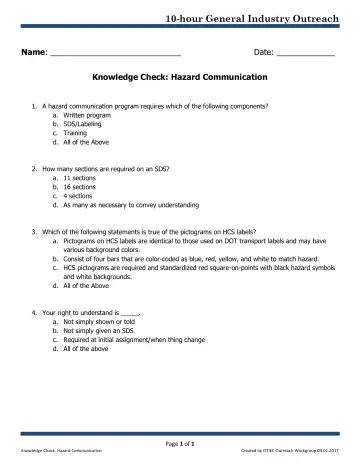
1 slidesHazard Communication: Knowledge Check (OSHA 10-Hour General Industry Outreach)
Student knowledge-check quiz for the OSHA General Industry hazard communication outreach deck.
U.S. Department of Labor, OSHA (with the OTIEC Outreach Workgroup)Public domain