1 / 35Use ← → to flip
Hazard Communication, Respiratory Protection and Process Safety Management
Chemical hazards in poultry and meatpacking plants: hazard communication, respirators, and ammonia process safety.
Slide text
· 35 slides · by Georgia Tech Research Institute
The words on each slide as the author wrote them, read from the file by software so they can be searched. Layout, pictures and tables are not shown here: the slides above and the download are the original.
- Slide 1
Chemical Hazards in Meat & Poultry
- Processing & Packing
- Hazard Communication, Respiratory Protection, and Process
- Safety Management
- Slide 2
Disclaimer
- This material was produced under grant number SH-29660-SH6 from the Occupational Safety and Health Administration, U.S. Department of Labor. It does not necessarily reflect the views or policies of the U.S. Department of Labor, nor does mention of trade names, commercial products, or organizations imply endorsement by the U.S. Government.
- Slide 3
Learning Objectives
- After completing this module, learners will be able to:
- Identify the main elements of OSHA’s hazard communication standard
- Explain what a respirator is and how the employer requirements differ if respirator use is required or voluntary
- Understand when process safety management standard applies and the main requirements.
- Slide 4
Chemical Hazards Present in Food Processing
- Detergents and disinfectants
- Alkaline and acid detergents, chlorine, hydrogen peroxide, ozone, quaternary ammonia compounds (”quats”), PAA
- Refrigerants
- Ammonia, carbon dioxide
- Ingredients and additives
- Other: biologicals
- Slide 5
Chemical Hazards of Food Processing
- Detergents
- Alkaline detergents – sodium hydroxide, nitrous oxide, sodium silicate, trisodium phosphate.
- Frequently used and can vary in strength;
- have sodium or potassium salts; corrosive
- Acidic detergents – hydrochloric acid, sulfuric acid, phosphoric acid, acetic acid
- Vary in strength; corrosive to skin and mucous membranes (e.g., eyes, nose), respiratory irritatant
- Chlorine – a disinfectant that is sometimes added to water for washing poultry.
- May cause respiratory irritation and breathing difficulties.
- Can generate chlorine gas.
- Hydrogen peroxide – sometimes used as disinfectants. These chemicals may cause eye, nose and respiratory irritation.
- Slide 6
Chemical Hazards of Food Processing – Detergents
- Ozone —an unstable gas form of oxygen and is a broad-spectrum biocide and disinfects against viruses, bacteria, biofilms, fungi and protozoa. May cause eye, nose and throat irritation, headaches, lung irritation, oxygen deficiency.
- Quaternary ammonia (“quats”) – a type of synthetic detergent used in ordinary environmental sanitation of surfaces such as floors, walls, and other surfaces. Has surfactant and disinfecting properties.
- Peracetic acid/Peroxyacetic acid (PAA) – may be used as a disinfectant in some poultry processing/meatpacking plants and has been associated with respiratory irritation.
- Slide 7
Exposure to Heat and Chemicals
- Slide 8
Chemical Hazards of Food Processing
- -Refrigeration
- Ammonia – may be used in poultry processing and meatpacking plants for refrigeration. Ammonia may cause irritation of the eyes and respiratory tract.
- Carbon dioxide – in the form of dry ice, it is used to keep meat cold. Inhaling carbon dioxide can cause an increase in the breathing rate, which can progress to shortness of breath, dizziness and vomiting.
- Slide 9
Additional Airborne Contaminants
- Food additives
- Sensitizers of natural/synthetic origin
- Dust from flour, seeds (breading/further processing)
- Vapors from preparation or cooked food processes
- Particulate from animal cleaning processes or cleaning equipment
- Slide 10
Hazard
- Communication Standard
- 29 CFR 1910.1200
- Slide 11
Purpose
- To insure that the hazards of all chemical produced in or imported into the U.S. are evaluated
- Hazards transmitted to
- employers
- employees
- Employees have both a need and a right to know the hazards and identities of the chemicals they are exposed to at work
- Slide 12
Global Harmonization System (GHS)
- Implementation Period: December 2013 through June 2016
- Standardizes Hazard Classification
- Labels: pictograms and warnings
- Standardizes Safety Data Sheets
- Information and Training
- Affects nearly 40 million workers and 5 million workplaces.
- Slide 13
Basic Program Elements
- Written Program
- Chemical Hazard Inventory
- SDSs (formerly MSDSs)
- Labeling
- Employee Training
- Contractor Training
- rd
- Haza unica
- Comm
- tion
- am
- Progr
- Slide 14
Written Program
- A list of the hazardous chemicals known to be present at the facility along with SDS’s for each chemical
- The methods the employer will use to inform employees of the hazards non-routine tasks
- The hazards of chemicals in unlabeled pipes
- Slide 15
Workplace Labeling
- The employer must ensure that each container of hazardous chemicals in the workplace is labeled, tagged or marked with either:
- The label information on the shipped container, or
- Product identifier and words, pictures, symbols, or combination providing general information on the hazards of chemicals
- Labels must be legible, in English (although other languages are permitted as well), and prominently displayed on the container
- Slide 16
Secondary Labels
- OSHA is maintaining the current approach to allowing alternatives to labels on each stationary process container.
- The exception for portable containers under the control of the person who filled them with the chemical remains the same.
- Slide 17
Example of GHS Simple Label
- Slide 18
Pictograms
- Slide 19
Employee Information and Training
- Employers must provide employees information and training on hazardous chemicals in their work area:
- At the time of their initial assignment
- Whenever a new physical or health hazard the employees have not previously been trained about is introduced into their work area
- Training may cover categories of hazards
- Slide 20
Required Employee Training
- OSHA standard covered
- Operations in their
- work area where chemical is used
- Pictograms
- Location of program,
- list of chemicals, and SDS
- Detection of chemical
- Hazards of chemical
- Protection measures
- Emergency procedures
- Labeling system used
- Slide 21
Temp Workers and Hazard Communication: Shared Responsibility
- Staffing Agency
- Generic Policies
- Host Company
- Hazard
- i ca
- Program
- Specific Chemicals
- Slide 22
Shared Responsibility Example: Hazard Communication
- Host employer holds the primary responsibility for training because the host employer:
- uses or produces chemicals
- creates and controls the hazards
- best suited to inform workers of chemical hazards specific to the workplace
- The staffing agency maintains a continuing relationship with its employees, and is, at a minimum, expected to inform employees of the requirements of the standard.
- Slide 23
What is hazardous in these photos?
- Slide 24
What’s a Respirator?
- Slide 25
Written Respirator Program Elements
- Selection of respirators
- Define use and application
- Medical evaluation
- Fit testing
- Training
- Maintenance and care
- Breathing air quality and use (air supplied respirators)
- Program evaluation
- Slide 26
Voluntary vs. Mandatory Respirator Use
- Voluntary use of
- Voluntary
- elastomeric
- 1910.134 Respiratory Protection use of negative-requirement
- dust
- pressure
- mask
- respirator
- Written respirator program
- No
- Medical evaluation
- Mandatory use of dust mask or cartridge respirator
- No
- Yes Yes
- Yes Yes
- Fit-testing
- No
- No
- Yes
- Annual training
- No
- No
- Yes
- Appendix D
- Yes
- Yes
- No
- Clean, inspect, maintain, store
- Yes
- Yes
- Yes
- Slide 27
Process Safety Management (PSM)
- 29 CFR 1910.119
- Slide 28
Process Safety Management (PSM) in Meatpacking
- Purpose:
- Prevent unwanted releases of hazardous chemicals
- Applicable if facility has ammonia refrigeration systems with 10,000 pounds or more of ammonia.
- This amount is known as threshold quantity (TQ)
- Systems that are co-located or located in close enough proximity such that loss of containment of one system could impact other systems must be considered in the aggregate.
- Slide 29
Process Safety Management (PSM) in Meatpacking
- Requirements include:
- Process Safety Information
- Process Hazard Analysis (PHA)
- Operating Procedures
- Employee Training
- Emergency Preparedness, and more.
- Slide 30
Process Safety Management (PSM) in Meatpacking
- The mechanical integrity (MI) of the ammonia system MUST be maintained and documented.
- MI includes OSHA regulations, standards incorporated by reference, governing codes (ANSI, ASTM, CGA, NFPA, AISC, etc.), and Recognized and Generally Accepted Good Engineering Practice (RAGAGEP).
- MI includes
- selecting equipment,
- equipment deficiency
- management,
- inspection and testing,
- program development, and
- quality assurance,
- continuous improvement of MI program.
- Slide 31
Process Safety Management (PSM) in Meatpacking
- Management of Change (MOC) is
- a process for evaluating and controlling modification to facility design, operation, organization, or activities – prior to implementation – to make certain that no new hazards are introduced and that the risk of existing hazards to employees, the public, or the environment are not knowingly increased.
- CCPS Guidelines for Management of Change for Process Safety, Wiley, 2008.
- Must establish and implement written procedures to manage changes except
- "replacements in kind" for a covered process.
- If a change in design or components is required, management of change must be employed, tracked, and analyzed.
- Slide 32
Process Safety Management (PSM) in Meatpacking
- Operating Procedures - The employer shall develop and implement written operating procedures that provide clear instructions for safely conducting activities involved in each covered process.
- Operating procedures must include the following phases:
- Initial start-up
- Normal operations
- Temporary operations
- Emergency shutdown
- Emergency operations
- Normal shutdown
- Start-up following turnaround
- Consequences of deviation
- Steps required to correct or avoid deviation
- Slide 33
Process Safety Management (PSM) in Meatpacking
- PSM Program must include Safe Work Practices
- Lock-out/Tag-out
- Confined space entry
- Line Opening process equipment or piping
- Hot work
- Control of entry into facility or engine room by employees, maintenance, contractors, or other support personnel
- Slide 34
Evaluation: Summary of Hazard Communication, Respiratory Protection, and PSM
- What are the typical hazardous chemicals encountered during poultry processing/meatpacking?
- Name the four GHS changes to the Hazard Communication standard
- Name six basic elements of a hazard communication program
- Slide 35
Evaluation: Summary of Hazard Communication, Respiratory Protection, and PSM
- What are the requirements for an employer if respirator use is required versus voluntary?
- Explain the purpose of the PSM standard.
- Name the threshold quantity of ammonia that triggers PSM.
More on HazCom
pptx
50 slidesHazard Communication (OSHA 10-Hour General Industry Outreach)
OSHA's outreach deck on the Hazard Communication Standard: labels, pictograms, SDSs and training (2017).
U.S. Department of Labor, OSHAPublic domain
pdf
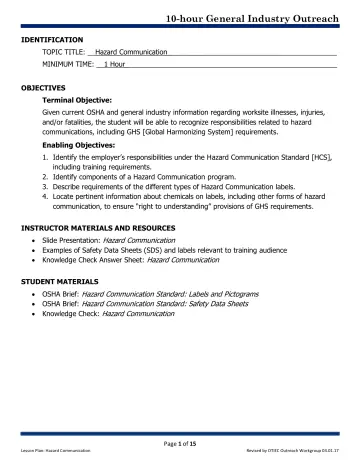
15 slidesHazard Communication: Lesson Plan (OSHA 10-Hour General Industry Outreach)
Instructor lesson plan (objectives, timing, teaching steps) for the OSHA General Industry hazard communication outreach deck.
U.S. Department of Labor, OSHA (with the OTIEC Outreach Workgroup)Public domain
pdf
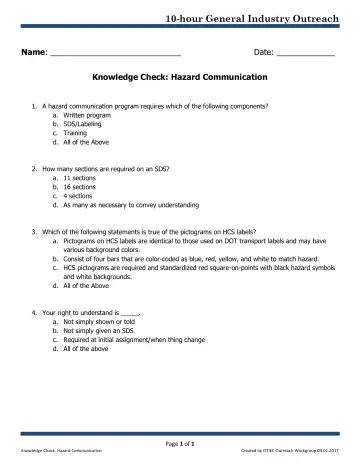
1 slidesHazard Communication: Knowledge Check (OSHA 10-Hour General Industry Outreach)
Student knowledge-check quiz for the OSHA General Industry hazard communication outreach deck.
U.S. Department of Labor, OSHA (with the OTIEC Outreach Workgroup)Public domain