1 / 32Use ← → to flip
Chemical Hazards and Hazard Communication Training
Hazard communication for workers in electronics assembly, janitorial and similar jobs: labels, pictograms, safety data sheets and rights.
Slide text
· 32 slides · by Asian Immigrant Women Advocates
The words on each slide as the author wrote them, read from the file by software so they can be searched. Layout, pictures and tables are not shown here: the slides above and the download are the original.
- Slide 1
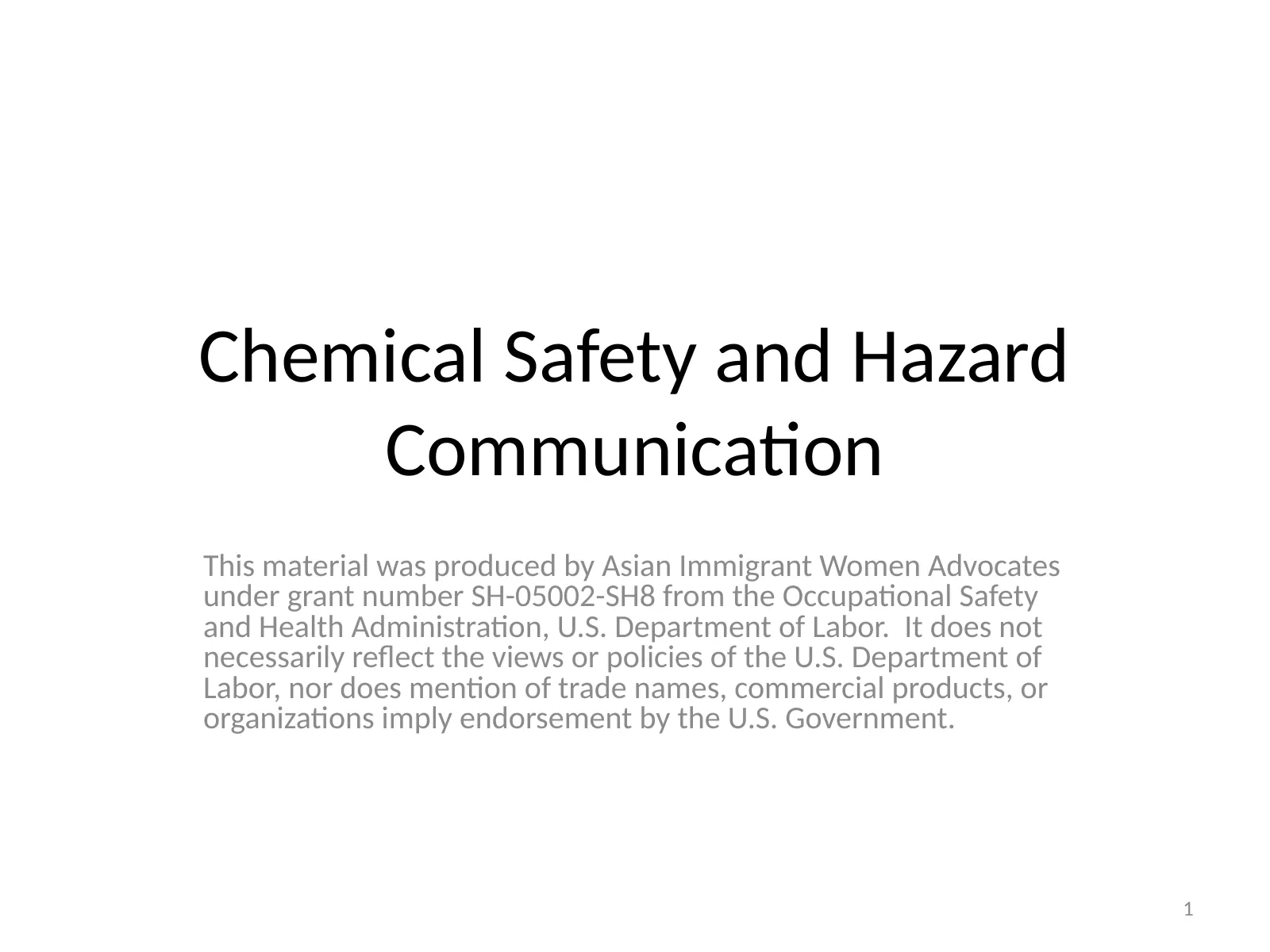
Chemical Safety and Hazard
- Communication
- This material was produced by Asian Immigrant Women Advocates under grant number SH-05002-SH8 from the Occupational Safety and Health Administration, U.S. Department of Labor. It does not necessarily reflect the views or policies of the U.S. Department of Labor, nor does mention of trade names, commercial products, or organizations imply endorsement by the U.S. Government.
- Slide 2
Training Objectives
- Employer requirements for chemical safety at the workplace
- How to recognize chemical hazards associated with the workplace
- How chemical hazards affect the body
- How to handle chemicals safely in the workplace
- Slide 3
Asian Immigrant Workers
- Asian immigrant workers handle chemicals in their workplaces every day. These are some of the most common chemicals they work with.
- Hand soaps
- Dish washing liquids
- Cleaning sprays and powders
- Bleaches
- Alcohol solutions
- Disinfectants
- Detergents
- Slide 4
Other Chemicals in the Workplace
- Depending on their industries (restaurant, hotel, janitorial, home care, salon and beauty services, and other employment settings), Asian immigrant workers recognize and handle other chemicals in the work areas.
- Slide 5
Do you work with chemicals?
- What chemicals do you use in the workplace?
- How does your body feel when you work with these chemicals?
- [short discussion]
- Slide 6
Employer Requirements: Workers’ “Right to Know” Law
- Employers are required
- to ensure that all employees know the hazards of chemicals they work with at their jobs
- to ensure that employees are provided with information about chemicals they work with through:
- Information on chemical labels
- Safety Data Sheets (SDSs)
- Training on hazard communication (HAZCOM)
- Written HAZCOM plan
- Slide 7
Employee Information and Training
- Employers must provide employees with information and training on hazardous chemicals in their work area.
- At the time of initial assignment
- When a new hazardous product or chemical is introduced into the workplace
- Slide 8
Employee Training
- Employee training shall include at least:
- The means to detect the presence of a hazardous chemicals in the work area
- The physical and health hazards of chemicals in the work area
- Measures employees can take to protect themselves
- Slide 9
Have you received training?
- Have you received training from your employer on the chemicals used in your work area and how to handle them safely?
- [Short discussion]
- Slide 10
What is a chemical hazard?
- Chemical hazards are gases, vapors, liquids, or dusts that can harm your body.
- Slide 11
HOW DO CHEMICALS GET INTO THE BODY?
- Breathing (Inhalation)
- Skin or Eye Contact
- Swallowing (Ingestion)
- Slide 12
Health Hazards
- Chemical exposure can cause serious health problems:
- Itching/rashes/burns
- Kidney/lung damage
- Heart problems
- Cancer
- Sterility
- Central nervous system damage
- Slide 13
HOW CHEMICALS CAN AFFECT YOUR BODY
- Slide 14
Health Hazards
- Major Types
- Corrosives - cause tissue damage and burns on contact with skin or eyes
- Primary Irritants - cause intense redness or swelling of skin or eyes on contact. No permanent tissue damage
- Sensitizers - cause an allergic skin or lung reaction
- Acutely Toxic Materials - cause an adverse effect even at very low doses
- Carcinogens - may cause cancer
- Teratogens - may cause birth defects
- Organ Specific hazards - damage to specific organ systems such as liver or lungs
- Slide 15
Acute and Chronic
- Acute health effects
- Happens quickly. Occur with short-term exposure and last a brief period. For example, skin irritation with chemical contact.
- Chronic health effects
- May not smell, see, or feel sick right away. Occur with long-term exposure and last a long time. For example: lung cancer.
- Slide 16
Chemical Hazard Protection
- What can you do to protect yourself from chemical hazards?
- [Short discussion]
- Slide 17
Chemical Hazard Control Approaches
- (1) Remove
- the Hazard from Work Area
- (2) Review and Follow Work
- Policies and Procedures
- (3) Wear Personal Protective Equipment
- Slide 18
(1) Remove the Hazardous Chemical
- Remove the chemical hazard from work area
- Choose nontoxic products
- “Green Seal Certified”
- “Ecologo UL”
- “Safer Choice”
- Slide 19
(2) Work Policies and Procedures
- Train on reading labels and know what symbols and warnings mean
- Use small amounts of chemicals, measuring & diluting them
- Use tools to avoid direct contact with chemicals
- Cover and store chemicals safely
- Slide 20
Learn to read Chemical Hazard Labels
- Train on reading labels and knowing what symbols and warnings mean
- Slide 21
Required Elements on a Label
- Information should be in the same order for all labels
- Labels MUST include:
- Product Identifier
- Supplier Identifier
- Chemical Identity
- Hazard Pictograms *
- Signal Words *
- Hazard Statements *
- Precautionary Information
- The items with * are hazard warning and MUST be located together on the label!
- Slide 22
Hazard Pictograms
- Pictograms are required on labels to alert users of the chemical hazards. Pictograms consists of a symbol on a white background framed within a red border and represents a distinct hazard.
- Slide 23
Pictograms and Hazards
- Slide 24
Hazard Signal Words
- There are two Signal Words used in chemical labels: DANGER or WARNING
- DANGER is used for more severe hazards
- WARNING is used for less severe hazards
- Slide 25
Hazard Statements
- Hazard statements provide wording to indicate the hazards of the chemical product, including, when appropriate, the degree of the hazard
- Slide 26
Safety Data Sheets (SDS)
- For information about chemical hazards, Safety Data Sheets provide valuable facts about chemicals and how to handle them. It contains:
- Product name, manufacturer, contact information and emergency number
- Hazard identification
- Information on chemical ingredients
- First-aid measures
- Firefighting measures
- Accidental release measures
- Handling and storage
- Slide 27
(3) Personal Protective Equipment
- Use gloves, masks, goggles, aprons, hats, shoes, and other protective covers
- Slide 28
Mei’s Story: What should Mei do?
- Slide 29
Summary
- Employees have the right to chemical safety information and training in the workplace.
- It is important to recognize chemical hazards through labels, pictograms, signal words, and hazard statements.
- It is important to use personal protective equipment for safely handling chemicals.
- Take action to make your workplace safer!
- Slide 30
Any Questions?
- Slide 31
Acknowledgements
- “Chemical Hazard and Hazard Communication” (PowerPoint Presentation). Susan Harwood Grant/OSHA.
- “Hazard Communication (HAZCOM) and the Globally Harmonized System of Classification and Labeling of Chemicals (GHS)” (PowerPoint Presentation). Susan Harwood Grant/OSHA.
- “Hazard Communication Standard 1910.1200” (PowerPoint Presentation). Susan Harwood Grant/OSHA.
- Scruggs, Kelsie, MPH. “Safe Jobs for Youth” (PowerPoint Presentation). Labor Occupational Health Program, U.C. Berkeley. Susan Harwood Grant/OSHA
- Slide 32
- Also this training was created by adapting publicly available materials from Susan
- Harwood Training Program, UC Berkeley Labor
- Occupational Health Program, and Pennsylvania Department of Labor & Industry.
More on HazCom
pptx
50 slidesHazard Communication (OSHA 10-Hour General Industry Outreach)
OSHA's outreach deck on the Hazard Communication Standard: labels, pictograms, SDSs and training (2017).
U.S. Department of Labor, OSHAPublic domain
pdf
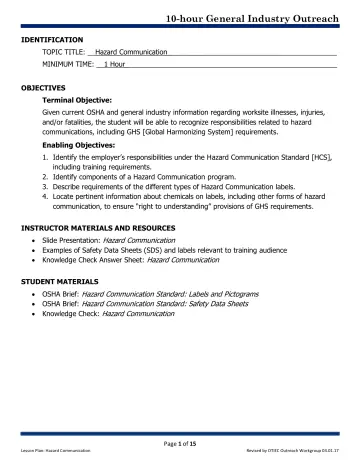
15 slidesHazard Communication: Lesson Plan (OSHA 10-Hour General Industry Outreach)
Instructor lesson plan (objectives, timing, teaching steps) for the OSHA General Industry hazard communication outreach deck.
U.S. Department of Labor, OSHA (with the OTIEC Outreach Workgroup)Public domain
pdf
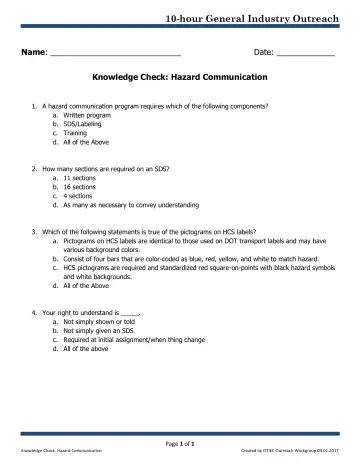
1 slidesHazard Communication: Knowledge Check (OSHA 10-Hour General Industry Outreach)
Student knowledge-check quiz for the OSHA General Industry hazard communication outreach deck.
U.S. Department of Labor, OSHA (with the OTIEC Outreach Workgroup)Public domain