1 / 23Use ← → to flip
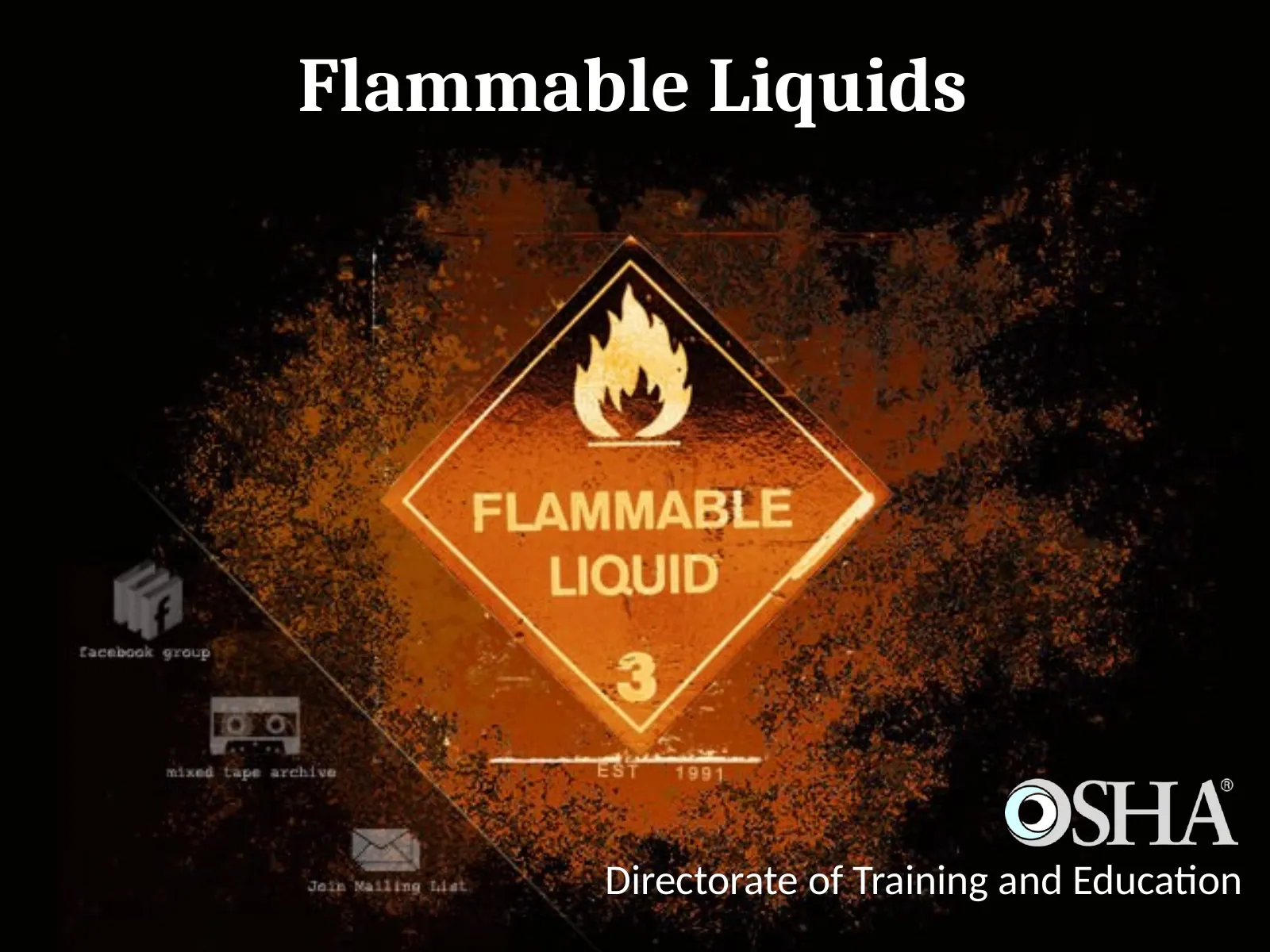
Flammable Liquids (OSHA training library deck)
OSHA training library slide presentation on flammable liquid storage and handling.
Slide text
· 23 slides · by U.S. Department of Labor, OSHA
The words on each slide as the author wrote them, read from the file by software so they can be searched. Layout, pictures and tables are not shown here: the slides above and the download are the original.
- Slide 1
Flammable Liquids
- Slide 2
Introduction
- The two primary hazards associated with flammable liquids are explosion and fire
- Safe handling and storage of flammable liquids requires the use of approved equipment and practices per OSHA standards
- Slide 3
Flash Point
- Flash point means the minimum temperature at which a liquid gives off vapor within a test vessel in sufficient concentration to form an ignitable mixture with air near the surface of the liquid.
- In general, the lower the flash point, the greater the hazard
- Flammable liquids have flash points at or below 199.4 o F (93 o C)
- Slide 4
Program Components
- A good plan for safe use of flammable liquids contains at least these components:
- Control of ignition sources
- Proper storage
- Fire control
- Safe handling
- Slide 5
Categories of Flammable Liquids
- Boiling Point ( o F)
- Slide 6
Classes of Some Flammable Liquids
- Common Name
- Flash Point ( o F)
- Category 1
- Ethyl Ether
- Category 2
- Acetone
- Category 3
- m-xylene
- CLASS IC
- Kerosene
- 140-162
- Slide 7
Sources of Ignition
- Must take adequate precautions to prevent ignition of flammable vapors. Some sources of ignition include:
- Open flames
- Smoking
- Static electricity
- Cutting and welding
- Hot surfaces
- Electrical and mechanical sparks
- Lightning
- Slide 8
Static Electricity
- Generated when a fluid flows through a pipe or from an opening into a tank
- Main hazards are fire and explosion from sparks containing enough energy to ignite flammable vapors
- Bonding or grounding of flammable liquid containers is necessary to prevent static electricity from causing a spark
- Slide 9
Bonding
- Physically connect two conductive objects together with a bond wire to eliminate a difference in static charge potential between them
- Must provide a bond wire between containers during flammable liquid filling operations, unless a metallic path between them is otherwise present
- Slide 10
Grounding
- Eliminates a difference in static charge potential between conductive objects and ground
- Although bonding will eliminate a difference in potential between objects, it will not eliminate a difference in potential between these objects and earth unless one of the objects is connected to earth with a ground wire
- Slide 11
Ventilation
- Always provide adequate ventilation to reduce the potential for ignition of flammable vapors.
- Slide 12
Storage Fundamentals
- Identify incompatible chemicals – check the Safety Data Sheets
- Isolate and separate incompatible materials
- Isolate by storing in another area or room
- Degree of isolation depends on quantities, chemical properties and packaging
- Separate by storing in same area or room, but apart from each other
- Slide 13
Storage of Flammable Liquids
- Storage must not limit the use of exits, stairways, or areas normally used for the safe egress of people
- In office occupancies:
- Storage prohibited except that which is required for maintenance and operation of equipment
- Storage must be in:
- closed metal containers inside a storage cabinet, or
- Inside storage room
- safety cans, or
- an inside storage room
- Slide 14
Safety Cans for Storage and Transfer
- Approved container of not more than 5 gallons capacity
- Spring-closing lid and spout cover
- Safely relieves internal pressure when exposed to fire
- Slide 15
Flame Arrester Screen
- Prevents fire flashback into can contents
- Double wire-mesh construction
- Large surface area provides rapid dissipation of heat from fire so that vapor temperature inside can remains below ignition point
- Slide 16
Storage Cabinets
- Not more than 60 gallons of Category 1, 2, or 3 flammable liquids, nor more than 120 gallons of Category 4 flammable liquids may be stored in a storage cabinet.
- Must be conspicuously labeled, “Flammable - Keep Fire Away”
- Doors on metal cabinets must have a three-point lock (top, side, and bottom), and the door sill must be raised at least 2 inches above the bottom of the cabinet
- Slide 17
Fire Control
- Suitable fire control devices, such as small hose or portable fire extinguishers must be available where flammable liquids are stored
- Open flames and smoking must not be permitted in these storage areas
- Materials which react with water must not be stored in the same room with flammable liquids
- Slide 18
Transferring Flammable Liquids
- Since there is a sizeable risk whenever flammable liquids are handled, OSHA allows only four methods for transferring these materials:
- Through a closed piping system
- From safety cans
- By gravity through an approved self-closing safety faucet By means of a safety pump
- Slide 19
Self-Closing Safety Faucet
- Bonding wire between drum and container
- Grounding wire between drum and ground
- Safety vent in drum22
- OSHA Office of Training and Education
- Slide 20
Safety Pump
- Faster and safer than using a faucet
- Spills less likely
- No separate safety vents in drum required
- Installed directly in drum bung opening
- Some pump hoses have integral bonding wires
- Slide 21
Waste and Residue
- Flammable waste and residue must be kept to a minimum, stored in covered metal receptacles and disposed of daily.
- Waste drum with disposal funnel
- Safety disposal can
- Oily-waste can (self-closing lid)
- Slide 22
Safe Handling Fundamentals
- Carefully read the manufacturer’s label on the flammable liquid container before storing or using it
- Practice good housekeeping in flammable liquid storage areas
- Clean up spills immediately, then place the cleanup rags in a covered metal container
- Only use approved metal safety containers or original manufacturer’s container to store flammable liquids
- Keep the containers closed when not in use and store away from exits or passageways
- Use flammable liquids only where there is plenty of ventilation
- Keep flammable liquids away from ignition sources such as open flames, sparks, smoking, cutting, welding, etc.
- Slide 23
Summary
- The two primary hazards associated with flammable liquids are explosion and fire
- Safe handling and storage of flammable liquids requires the use of approved equipment and practices per OSHA standards
- An excellent reference on this topic is National Fire Protection Association Standard No. 30, Flammable Liquids and Combustible Code
More on Fire
ppt
73 slidesEgress and Fire Protection
Egress and fire protection module from TEEX's OSHA standards course (2006, oil and gas context).
Texas Engineering Extension ServiceArchivedOSHA Harwood grant
pdf
2 slidesFire Safety Fact Sheet (OSHA 3527)
OSHA fact sheet on workplace fire safety, extinguishers and emergency plans.
U.S. Department of Labor, OSHAPublic domain
link
Fire Prevention (Construction) Presentation
NCDOL slide presentation on fire protection and prevention on construction sites (Subpart F).
North Carolina Department of Labor, OSH DivisionExternal link