1 / 3Use ← → to flip
Reducing Falls in Construction: Safe Use of Extension Ladders (OSHA 3660)
OSHA fact sheet on extension ladder setup and use.
Page text
· 3 pages · by U.S. Department of Labor, OSHA
The words on each page as the author wrote them, read from the file by software so they can be searched. Layout, pictures and tables are not shown here: the pages above and the download are the original.
- Page 1
FactSheet
- Reducing Falls in Construction: Safe Use of Extension Ladders
- Workers who use extension ladders risk permanent injury or death from falls and electrocutions. These hazards can be eliminated or substantially reduced by following good safety practices. This fact sheet examines some of the hazards workers may encounter while working on extension ladders and explains what employers and workers can do to reduce injuries. OSHA’s requirements for extension ladders are in Subpart X—Stairways and Ladders of OSHA’s Construction standards.
- What is an Extension Ladder?
- PLAN Ahead to Get the Job Done Safely.
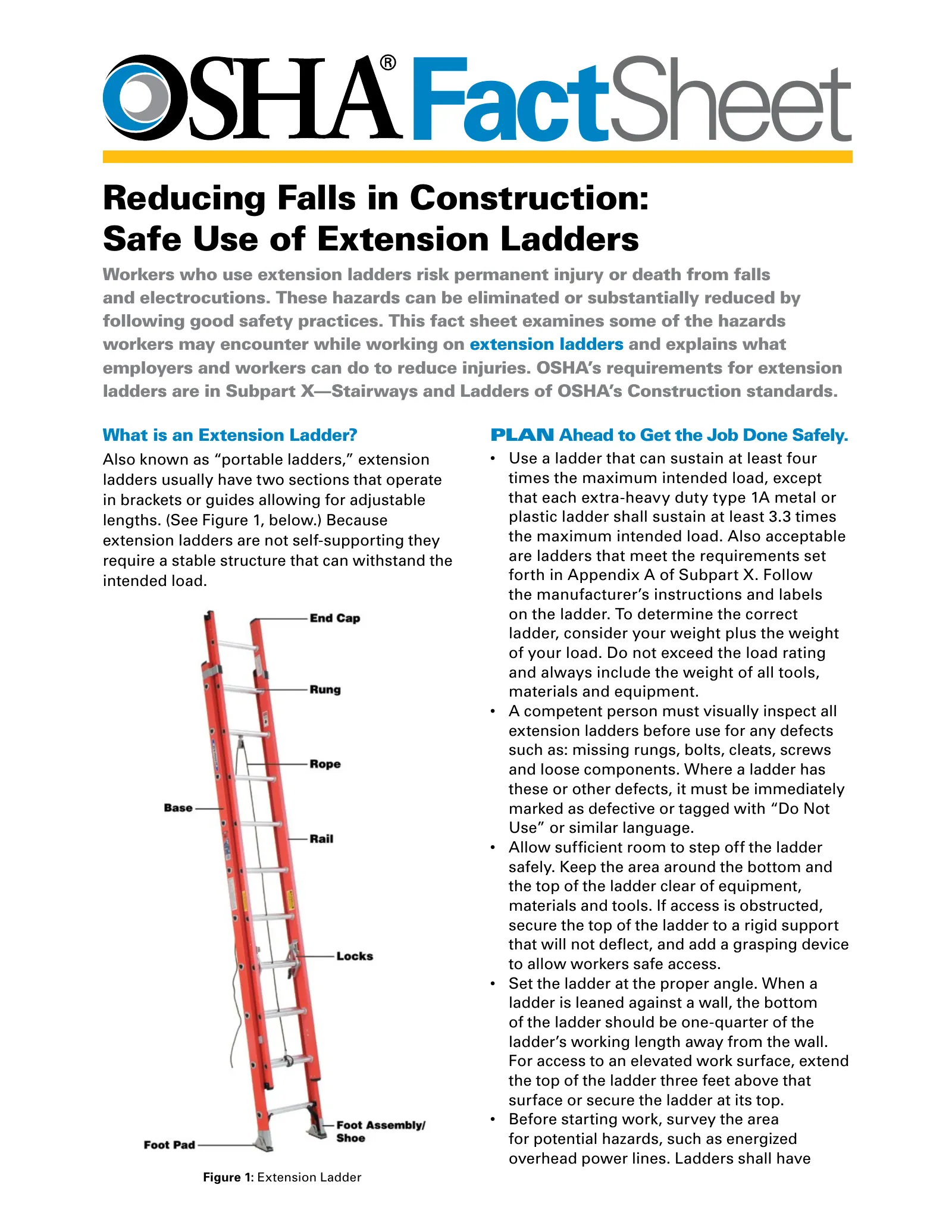
- Also known as “portable ladders,” extension ladders usually have two sections that operate in brackets or guides allowing for adjustable lengths. (See Figure 1, below.) Because extension ladders are not self-supporting they require a stable structure that can withstand the intended load.
- Use a ladder that can sustain at least four times the maximum intended load, except that each extra-heavy duty type 1A metal or plastic ladder shall sustain at least 3.3 times the maximum intended load. Also acceptable are ladders that meet the requirements set forth in Appendix A of Subpart X. Follow the manufacturer’s instructions and labels on the ladder. To determine the correct ladder, consider your weight plus the weight of your load. Do not exceed the load rating and always include the weight of all tools, materials and equipment.
- A competent person must visually inspect all extension ladders before use for any defects such as: missing rungs, bolts, cleats, screws and loose components. Where a ladder has these or other defects, it must be immediately marked as defective or tagged with “Do Not Use” or similar language.
- Allow sufficient room to step off the ladder safely. Keep the area around the bottom and the top of the ladder clear of equipment, materials and tools. If access is obstructed, secure the top of the ladder to a rigid support that will not deflect, and add a grasping device to allow workers safe access.
- Set the ladder at the proper angle. When a ladder is leaned against a wall, the bottom of the ladder should be one-quarter of the ladder’s working length away from the wall. For access to an elevated work surface, extend the top of the ladder three feet above that surface or secure the ladder at its top.
- Before starting work, survey the area for potential hazards, such as energized overhead power lines. Ladders shall have
- Figure 1: Extension Ladder
- Page 2
PLAN. PROVIDE. TRAIN.
- nonconductive side rails if they are used where the worker or the ladder could contact exposed energized electrical equipment. Keep all ladders and other tools at least 10 feet away from any power lines.
- Set the base of the ladder so that the bottom sits securely and so both side rails are evenly supported. The ladder rails should be square to the structure against which it is leaning with both footpads placed securely on a stable and level surface.
- Secure the ladder’s dogs or pawls before climbing.
- When using a ladder in a high-activity area, secure it to prevent movement and use a barrier to redirect workers and equipment. If the ladder is placed in front of a door, always block off the door.
- TRAIN Workers to Use Extension
- Ladders Safely.
- Employers must train each worker to recognize and minimize ladder-related hazards.
- Three simple steps to prevent falls.
- Safe Ladder Use—DO:
- Maintain a 3-point contact (two hands and a foot, or two feet and a hand) when climbing/ descending a ladder.
- Face the ladder when climbing up or descending.
- Keep the body inside the side rails.
- Use extra care when getting on or off the ladder at the top or bottom. Avoid tipping the ladder over sideways or causing the ladder base to slide out.
- Carry tools in a tool belt or raise tools up using a hand line. Never carry tools in your hands while climbing up/down a ladder.
- Extend the top of the ladder three feet above the landing. (See Figure 2.)
- Keep ladders free of any slippery materials.
- Safe Ladder Use—DO NOT:
- Figure 2: Ladder extending three feet above the landing area.
- PROVIDE the Right Extension Ladder for the Job with the Proper Load Capacity.
- Select a ladder based on the expected load capacity (duty rating), the type of work to be done and the correct height. There are five categories of ladder duty ratings.
- Type
- Duty Rating
- Use
- Load
- IAA*
- Special Duty
- Rugged
- 375 lbs.
- IA
- Extra Duty
- Industrial
- 300 lbs.
- Heavy Duty
- Industrial
- 250 lbs.
- II
- Medium Duty
- Commercial
- 225 lbs.
- III
- Light Duty
- Household
- 200 lbs.
- Source for Types IA, I, II, III: Subpart X—Stairways and Ladders, Appendix A (American National Standards Institute (ANSI)) 14.1, 14.2, 14.5 (1982)) of OSHA’s Construction standards. Source for Type IAA: ANSI 14.1, 14.2, 14.5 (2009), which are non-mandatory guidelines.
- Place a ladder on boxes, barrels, or unstable bases.
- Use a ladder on soft ground or unstable footing.
- Exceed the ladder’s maximum load rating.
- Tie two ladders together to make them longer.
- Ignore nearby overhead power lines.
- Move or shift a ladder with a person or equipment on the ladder.
- Lean out beyond the ladder’s side rails.
- Use an extension ladder horizontally like a platform.
- Page 3
OSHA standard: 29 CFR 1926 Subpart X—Stairways and Ladders
- American National Standards Institute standard: ANSI A14.1, A14.2, A14.5—Ladder Safety Requirements (Not an OSHA standard, included to be used as guidance to meet OSHA’s requirements)
- Employers using extension ladders must follow the ladder requirements set forth in 29 CFR 1926 Subpart
- X. Per Appendix A to Subpart X of Part 1926—Ladders, ladders designed in accordance with the following ANSI standards will be considered in accordance with 29 CFR 1926.1053(a)(1): ANSI A14.1-1982—American National Standard for Ladders—Portable Wood—Safety Requirements, ANSI A14.2-1982—American National Standard for Ladders—Portable Metal—Safety Requirements, and ANSI A14.5-1982—American National Standard for Ladders—Portable Reinforced Plastic—Safety Requirements.
- State plan guidance: States with OSHA-approved state plans may have additional requirements for avoiding falls from ladders. For more information on these requirements, please visit: www.osha.gov/dcsp/osp/statesstandards.html.
- Most OSHA offices have compliance assistance specialists to help employers and workers comply with OSHA standards. For details call 1-800-321-OSHA (6742) or visit: www.osha.gov/htm/RAmap.html.
- This is one in a series of informational fact sheets highlighting OSHA programs, policies or standards. It does not impose any new compliance requirements. For a comprehensive list of compliance requirements of OSHA standards or regulations, refer to Title 29 of the Code of Federal Regulations. This information will be made available to sensory-impaired individuals upon request. The voice phone is (202) 693-1999; teletypewriter (TTY) number: (877) 889-5627.
- DOC FS-3660 05/2013
More on Ladders

pptx
36 slidesStairways and Ladders (OSHA 10-Hour Construction Outreach)
OSHA's own 10-hour Construction Outreach deck on stairways and portable/job-made ladders (2015 edition), with case studies and a built-in knowledge check.
U.S. Department of Labor, OSHA (with the OTIEC Outreach Workgroup)ArchivedPublic domain
pdf
9 slidesStairways and Ladders: Lesson Plan (OSHA 10-Hour Construction Outreach)
Instructor lesson plan with objectives, timing and teaching procedures for the OSHA stairways and ladders outreach deck.
U.S. Department of Labor, OSHA (with the OTIEC Outreach Workgroup)ArchivedPublic domain
pdf
1 slidesStairways and Ladders: Knowledge Check (OSHA 10-Hour Construction Outreach)
Student knowledge-check quiz that accompanies the OSHA stairways and ladders outreach deck.
U.S. Department of Labor, OSHA (with the OTIEC Outreach Workgroup)ArchivedPublic domain