1 / 44Use ← → to flip
Ladders (Residential Construction)
Ladder safety module from the Job-Site Safety Institute residential construction fall prevention course.
Slide text
· 44 slides · by Job-Site Safety Institute
The words on each slide as the author wrote them, read from the file by software so they can be searched. Layout, pictures and tables are not shown here: the slides above and the download are the original.
- Slide 1
Section 2
- LADDERS
- Slide 2
Disclaimer
- This material was produced under grant number SH-31198-SH7 from the Occupational Safety and Health Administration, U.S. Department of Labor. It does not necessarily reflect the views or policies of the U.S. Department of Labor, nor does mention of trade names, commercial products, or organizations imply endorsement by the U.S. Government.
- This presentation is intended to discuss Federal Regulations only - your individual State requirements may be more stringent as many states operate their own state OSHA and they may have adopted construction standards that are different from information presented in this training. If you live in a state with an OSHA approved state plan, you should contact your local administrator for further information on the standards applicable in your state.
- These materials are meant for informational purposes only.
- No representation is made as to the thoroughness of the presentation.
- Slide 3
Disclaimer , cont.
- It is not the intent to provide compliance-based training in this presentation, the intent is more to address hazard awareness in the residential construction (i.e. home building) industry, and to recognize the overlapping hazards present in many construction workplaces.
- Photos shown in this presentation may depict situations that are not in compliance with applicable OSHA/safety requirements.
- No legal advice is offered or implied, and no attorney-client relationship is intended or established. If legal advice or other expert assistance is required the services of a competent professional person should be sought.
- It is the responsibility of the employer and its employees to comply with all pertinent OSHA/safety rules and regulations in the jurisdiction in which they work.
- Slide 4
Copyright Information © 2018
- This material is the copyrighted property of the Job-Site Safety Institute and the National Association of Home Builders. By federal regulation, OSHA reserves a license to use and disseminate such material for the purpose of promoting safety and health in the workplace. The Job-Site Safety Institute and the National Association of Home Builders hereby authorizes employers and workplace safety and health professionals to use this material, distributed by or through OSHA, in their workplaces or practices in accordance with the guidance contained in the material.
- To this end, permission is granted to use such copyrighted material solely for non-commercial, instructional, personal, or scholarly purposes. The material may be used and incorporated into other workplace safety and health programs on the condition that no fee may be charged for the subsequent use of the material. Use of the material for any other purpose, particularly commercial use, without the prior, express written permission of the copyright owner/s is prohibited. Furthermore, any modification to the material is prohibited without the prior, express written permission of the copyright owners.
- Slide 5
Learning Objectives: Section 2
- Determine the proper ladder to use based on weight capacity and height.
- Calculate the proper pitch of extension ladders for proper set-up, and identify how to secure and stabilize ladders.
- Identify how to maintain a safe position when using a ladder.
- Slide 6
- Ladders
- Slide 7
Ladder Hazards
- The likelihood of
- surviving a fall from a ladder at least 10 feet high is only 50%.
- Approximately half of all injuries caused by slips, trips or falls from ladders and stairways require time off work.
- Slide 8
Ladder Training Requirements
- Each employee using ladders should be trained to recognize hazards.
- Hazards Include:
- Nature of the fall hazards in the work area.
- Correct procedures for placement, use and maintenance.
- Maximum intended load-carrying capacities.
- Slide 9
Ladder or Scaffold?
- Slide 10
Choosing the Right Ladder
- Before stepping onto a ladder, think about these things:
- What capacity can it hold?
- Height of the ladder—too short or too tall?
- Condition of the ladder and instructions unique to the ladder selected.
- We’ll look at each of these in detail.
- Slide 11
Proper Duty Rating/Capacity
- OSHA Requirement
- Ladders shall not be loaded beyond the maximum intended load for which they were built nor beyond their manufacturer's rated capacity.
- Slide 12
Proper Duty Rating/Capacity
- How much weight will be on
- the ladder?
- Factor your weight plus tools
- and materials being handled.
- NOTE: workers must not carry any tools/materials when climbing a ladder that could cause them to lose balance and fall.
- Duty rating is the maximum
- safe load capacity of the ladder.
- Slide 13
- Proper Duty Rating/Capacity, cont.
- Select a ladder with the proper duty rating for your weight and the materials you are handling.
- Slide 14
“3 Feet Rule” for Extension Ladders
- When using an
- extension ladder for access to another level, the ladder must extend at least 3 feet (.9 m) above the landing to provide a hand hold for getting on and off the ladder.
- Slide 15
“3 Feet Rule” for Extension Ladders, cont.
- Add-on extensions to
- ladders which allow workers to walk-through the top of an extension ladder are acceptable if they extend at least 3 feet (.9 m) above the landing.
- Slide 16
- “3 Feet Rule” for Extension Ladders, cont.
- 3 feet
- Slide 17
Calculate length of Ladder Needed
- Extension ladders
- should be 7 to 10 feet longer than the highest contact point.
- Allows for proper
- positioning angle and extension above the roof line or landing
- Slide 18
Proper Height Stepladders
- Choose a stepladder that
- is no more than 4 feet shorter than the height being reached.
- Slide 19
Inspect your Ladder
- Inspect ladders prior to use for visible defects.
- Never use a ladder that is broken or otherwise damaged.
- Remove damaged ladders from service, tag them as damaged, and discard them immediately, if feasible.
- Slide 20
Inspection of Ladders
- Missing, broken or
- loose rungs.
- Damaged or worn non-slip feet.
- Loose nails, screws, bolts, rivets.
- Loose or faulty spreaders, locks, other materials.
- Rot, decay of wooden
- ladders.
- Cracked, split, worn or broken rails, braces, steps.
- Missing identification or safety labels.
- Do not paint ladders since defects may be concealed.
- Slide 21
Job-Made Wooden Ladders
- Job-made wooden ladders are permissible, if constructed according to OSHA and ANSI specifications.
- Must be constructed to ANSI A14.4-2009 standard.
- Standard contains very specific requirements for type of materials to use, as well as spacing and limitations.
- Do not use job-made ladders unless you have reviewed the OSHA and ANSI regulations and standards.
- Slide 22
Damaged Ladder Photos
- This ladder shows the use of 2x4 wood to repair damaged side-rails and feet of a ladder.
- This ladder should be tagged and removed from service.
- Slide 23
Damaged Ladder Photos
- The side-rail of this ladder is dented.
- This ladder should be tagged and removed from service.
- Slide 24
Ladder Labels
- Check the labels to
- learn about:
- Warnings
- Duty rating
- Set-up
- Slide 25
Ladder Setup - Placement
- Avoid setting up a ladder in high traffic areas or barricade areas around ladder.
- Do not use metal or aluminum ladders near electrical lines.
- Place ladders on stable and level surfaces.
- Slide 26
Ladder Setup – Proper Pitch
- Extension ladders
- should be used at a 4 to 1 pitch (1.2 to .3 m).
- For every 4 ft. (1.2 m) in height, the bottom of the ladder should be 1 ft. (.3
- m) away from the structure.
- Example:
- 20 ft. (height) ÷ 4 ft. = 5 ft. pitch
- Slide 27
Correct Pitch?
- Remember, for every 4 ft.
- (1.2 m) in height, the bottom of the ladder should be 1 ft. (.3 m) away from the structure.
- Slide 28
Identify the Hazards
- How many hazards
- do you see in this photo?
- Slide 29
Identify the Hazards
- How many hazards
- do you see in this photo?
- Slide 30
Stepladders
- Stepladders are
- designed for use in an opened-and-locked position.
- Do not use a
- stepladder that is folded or in a leaning position.
- Slide 31
Stepladders, cont.
- Never stand on the
- top 2 rungs of a stepladder.
- Slide 32
Identify the Hazards
- How many hazards
- do you see in these photos?
- Slide 33
Secure and Stabilize Ladders
- Secure extension ladders at the top or bottom to prevent movement.
- The base of an extension ladder must be secured in place by using the safety feet on the ladder or other effective means.
- Slide 34
Ladder Secured at the Top
- Slide 35
Ladder Secured at the Bottom
- Slide 36
Securing Ladders in Loose Soil
- Dig feet/cleat of
- extension ladder into soil.
- The feet should face
- outward and dig into the ground to prevent ladder from kicking out.
- Slide 37
Securing Ladders on Firm Base
- Use anti-slip shoes/
- safety feet on firm ground.
- Install a kick-plate or have someone hold the ladder while in use.
- Slide 38
Identify the Hazards
- How many
- hazards do you see in these photos?
- Slide 39
Securing Ladders on Uneven Surfaces
- When the surface is
- not level, use a ladder leveler (accessory) to provide even contact points.
- Slide 40
Safely Working from Ladders
- Face the ladder when ascending or descending.
- Keep your body centered on the ladder.
- Never let your belt buckle pass either ladder side-rail.
- Slide 41
Safely Working from Ladders
- Maintain three points of contact when ascending or descending a ladder.
- Slide 42
Safely Working from Ladders
- Remember:
- Maintain three points of contact when ascending or descending.
- Secure the ladder at the top or bottom.
- Extend the ladder at least 3 feet above the level being accessed.
- Slide 43
Safely Working from Ladders, cont.
- Do not overreach when working from the ladder.
- Do not stand on the top two rungs of a stepladder.
- Do not allow another person on a ladder at any given time, unless you are using a double-cleated ladder that is intended for two-way traffic.
- Slide 44
Safely Working from Ladders - Review
- Do not carry anything that may cause loss of balance.
- Consider using rope to raise/lower material.
- Do not stand on top 2 rungs of stepladder.
- Use a pulley system to get materials to your working level.
More on Ladders

pptx
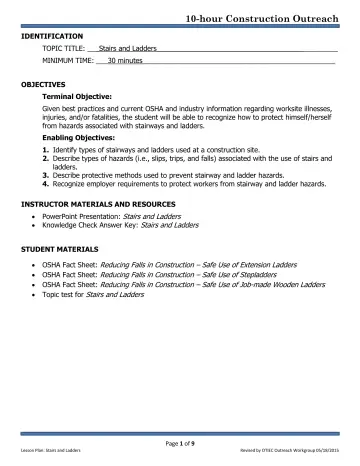
36 slidesStairways and Ladders (OSHA 10-Hour Construction Outreach)
OSHA's own 10-hour Construction Outreach deck on stairways and portable/job-made ladders (2015 edition), with case studies and a built-in knowledge check.
U.S. Department of Labor, OSHA (with the OTIEC Outreach Workgroup)ArchivedPublic domain
pdf
9 slidesStairways and Ladders: Lesson Plan (OSHA 10-Hour Construction Outreach)
Instructor lesson plan with objectives, timing and teaching procedures for the OSHA stairways and ladders outreach deck.
U.S. Department of Labor, OSHA (with the OTIEC Outreach Workgroup)ArchivedPublic domain
pdf
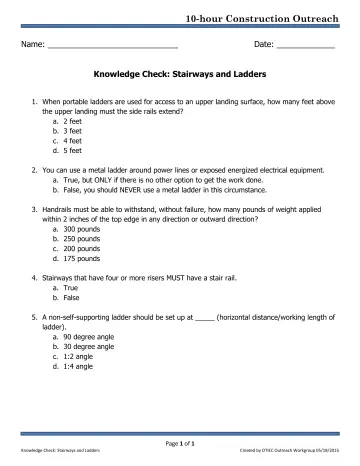
1 slidesStairways and Ladders: Knowledge Check (OSHA 10-Hour Construction Outreach)
Student knowledge-check quiz that accompanies the OSHA stairways and ladders outreach deck.
U.S. Department of Labor, OSHA (with the OTIEC Outreach Workgroup)ArchivedPublic domain