1 / 46Use ← → to flip
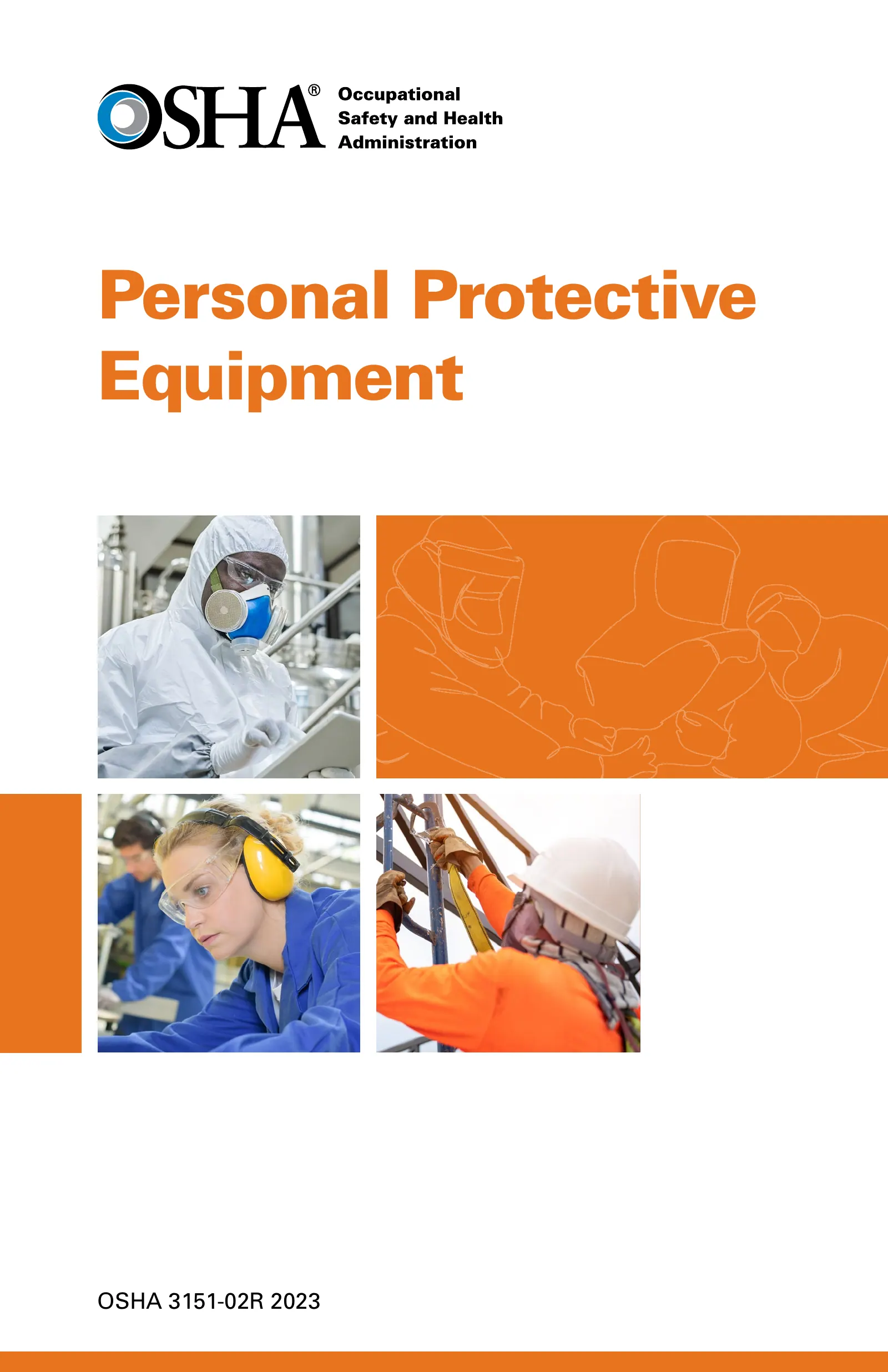
Personal Protective Equipment (OSHA 3151)
OSHA booklet covering hazard assessment and selection of eye, face, head, foot, hand, body and hearing protection.
Page text
· 46 pages · by U.S. Department of Labor, OSHA
The words on each page as the author wrote them, read from the file by software so they can be searched. Layout, pictures and tables are not shown here, and long pages are shortened: the pages above and the download are the original.
- Page 1
Personal Protective Equipment
- OSHA 3151-02R 2023
- Page 2
Occupational Safety and Health Act of 1970
- “To assure safe and healthful working conditions for working men and women; by authorizing enforcement of the standards developed under the Act; by assisting and encouraging the States in their efforts to assure safe and healthful working conditions; by providing for research, information, education, and training in the field of occupational safety and health.”
- This guidance is not a standard or regulation, and it creates no new legal obligations. It contains recommendations as well as descriptions of mandatory safety and health standards.
- …
- Page 3
Personal Protective Equipment
- U.S. Department of Labor
- Occupational Safety and Health Administration
- OSHA 3151-02R 2023
- Page 4
Contents
- Introduction … 3
- The Requirement for PPE … 4
- The Hazard Assessment … 5
- Selecting PPE … 7
- Training Employees in the Proper Use of PPE … 9
- Eye and Face Protection … 9
- Head Protection … 16
- Foot and Leg Protection … 19
- Hand and Arm Protection … 22
- Body Protection … 30
- Hearing Protection … 31
- Personal Fall Protection Systems … 33
- OSHA Assistance, Services, and Programs … 34
- OSHA Regional Offices … 37
- How to Contact OSHA … 39
- Appendix A: OSHA Standards that Require PPE … 40
- Page 5
Introduction
- Hazards exist in every workplace in many different forms: sharp edges, falling objects, flying sparks, chemicals, noise and a myriad of other potentially dangerous situations. The Occupational Safety and Health Administration (OSHA) requires that employers protect their employees from workplace hazards that can cause injury.
- Controlling a hazard at its source is the best way to protect employees. Depending on the hazard or workplace conditions, OSHA recommends the use of engineering or work practice controls to manage or eliminate hazards to the greatest extent possible. …
- …
- Page 6
The Requirement for PPE
- on the OSHA requirements for PPE as set forth in the Code of Federal Regulations (CFR) at 29 CFR 1910.132 (General requirements); 29 CFR 1910.133 (Eye and face protection);
- 29 CFR 1910.135 (Head protection); 29 CFR 1910.136 (Foot protection); 29 CFR 1910.137 (Electrical protective equipment); 29 CFR 1910.138 (Hand protection); 29 CFR 1910.140 (Personal Fall Protection) and regulations that cover the construction industry, at 29 CFR 1926.95 (Criteria for personal protective equipment); 29 CFR 1926.96 (Occupational foot protection); 29 CFR 1926.97 (Electrical protective equipment); 29 CFR 1926.100 (Head protection); 29 CFR…
- …
- Page 7
In general, employees should:
- Properly wear PPE,
- Attend training sessions on PPE,
- Care for, clean and maintain PPE, and
- Inform a supervisor of the need to repair or replace PPE. Specific requirements for PPE are presented in many different
- OSHA standards, published in 29 CFR. Some standards require that employers provide PPE at no cost to the employee while others simply state that the employer must provide PPE. Appendix A at page 40 lists those standards that require the employer to provide PPE and those that require the employer to provide PPE at no cost to the employee.
- …
- Page 8
- Fall hazards,
- Impact,
- Penetration,
- Compression (roll-over),
- Chemical,
- Heat/cold,
- Harmful dust,
- Light (optical) radiation, and
- Biologic.
- In addition to noting the basic layout of the facility and reviewing any history of occupational illnesses or injuries, things to look for during the walkthrough survey include:
- Sources of electricity.
- Sources of motion such as machines or processes where movement may exist that could result in an impact between personnel and equipment.
- Sources of high temperatures that could result in burns, eye injuries or fire.
- Types of chemicals used in the workplace.
- Sources of harmful dusts.
- …
- Page 9
- The employer should become aware of the different types of PPE available and the levels of protection offered. It is definitely a good idea to select PPE that will provide a level of protection greater than the minimum required to protect employees from hazards.
- Then periodically reassess the workplace for any changes in conditions, equipment or operating procedures that could create occupational hazards. This periodic reassessment should also include a review of injury and illness records to spot any trends or areas of concern and taking appropriate corrective action. …
- …
- Page 10
- OSHA requires that many categories of PPE meet or be equivalent to standards approved by the American National Standards Institute (ANSI). ANSI has been preparing safety standards since the 1920s, when the first safety standard was approved to protect the heads and eyes of industrial workers. Employers who need to provide PPE in the categories listed below must make certain that any new equipment procured meets the cited ANSI standard. Existing PPE stocks must meet the ANSI standard in effect at the time of its manufacture or provide protection equivalent to PPE manufactured to the ANSI criteria. …
- …
- Page 11
Training Employees in the Proper Use of PPE
- Employers are required to train each employee who must use PPE. Employees must be trained to know at least the following:
- When PPE is necessary.
- What PPE is necessary.
- How to properly put on, take off, adjust and wear the PPE.
- The limitations of the PPE.
- Proper care, maintenance, useful life, and disposal of PPE.
- Employers shall make sure that each employee demonstrates an understanding of the PPE training (i.e., in a language they understand) as well as the ability to properly wear and use PPE before they are allowed to perform work requiring the use of the PPE. …
- …
- Page 12
Prescription Lenses
- Use of ordinary prescription corrective lenses will not provide adequate protection against most occupational eye and face hazards, so employers must make sure that employees with corrective lenses either wear eye protection that incorporates the prescription into the design of adequate eye protection or wear eye protection that fits over their prescription lenses. It is important to ensure that the protective eyewear fits properly, and does not disturb the proper positioning of the prescription lenses so that the employee’s vision will not be inhibited or limited. …
- …
- Page 13
Types of Eye Protection
- Selecting suitable eye and face protection for employees should take into consideration the following elements:
- Ability to protect against specific workplace hazards.
- Should fit properly and be reasonably comfortable to wear.
- Should provide unrestricted vision and movement.
- Should be durable and cleanable.
- Should allow unrestricted functioning of any other required PPE.
- The eye and face protection selected for employee use must clearly identify the manufacturer. Any new eye and face protective devices must comply with any of the following; ANSI Z87.1-2010, ANSI Z87.1-2003, or ANSI Z87.1-1989(R1998) or be at least as…
- …
- Page 14
- Laser safety goggles. These specialty goggles protect against intense concentrations of light produced by lasers. The type of laser safety goggles an employer chooses will depend upon the equipment and operating conditions in the workplace.
- Face shields. These transparent sheets of plastic extend from the eyebrows to below the chin and across the entire width of the employee’s head. Some are polarized for glare protection. Face shields protect against potential splashes or sprays of hazardous liquids, droplets, and particles but will not provide adequate protection against impact hazards. …
- …
- Page 15
Table 1: Filter Lenses for Protection Against Radiant Energy
- Operations
- Shielded metal arc welding
- Plate thickness inches
- Plate thickness mm
- Minimum* protective shade
- < 3
- < 60
- 3 - 5
- 60 - 160
- 5 - 8
- 160 - 250
- 250 - 550
- Gas metal arc welding and flux cored arc welding
- Gas tungsten arc welding
- < 60
- 60 - 160
- 160 - 250
- 250 - 500
- < 50
- 50 - 150
- 150 - 500
- Air carbon
- (light)
- < 500
- Arc cutting
- (heavy)
- 500 - 1,000
- < 20
- Plasma arc welding
- Plasma arc cutting
- 20 - 100
- 100 - 400
- 400 - 800
- (light)**
- < 300
- (medium)**
- 300 - 400
- (heavy)**
- 400 - 800
- Torch brazing
- Torch soldering
- Carbon arc welding
- Gas welding: Light
- < 1/8
- < 3.2
- Gas welding: Medium
- 1/8 - 1/2
- …
- Page 16
Operations
- Plate thickness inches
- Plate thickness mm
- Minimum* protective shade
- Oxygen cutting: Light
- < 1
- < 25
- Oxygen cutting: Medium
- 1 - 6
- 25 - 150
- Oxygen cutting: Heavy
- Source: 29 CFR 1910.133(a)(5).
- As a rule of thumb, start with a shade that is too dark to see the weld zone. Then go to a lighter shade which gives sufficient view of the weld zone without going below the minimum. In oxyfuel gas welding or cutting where the torch produces a high yellow light, it is desirable to use a filter lens that absorbs the yellow or sodium line in the visible light of the (spectrum) operation.
- …
- Page 17
Laser Operations
- Welding Operation
- Shade Number
- Heavy cutting, more than 6 inches
- 5 or 6
- Gas welding (light), up to 1/8-inch
- 4 or 5
- Gas welding (medium), 1/8- to 1/2-inch
- 5 or 6
- Gas welding (heavy), more than 1/2-inch
- 6 or 8
- Source: 29 CFR 1926.102(c)(1).
- Laser light radiation can be extremely dangerous to the unprotected eye and direct or reflected beams can cause permanent eye damage. Laser retinal burns can be painless, so it is essential that all personnel in or around laser operations wear appropriate eye protection.
- Laser safety goggles should protect for the specific wavelength of the laser and must be of sufficient optical density for…
- …
- Page 18
Head Protection
- Protecting employees from potential head injuries is a key element of any safety program. A head injury can impair an employee for life or it can be fatal. Wearing a safety helmet or hard hat is one of the easiest ways to protect an employee’s head from injury. Hard hats can protect employees from impact and penetration hazards as well as from electrical shock and burn hazards.
- Employers must ensure that their employees wear head protection if any of the following apply:
- Objects might fall from above and strike them on the head;
- They might bump their heads against fixed objects, such as exposed pipes or beams; or
- …
- Page 19
Types of Hard Hats
- Protective headgear must comply with any of the following consensus standards ANSI Z89.1-2009, ANSI Z89.1-2003, or ANSI Z89.1-1997 or provide an equivalent level of protection.
- There are many types of hard hats available in the marketplace today. In addition to selecting protective headgear that meets ANSI standard requirements, employers should ensure that employees wear hard hats that provide appropriate protection against potential workplace hazards. It is important for employers to understand all potential hazards when making this selection, including electrical hazards. …
- …
- Page 20
Size and Care Considerations
- Head protection that is either too large or too small is inappropriate for use, even if it meets all other requirements. Protective headgear must fit appropriately on the body and for the head size of each individual. Most protective headgear comes in a variety of sizes with adjustable headbands to ensure a proper fit (many adjust in 1/8-inch increments). A proper fit should allow sufficient clearance between the shell and the suspension system for ventilation and distribution of an impact. The hat should not bind, slip, fall off or irritate the skin.
- …
- Page 21
Foot and Leg Protection
- Always replace a hard hat if it sustains an impact, even if damage is not noticeable. Suspension systems are offered as replacement parts and should be replaced when damaged or when excessive wear is noticed. It is not necessary to replace the entire hard hat when deterioration or tears of the suspension systems are noticed.
- Employees who face possible foot or leg injuries from falling or rolling objects or from crushing or penetrating materials should wear protective footwear. Also, employees whose work involves exposure to hot substances or corrosive or poisonous materials must have protective gear to cover exposed body…
- …
- Page 22
- and offers impact and compression protection, but the type and amount of protection is not always the same. Different footwear protects in different ways. Check the product’s labeling or consult the manufacturer to make sure the footwear will protect the user from the hazards they face.
- Foot and leg protection choices include the following:
- Leggings protect the lower legs and feet from heat hazards such as molten metal or welding sparks. Safety snaps allow leggings to be removed quickly.
- Metatarsal guards protect the instep area from impact and compression. Made of aluminum, steel, fiber or plastic, these guards may be strapped to the outside…
- …
- Page 23
Foundry Shoes
- because it provides insulation, reducing the conductive ability of the shoes. Silk, wool and nylon socks can produce static electricity and should not be worn with conductive footwear. Conductive shoes must be removed when the task requiring their use is completed. Note: Employees exposed to electrical hazards must never wear conductive shoes.
- Electrical hazard, safety-toe shoes are nonconductive and will prevent the wearers’ feet from completing an electrical circuit to the ground. These shoes can protect against open circuits of up to 600 volts in dry conditions and should be used in conjunction with other insulating equipment…
- …
- Page 24
Hand and Arm Protection
- If a workplace hazard assessment reveals that employees face potential injury to hands and arms that cannot be eliminated through engineering and work practice controls, employers must ensure that employees wear appropriate protection. Potential hazards include skin absorption of harmful substances, chemical or thermal burns, electrical dangers, bruises, abrasions, cuts, punctures, fractures and amputations. Protective equipment includes gloves, finger guards and arm coverings or elbow-length gloves.
- Employers should explore all possible engineering and work practice controls to eliminate hazards and use PPE to provide…
- …
- Page 25
Leather, Canvas or Metal Mesh Gloves
- Area requiring protection (hand only, forearm, arm).
- Grip requirements (dry, wet, oily).
- Thermal protection.
- Size and comfort.
- Abrasion/resistance requirements.
- Gloves made from a wide variety of materials are designed for many types of workplace hazards. In general, gloves fall into four groups:
- Gloves made of leather, canvas or metal mesh;
- Fabric and coated fabric gloves;
- Chemical- and liquid-resistant gloves;
- Insulating rubber gloves (See 29 CFR 1910.137 and the following section on electrical protective equipment for detailed require- ments on the selection, use and care of insulating rubber gloves).
- …
- Page 26
Fabric and Coated Fabric Gloves
- Fabric and coated fabric gloves are made of cotton or other fabric to provide varying degrees of protection.
- Fabric gloves protect against dirt, slivers, chafing and abrasions. They do not provide sufficient protection for use with rough, sharp or heavy materials. Adding a plastic coating will strengthen some fabric gloves.
- Coated fabric gloves are normally made from cotton flannel with napping on one side. By coating the unnapped side with plastic, fabric gloves are transformed into general-purpose hand protection offering slip-resistant qualities. …
- …
- Page 27
- abrasion, and remain flexible at low temperatures. Butyl rubber does not perform well with aliphatic and aromatic hydrocarbons and halogenated solvents.
- Natural (latex) rubber gloves are comfortable to wear, which makes them a popular general-purpose glove.
- They feature outstanding tensile strength, elasticity, and temperature resistance. In addition to resisting abrasions caused by grinding and polishing, these gloves protect employees’ hands from most water solutions of acids, alkalis, salts, and ketones. Latex gloves have caused allergic reactions in some individuals and may not be appropriate for all employees. …
- …
- Page 28
Table 4: Chemical Resistance Selection Chart for Protective Gloves
- Chemical
- Neoprene Latex/Rubber
- Butyl
- Nitrile
- Acetaldehyde*
- VG
- VG
- Acetic acid
- VG
- VG
- VG
- VG
- Acetone*
- VG
- VG
- Ammonium hydroxide
- VG
- VG
- VG
- VG
- Amyl acetate*
- Aniline
- Benzaldehyde*
- Benzene*
- Butyl acetate
- Butyl alcohol
- VG
- VG
- VG
- VG
- Carbon disulfide
- Carbon tetrachloride*
- Castor oil
- VG
- Chlorobenzene*
- Chloroform*
- Chloronaphthalene
- Chromic acid (50%)
- Citric acid (10%)
- VG
- VG
- VG
- VG
- Cyclohexanol
- VG
- Dibutyl phthalate*
- Diesel fuel
- VG
- Diisobutyl ketone
- Dimethylformamide
- Dioctyl phthalate
- VG
- Dioxane
- VG
- Epoxy resins, dry
- VG
- VG
- VG
- VG
- Ethyl acetate*
- Ethyl alcohol
- VG
- VG
- VG
- VG
- Ethyl ether*
- VG
- VG
- Page 29
Chemical
- Neoprene Latex/Rubber
- Butyl
- Nitrile
- Ethylene dichloride*
- Ethylene glycol
- VG
- VG
- VG
- VG
- Formaldehyde
- VG
- VG
- VG
- VG
- Formic acid
- VG
- VG
- VG
- VG
- Freon 11
- Freon 12
- Freon 21
- Freon 22
- Furfural*
- Gasoline, leaded
- VG
- Gasoline, unleaded
- VG
- Glycerin
- VG
- VG
- VG
- VG
- Hexane
- Hydrazine (65%)
- Hydrochloric acid
- VG
- Hydrofluoric acid (48%)
- VG
- Hydrogen peroxide (30%)
- Hydroquinone
- Isooctane
- VG
- Kerosene
- VG
- VG
- Ketones
- VG
- VG
- Lacquer thinners
- Lactic acid (85%)
- VG
- VG
- VG
- VG
- Lauric acid (36%)
- VG
- VG
- VG
- Lineolic acid
- VG
- Linseed oil
- VG
- VG
- Maleic acid
- VG
- VG
- VG
- VG
- Methyl alcohol
- VG
- VG
- VG
- VG
- Methylamine
- Page 30
Chemical
- Neoprene Latex/Rubber
- Butyl
- Nitrile
- Methyl bromide
- Methyl chloride*
- Methyl ethyl ketone*
- VG
- Methyl isobutyl ketone*
- VG
- Methyl metharcrylate
- VG
- Monoethanolamine
- VG
- VG
- VG
- Morpholine
- VG
- VG
- VG
- Naphthalene
- Napthas, aliphatic
- VG
- VG
- Napthas, aromatic
- Nitric acid*
- fuming
- Nitromethane (95.5%)*
- Nitropropane (95.5%)
- Octyl alcohol
- VG
- VG
- VG
- VG
- Oleic acid
- VG
- VG
- Oxalic acid
- VG
- VG
- VG
- VG
- Palmitic acid
- VG
- VG
- VG
- VG
- Perchloric acid (60%)
- VG
- Perchloroethylene
- (naphtha)
- VG
- Phenol
- VG
- Phosphoric acid
- VG
- VG
- VG
- Potassium hydroxide
- VG
- VG
- VG
- VG
- Propyl acetate
- Propyl alcohol
- VG
- VG
- VG
- VG
- Nitric acid, red and white
- Petroleum distillates
- Page 31
Chemical
- Neoprene Latex/Rubber
- Butyl
- Nitrile
- Propyl alcohol (iso)
- VG
- VG
- VG
- VG
- Sodium hydroxide
- VG
- VG
- VG
- VG
- Styrene
- Styrene (100%)
- Sulfuric acid
- Tannic acid (65)
- VG
- VG
- VG
- VG
- Tetrahydrofuran
- Toluene*
- Toluene diisocyanate (TDI)
- Trichloroethylene*
- Triethanolamine (85%)
- VG
- VG
- Tung oil
- VG
- VG
- Turpentine
- VG
- Xylene*
- Note: When selecting chemical-resistant gloves be sure to consult the manufacturer’s recommendations, especially if the gloved hand(s) will be immersed in the chemical.
- Care of Protective Gloves
- Inspect protective gloves before each use to ensure that they are not torn, punctured or made ineffective in any way. …
- …
- Page 32
Body Protection
- Employees who face possible bodily injury of any kind that cannot be eliminated through engineering, work practice or administrative controls must wear appropriate body protection while performing their jobs. In addition to cuts and radiation, the following are examples of workplace hazards that could cause bodily injury:
- Temperature extremes;
- Hot splashes from molten metals and other hot liquids;
- Potential impacts from tools, machinery and materials;
- Hazardous chemicals.
- There are varieties of protective clothing available for specific hazards. Employers are required to ensure that their employees wear personal protective…
- …
- Page 33
Hearing Protection
- Rubber, rubberized fabrics, neoprene and plastics protect against certain chemicals and physical hazards. When chemical or physical hazards are present, check with the clothing manufacturer to ensure that the material selected will provide adequate protection against the specific hazard.
- Certain operations generate noise requiring hearing protection. Employee exposure to excessive noise depends upon a number of factors, including:
- The noise level, as measured in decibels (dB).
- The duration of each employee’s exposure to the noise.
- Whether employees move between work areas with different noise levels.
- …
- Page 34
- type of noise must not exceed 140 dB. Examples of situations or tools that may result in impact or impulse noises are powderactuated nail guns, the use of a punch press or drop hammers.
- Table 5: Permissible Noise Exposures
- Duration per day, in hours
- Sound level in dB*
- 1/4 or less
- *When measured on the A scale of a standard sound level meter at slow response.
- Source: 29 CFR 1910.95, Table G-16.
- If engineering and work practice controls do not lower employee exposure to workplace noise to acceptable levels, employees must wear appropriate hearing protection. …
- …
- Page 35
Personal Fall Protection Systems
- over an eight-hour period, the employer is required to institute a hearing conservation program that includes regular testing of employees’ hearing by qualified professionals. Refer to 29 CFR 1910.95(c) for a description of the requirements for a hearing conservation program.
- Some types of hearing protection include:
- Single-use earplugs are made of waxed cotton, foam, silicone rubber or fiberglass wool. They are self-forming and, when properly inserted, they work as well as most molded earplugs.
- Pre-formed or molded earplugs are individually fitted by a professional and can be disposable or reusable. …
- …
- Page 36
- A positioning system is a system of equipment and connectors that, when used with a body harness or body belt, allows an employee to be supported on an elevated vertical surface, such as a wall or windowsill, and work with both hands free. Positioning systems also are called “positioning system devices” and “work-positioning equipment.”
- A personal fall arrest system is a system used to arrest an employee in a fall from a walking-working surface. It consists of a body harness, anchorage, and connector. The means of connection may include a lanyard, deceleration device, lifeline, or a suitable combination of these.
- …
- Page 37
Compliance Assistance Specialists
- OSHA compliance assistance specialists can provide information to employers and workers about OSHA standards, short educational programs on specific hazards or OSHA rights and responsibilities, and information on additional compliance assistance resources.
- Visit www.osha.gov/complianceassistance/cas or call 1-800- 321-OSHA (6742) to contact your local OSHA office.
- No-Cost On-Site Safety and Health Consultation Services for Small Business
- OSHA’s On-Site Consultation Program offers no‑cost and confidential advice to small and medium-sized businesses in all states, with priority given to high-hazard worksites. …
- …
- Page 38
Occupational Safety and Health Training
- stakeholders. Through the Alliance Program, OSHA works with groups to develop compliance assistance tools and resources to share with workers and employers, and educate workers and employers about their rights and responsibilities.
- Voluntary Protection Programs (VPP)
- The VPP recognize employers and workers in the private sector and federal agencies who have implemented effective safety and health programs and maintain injury and illness rates below the national average for their respective industries.
- OSHA partners with 26 OSHA Training Institute Education Centers at 37 locations throughout the United…
- …
- Page 39
OSHA Regional Offices
- Region 1
- Boston Regional Office
- (CT*, ME*, MA*, NH, RI, VT*)
- JFK Federal Building
- 25 New Sudbury Street, Room E340
- Boston, MA 02203
- (617) 565-9860 (617) 565-9827 Fax
- Region 2
- New York Regional Office
- (NJ*, NY*, PR*, VI*)
- Federal Building
- 201 Varick Street, Room 670
- New York, NY 10014
- (212) 337-2378 (212) 337-2371 Fax
- Region 3
- Philadelphia Regional Office
- (DE, DC, MD*, PA, VA*, WV)
- The Curtis Center
- 170 S. Independence Mall West, Suite 740 West Philadelphia, PA 19106-3309
- (215) 861-4900 (215) 861-4904 Fax
- Region 4
- Atlanta Regional Office
- (AL, FL, GA, KY*, MS, NC*, SC*, TN*)
- Sam Nunn Atlanta Federal Center
- …
- Page 40
Region 6
- Dallas Regional Office (AR, LA, NM*, OK, TX)
- A. Maceo Smith Federal Building 525 Griffin Street, Room 602 Dallas, TX 75202
- (972) 850-4145 (972) 850-4149 Fax
- Region 7
- Kansas City Regional Office
- (IA*, KS, MO, NE)
- Two Pershing Square Building
- 2300 Main Street, Suite 1010
- Kansas City, MO 64108-2416
- (816) 283-8745 (816) 283-0547 Fax
- Region 8
- Denver Regional Office
- (CO, MT, ND, SD, UT*, WY*) Cesar Chavez Memorial Building 1244 Speer Boulevard, Suite 551 Denver, CO 80204
- (720) 264-6550 (720) 264-6585 Fax
- Region 9
- San Francisco Regional Office
- (AZ*, CA*, HI*, NV*, and American Samoa, Guam and the Northern Mariana Islands) San Francisco Federal…
- …
- Page 41
How to Contact OSHA
- *These states and territories operate their own OSHA-approved job safety and health plans and cover state and local government employees as well as private sector employees. The Connecticut, Illinois, Maine, Massachusetts, New Jersey, New York and Virgin Islands programs cover public employees only. (Private sector workers in these states are covered by Federal OSHA). States with approved programs must have standards that are identical to, or at least as effective as, the Federal OSHA standards.
- Note: To get contact information for OSHA area offices, OSHA-approved State Plans and OSHA consultation projects, please visit us…
- …
- Page 42
Appendix A: OSHA Standards that Require PPE
- 29 CFR 1910, General Industry
- Standards that Require the Employer to Provide PPE:
- 1910.28 1910.66 1910.67 1910.94 1910.119 1910.120 1910.132 1910.133 1910.134 1910.135 1910.136 1910.137 1910.138 1910.140 1910.157 1910.160 1910.183 1910.218 1910.242 1910.243 1910.252 1910.261 1910.262 1910.268 1910.269 1910.333 1910.335 1910.1000 1910.1003 1910.1017 1910.1029 1910.1043 1910.1096
- Duty to have fall protection and falling object protection Powered platforms for building maintenance Vehicle-mounted elevating and rotating work platforms Ventilation
- …
- Page 43
Standards that Require the Employer to Provide PPE at No Cost to the Employee:
- 1910.95 1910.134 1910.146 1910.156 1910.266 1910.1001 1910.1018 1910.1025 1910.1027 1910.1028 1910.1030 1910.1044 1910.1045 1910.1047 1910.1048 1910.1050 1910.1051 1910.1052 1910.1450
- Occupational noise exposure
- Respiratory protection
- Permit-required confined spaces
- Fire brigades
- Logging operations
- Asbestos
- Inorganic Arsenic
- Lead
- Cadmium
- Benzene
- Bloodborne pathogens 1,2-dibromo-3-chloropropane
- Acrylonitrile
- Ethylene oxide
- Formaldehyde
- Methylenedianiline
- 1,3-Butadiene
- Methylene chloride
- Occupational exposure to chemicals in laboratories
- 29 CFR 1915, Shipyard Employment
- …
- Page 44
29 CFR 1917, Marine Terminals
- Standards that Require the Employer to Provide PPE at No Cost to the Employee:
- 1915.154
- Respiratory Protection
- 1915.1001 Asbestos
- Standards that Require the Employer to Provide PPE:
- 1917.22
- Hazardous cargo
- 1917.25
- Fumigants, pesticides, insecticides and hazardous waste 1917.26
- First aid and lifesaving facilities
- 1917.91
- Eye and face protection
- 1917.93
- Head protection
- 1917.95
- Other protective measures
- 1917.126
- River banks
- 1917.152
- Welding, cutting and heating (hot work)
- 1917.154
- Compressed air
- 1917.92
- 29 CFR 1918, Longshoring
- Standards that Require the Employer to Provide PPE: 1918.85
- Containerized cargo operations
- …
- Page 45
- 1926.95
- 1926.96
- 1926.100
- 1926.101
- 1926.102
- 1926.104
- 1926.105
- 1926.106
- 1926.250
- 1926.300
- 1926.302
- 1926.304
- 1926.353
- 1926.354
- 1926.416
- 1926.451
- 1926.453
- 1926.501
- 1926.502
- 1926
- Subpart CC
- 1926.551
- 1926.701
- 1926.760 1926.800 1926.951 1926.955 1926.1101
- Criteria for personal protective equipment
- Occupational foot protection
- Head protection
- Hearing protection
- Eye and face protection
- Safety belts, lifelines and lanyards
- Safety nets
- Working over or near water
- General requirements for storage
- General requirements (Hand and power tools) Power-operated hand tools
- Woodworking tools
- …
- Page 46
U.S. Department of Labor
- For more information:
- Occupational Safety and Health Administration www.osha.gov (800) 321-OSHA (6742)
More on PPE
pdf
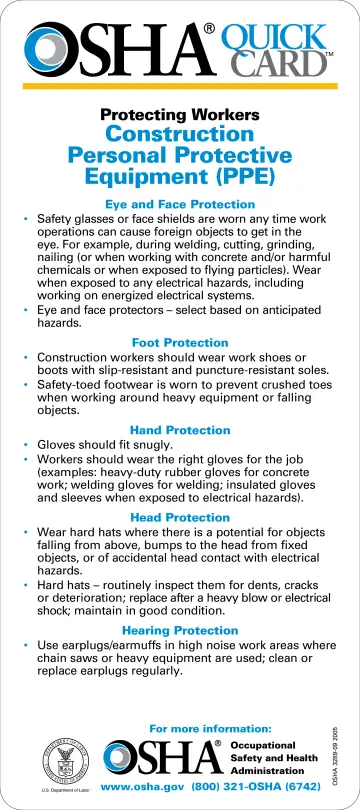
1 slidesConstruction PPE QuickCard (OSHA 3289)
Pocket card on hard hats, eye, hearing, hand and foot protection on construction sites.
U.S. Department of Labor, OSHAPublic domain
pdfes
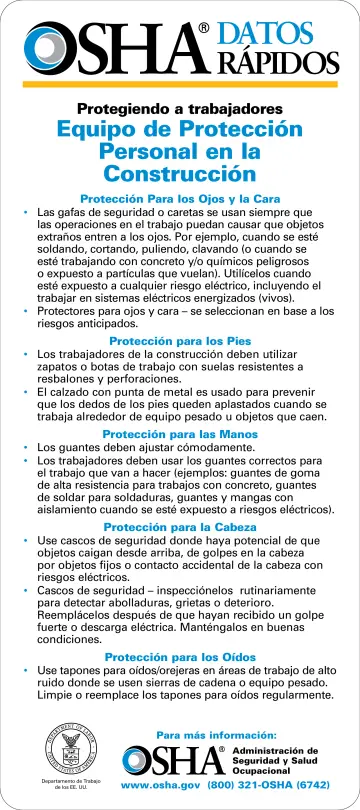
1 slidesTarjeta: EPP en la construcción (OSHA 3289)
Spanish construction PPE QuickCard.
U.S. Department of Labor, OSHAPublic domain
pdf
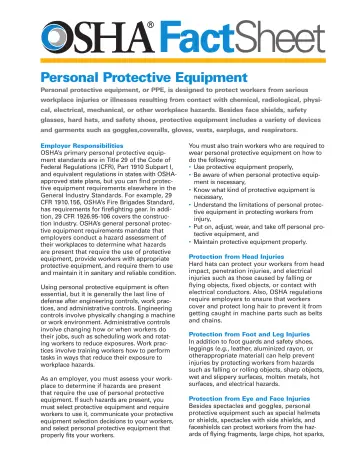
2 slidesPersonal Protective Equipment Fact Sheet
OSHA fact sheet on PPE requirements and employer responsibilities.
U.S. Department of Labor, OSHAPublic domain