1 / 7Use ← → to flip
Personal Protective Equipment: Lesson Plan (OSHA 10-Hour Construction Outreach)
Instructor lesson plan with objectives, timing and teaching procedures for the OSHA personal protective equipment outreach deck.
Page text
· 7 pages · by U.S. Department of Labor, OSHA (with the OTIEC Outreach Workgroup)
The words on each page as the author wrote them, read from the file by software so they can be searched. Layout, pictures and tables are not shown here: the pages above and the download are the original.
- Page 1
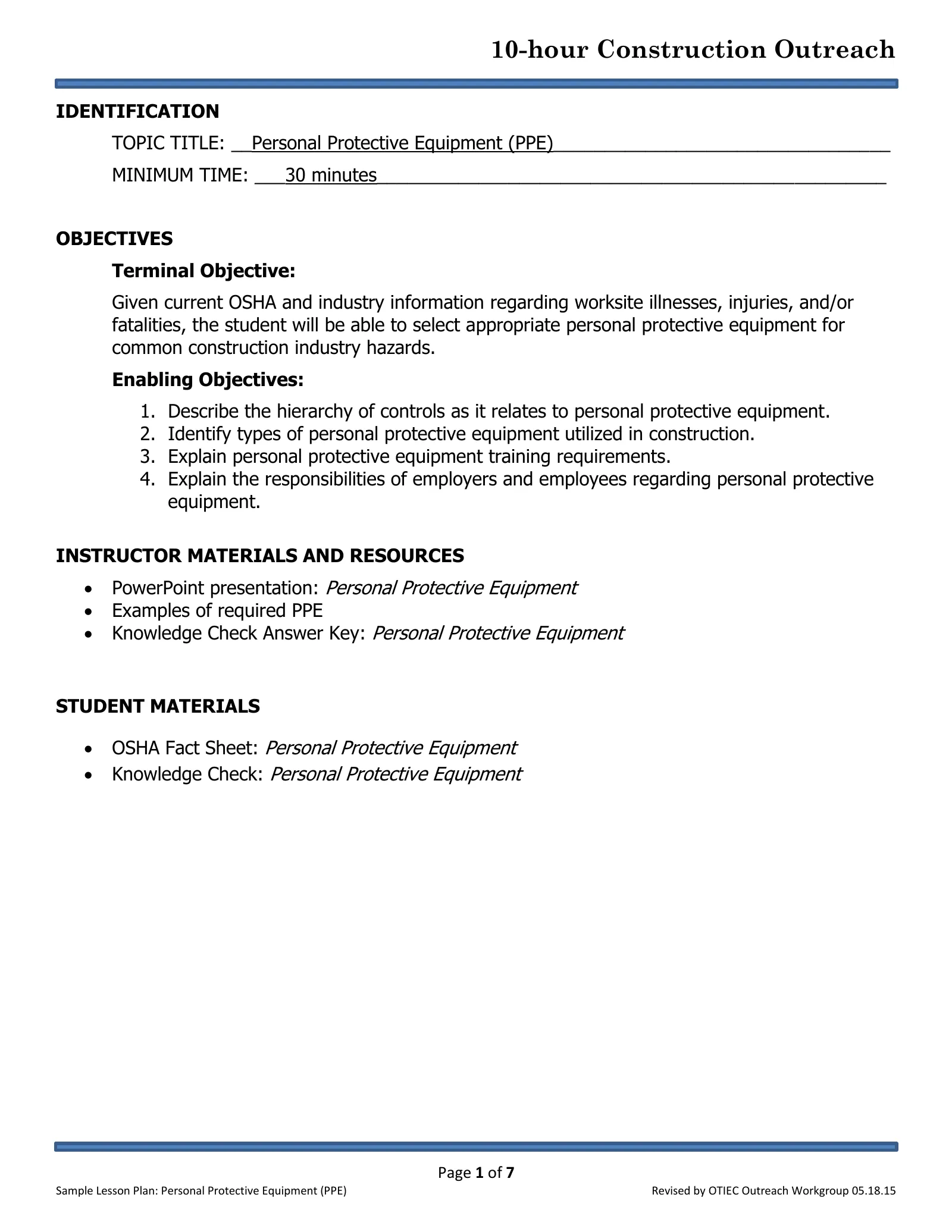
IDENTIFICATION
- TOPIC TITLE: __Personal Protective Equipment (PPE)___
- MINIMUM TIME: ___30 minutes___
- OBJECTIVES
- Terminal Objective:
- Given current OSHA and industry information regarding worksite illnesses, injuries, and/or fatalities, the student will be able to select appropriate personal protective equipment for common construction industry hazards.
- Enabling Objectives:
- 1. Describe the hierarchy of controls as it relates to personal protective equipment.
- 2. Identify types of personal protective equipment utilized in construction.
- 3. Explain personal protective equipment training requirements.
- 4. Explain the responsibilities of employers and employees regarding personal protective equipment.
- INSTRUCTOR MATERIALS AND RESOURCES
- PowerPoint presentation: Personal Protective Equipment Examples of required PPE
- Knowledge Check Answer Key: Personal Protective Equipment
- STUDENT MATERIALS
- OSHA Fact Sheet: Personal Protective Equipment Knowledge Check: Personal Protective Equipment
- Page 2
TEACHING PROCEDURES ---Preparation, Presentation, Application, Evaluation
- Anticipatory Set (Focus Attention/Gain Interest)
- Estimated Time: ?? hours
- Key Points
- Methods
- OSHA requires employees to protect their employees from workplace hazards through the use of engineering or work practice controls. When these controls are not feasible or do not provide sufficient protection, the use of personal protective equipment (PPE) is required.
- PPT slides #1 – #3
- Employers are required to assess the workplace to determine if hazards are present, or are likely to be present, which necessitates the use of PPE. If employees use PPE, employers must establish general procedures, called a PPE Program , to give employees necessary protective equipment and to train them to use it properly. The program should explain when to use PPE and how to select, maintain, and evaluate it.
- Presentation (Instruction)___
- Key Points
- Methods
- I. Hierarchy of controls
- Instructor-led discussion
- A. Engineering controls
- PPT slides #4 - #8
- https://www.osha.gov/SLTC/etools/safetyhealth/comp3.ht ml
- 1. Substitution
- 2. Isolation
- 3. Ventilation
- 4. Equipment modification
- 5. Others
- B. Administrative controls
- 1. Proper procedures
- 2. Inspection and maintenance
- Page 3
3. Housekeeping
- 4. Supervision
- 5. Regulated areas (no eating, drinking, smoking, chewing tobacco or gum, and applying cosmetics)
- 6. Limit exposure by time or distance
- 7. Others
- C. PPE
- PPT slides #9 – #29
- II. Types of PPE
- https://www.osha.gov/SLTC/etools/safetyhealth/comp3.ht ml
- A. Head protection
- 1. Classes of hard hats
- https://www.osha.gov/Publications/osha3151.html
- 2. Selecting the right hard hat
- B. Eye and face protection
- 1. When must eye protection be provided?
- https://www.osha.gov/SLTC/etools/eyeandface/index.html
- 2. Criteria for selecting eye protection
- 3. Employees who wear eyeglasses
- 4. Examples of eye and face protection
- C. Respiratory Protection
- D. Hearing protection
- 1. Average dBA for selected construction trades/ activities
- 2. When must hearing protection be provided?
- https://www.osha.gov/SLTC/etools/respiratory/respirator_selection.html https://www.osha.gov/dts/osta/otm/noise/index.html
- 3. Examples of hearing protection
- E. Hand and arm protection
- 1. When must hand protection be provided?
- 2. Examples of hand and arm protection
- Page 4
F. Foot and leg protection
- 1. When must foot protection be provided?
- https://www.osha.gov/Publications/osha3151.html
- 2. Examples of foot and leg protection
- G. Body protection – protective clothing
- 1. Major causes of body injuries https://www.osha.gov/Publications/osha3151.html
- 2. Criteria for selecting body protection
- 3. Examples of body protection
- III. Training employees who are required to use PPE
- PPT slide #30
- A. Why PPE is necessary
- B. How PPE will protect employee
- C. What PPE can and cannot do
- D. When and how to wear PPE
- E. How to identify signs of wear and tear
- F. How to clean and disinfect PPE
- G. When PPE is worn out and how to properly dispose of PPE
- IV. Responsibilities
- PPT slides #31 – #32
- A. Employer
- 1. Assess workplace for hazards
- 2. Provide PPE at no cost to employee
- 3. Determine when to use
- https://www.osha.gov/Publications/osha3151.html https://www.osha.gov/dte/outreach/intro_osha/7_employee_ppe.pdf
- 4. Provide PPE training
- Page 5
B. Employee
- 1. Use PPE in accordance with training and other instructions
- 2. Inspection and maintenance
- 3. Turn in PPE for replacement when needed
- Application (How students apply what they learn) __
- Estimated Time: ?? hours
- Key Points
- Methods
- Show pictures of jobsite activities. Have students identify the hazards and PPE needed.
- PPT slides #33 – #36
- Evaluation/Summary
- Key Points
- Methods
- Summarize key points
- PPT slide #37
- Knowledge Check: Personal Protective Equipment
- PPT slides #38 – #45
- Page 6
References
- OSHA Standard:
- https://www.osha.gov/pls/oshaweb/owasrch.search_form?p_doc_type=STANDARDS&p_toc_level =1&p_keyvalue=Construction
- 1926 Subpart C, General safety and health provisions
- 1926.28, Personal protective equipment
- 1926 Subpart E, Personal protective and life-saving equipment
- 1926.95, Criteria for personal protective equipment
- 1926.96, Occupational foot protection
- 1926.100, Head protection
- 1926.101, Hearing protection
- 1926.102, Eye and face protection
- 1926.103, Respiratory protection
- 1926.104, Safety belts, lifelines, and lanyards
- 1926.105, Safety nets
- 1926.106, Working over or near water
- 1926.107, Definitions applicable to this subpart
- OSHA Publications
- http://www.osha.gov/pls/publications/publication.athruz?pType=Industry&pID=55
- Construction PPE QuickCard™
- (OSHA 3289 - 2005) (English: HTML PDF) Construction Personal Protective Equipment QuickCard (OSHA 3289) (Spanish: HTML PDF)
- Fall Prevention: Training Guide - A Lesson Plan for Employers (OSHA 3666 - 2013) (English: EPUB MOBI PDF)
- Personal Protective Equipment
- (OSHA 3151 - 2003) (English: HTML PDF)
- Personal Protective Equipment Fact Sheet (English: PDF)
- (OSHA FS 3603 - 2012) (Portuguese: PDF)
- Page 7
Respirators QuickCard™
- (OSHA 3280 - 2005) (English: HTML PDF) (OSHA 3600 - 2012) (Portuguese: PDF) (OSHA 3280 - 2005) (Spanish: HTML PDF)
- Silica: Controlling Silica Exposures in Construction
- (OSHA 3362 - 2009) (English: PDF)
- OSHA References/Resources
- Personal Protective Equipment (PPE) Safety and Health Topics –
- Eye and Face Protection eTool – https://www.osha.gov/SLTC/etools/eyeandface/index.html
- Respiratory Protection eTool – https://www.osha.gov/SLTC/etools/respiratory/index.html
- Noise and Hearing Conservation eTool - – https://www.osha.gov/SLTC/personalprotectiveequipment/construction.html https://www.osha.gov/dts/osta/otm/noise/index.html
More on PPE
pdf
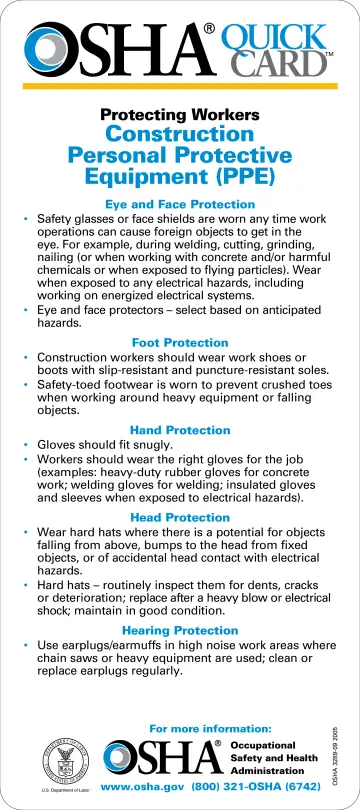
1 slidesConstruction PPE QuickCard (OSHA 3289)
Pocket card on hard hats, eye, hearing, hand and foot protection on construction sites.
U.S. Department of Labor, OSHAPublic domain
pdfes
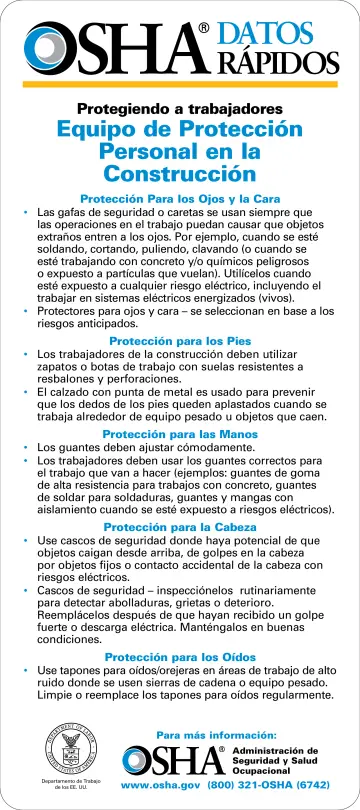
1 slidesTarjeta: EPP en la construcción (OSHA 3289)
Spanish construction PPE QuickCard.
U.S. Department of Labor, OSHAPublic domain
pdf
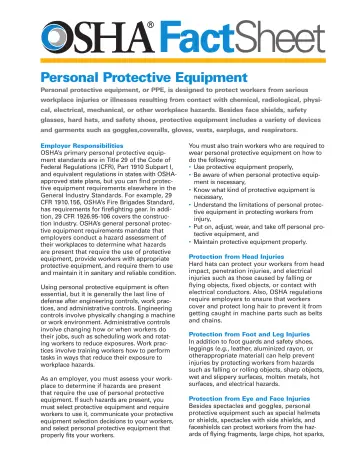
2 slidesPersonal Protective Equipment Fact Sheet
OSHA fact sheet on PPE requirements and employer responsibilities.
U.S. Department of Labor, OSHAPublic domain