1 / 59Use ← → to flip
Personal Protective Equipment
PPE training manual/slide handout from Tampa Hillsborough Action Plan.
Slide text
· 59 slides · by Tampa Hillsborough Action Plan
The words on each slide as the author wrote them, read from the file by software so they can be searched. Layout, pictures and tables are not shown here: the slides above and the download are the original.
- Slide 1
Personal Protective
- Equipment
- This material was produced under grant number SH-05159-SH9 from the Occupational Safety and Health Administration, U.S. Department of Labor. It does not necessarily reflect the views or policies of the U.S. Department of Labor, nor does mention of trade names, commercial products, or organizations imply endorsement by the U.S. Government.
- Slide 2
Icebreaker
- Ice Breaker Video showing OSHA safety violations
- Slide 3
An Intro to PPE
- Intro to PPE Video
- Slide 4
Personal Protective Equipment
- Employers required to provide hazard-free environment
- Protected against potential hazards
- Purpose of Personal
- Protective Equipment or PPE
- Slide 5
WHAT is PPE?
- Clothing and accessories
- Create a barrier
- Head protection
- Eye and Face protective
- Hearing protection
- Hand protection
- Foot protection
- Respiratory protection
- Poster displaying a man wearing all PPE and descriptions listed
- Slide 6
Total & Targeting Participant Fatalities in 2017
- Total & Targeted Participant Fatalities in Florida 2017
- 90%
- 84%
- 80%
- 71%
- 65%
- 70%
- 61%
- 60%
- 59%
- 60%
- 50%
- 40%
- 30%
- 30%
- Total
- Transportation
- 20%
- Violence & other
- Totals
- Fires & explosions
- Project Targeted Occupations*
- Falls, slips, trips
- Harmful substance exposure
- Contact with objects & equipment
- % in Project Targeted Occups.
- 10%
- 0%
- Slide 7
Personal Protective Equipment
- PPE is selected based on the specific job hazards you face.
- Who pays for PPE?
- Do employees provide PPE?
- Slide 8
Engineering Controls
- PPE is always considered a last resort
- Temporary type of protection
- First choice will always be to eliminating hazard
- Examples:
- Initial design specification
- Substitute less harmful
- material
- Change process
- Enclose process
- Isolate process
- White board with Hierarchy of Hazard Control
- Slide 9
Work Practice Controls
- Employees can change the process
- Examples:
- Job rotation
- Wet method
- Personal Hygiene
- House Keeping
- Increase Maintenance
- Slide 10
Job Hazards
- Examples of Job Hazards are:
- Noise
- Chemicals
- Accidental Impact
- Sharp objects
- Flying Particles
- Dust & Mists
- Bright Light
- Vibration
- Slide 11
About PPE
- You should know:
- Limitations of PPE
- How to use PPE
- When to use PPE
- Inspect before use
- Replacement
- Cleaning & Storage
- Slide 12
PPE Limitations
- PPE acts as a barrier between you and a hazard
- PPE will not protect you if it is:
- 1. not designed for the specific hazard
- 2. damaged or worn
- 3. not adjusted properly
- Illustration of 4 figures working
- Slide 13
Using PPE
- For PPE to be effective in protecting you must:
- 1. Use it in the manner you have been trained
- 2. Use it only for the specific hazards for its design
- Slide 14
Inspect before using
- Before you use your PPE, inspect it for:
- 1. Worn or damaged parts
- 2. Leaks, cracks or deformities
- 3. Cleanliness
- 4. Correct size
- The word inspection written on a window
- Slide 15
Replace
- If any PPE is damaged or worn
- 1. Get it repaired or replaced immediately
- 2. Do not work without replacement PPE
- 3. Tell your supervisor you need new PPE
- Slide 16
Cleaning & Storage
- Clean your PPE regularly
- Do not store it where it will be in contact with:
- Dust & Dirt
- Chemicals
- Sunlight
- Water
- Blue storage cabinet for storing & organizing PPE
- Slide 17
Written PPE Program
- 1. An employer should verify written hazard assessment has established for the workplace. This verification should include the following:
- Written certification that workplace has been evaluated.
- The person certifying the evaluation
- The date(s) evaluation performed
- 2. Two basic objectives of a PPE
- Program
- Protect the wearer
- Prevent injury
- Slide 18
Comprehensive PPE Program
- Hazard identification
- Medical monitoring
- Selection
- Use
- Maintenance Decontamination
- Training
- Slide 19
Eye & Face Protection
- Pictures of eye and face protection
- Slide 20
Protecting your eyes
- Your eyes are very sensitive organs and may be easily injured.
- Eye Hazards include:
- Chemical Splashes
- Flying dist, chips, sparks
- High Heat
- Intense or UV light
- Caution sign and 5 ways eyes can be damaged without eye protection
- Slide 21
Specific
- IMPACT - Chipping, grinding machining, masonry work, woodworking, sawing, drilling, chiseling, powered fastening, riveting, and sanding.
- HEAT - Furnace operations, pouring,
- hazards casting, hot dipping, welding include… • LIGHT or RADIATION - Electric arc
- welding, gas welding, gas cutting
- IRRITANTS / CORROSIVES - mists, dusts, sprays, splashes
- Slide 22
Face Protection
- Use a face shield when any of the following hazards exist:
- Chemical splashes Liquid spray
- Flying chips or sparks High Heat
- Special faceshield
- Photo of a Faceshield
- Slide 23
When using a face shield…
- Always us the correct type eye protection with a face shield….
- A face shield is NOT designed to protect your eyes
- Photo of a man wearing a face shield and full body Tyvek suit
- Slide 24
Types of Eye Protection
- Safety Glasses – for flying chips & low hazards
- Vented Goggles – for dust and non-hazardous mist
- Non-Vented Goggles – hazardous chemicals
- Dark Lenses – intense or UV light
- Slide 25
Corrective glasses and eye protection
- Spectacles with protective lenses
- Goggles worn over corrective spectacles
- Goggles that incorporate corrective lenses
- Slide 26
Inspection& Maintenance of Eye protection
- Keep lenses clean
- Daily inspection and cleaning
- Replace pitted lenses, like dirty lenses, can be a source of reduced vision
- Headbands
- Storage
- Slide 27
Photo of a hard hat
- Head
- Protection
- Slide 28
Hardhats
- Hard hats are needed to protect against:
- Falling objects
- Accidental impact
- Use an electrically rated hard hat when there is a potential for contact with live circuits
- Slide 29
Head Protection
- Resist penetration
- Absorb the shock of a blow
- ANSI Standards
- Z89.1-1986
- Z89.1-1997
- Photo showing the specifications of a hard hat
- Slide 30
Protective Hat
- Types
- Type 1
- Type 2
- Three Classes
- Class G
- Class E
- Class C
- Types of Protective Hard hats
- Slide 31
Helmet
- Construction
- Water Resistant
- Slow Burning
- Shell and suspension
- Adjustable headbands
- Photo showing the components of a hard hat
- Slide 32
Replace your hard hat if:
- The suspension system shows signs of deterioration such as:
- Cracking,
- Tearing, or
- Fraying
- The suspension system no longer holds the shell from 1 inch to 1 1/4 inches away from the head.
- Photo of cracked hard hat
- Slide 33
Replace your hard hat if…
- 1. The brim or shell is cracked, perforated, or deformed.
- 2. The brim or shell shows signs of exposure to heat, chemicals, ultraviolet light, or other radiation. Signs include:
- - Loss of surface
- gloss,
- -Chalking, or
- - Flaking
- Photos of damaged hard hats
- Slide 34
Helmet Maintenance and Inspection
- Cleaning helmets
- Inspect daily
- Exposure to unusual conditions
- Storage
- Slide 35
Caution Safety Shoe Sign
- Foot Protection
- Slide 36
Foot Hazards
- Heavy objects such as barrels or tools that might roll onto or fall onto your feet.
- Sharp objects such as nails or spikes that might pierce the soles or uppers of ordinary shoes.
- Molten metal that might splash
- Hot, slippery or wet surfaces
- Corrosive Chemicals
- Slide 37
Hazardous Conditions:
- IMPACT - Carrying or handling materials such as packages, objects, parts or heavy tools which could be dropped
- COMPRESSION - Work activities involving skid trucks (manual material handling carts, around bulk rolls, around heavy pipes
- PUNCTURE - Sharp object hazards such as nails, wire, tacks, screws, large staples, scrap metal, etc
- CHEMICAL - Check MSDS for protection
- Slide 38
5 types of foot protective boots
- Types of Foot
- Protection
- Types of foot protection
- Safety shoes
- Boots
- Leggings
- Slide 39
Inspect Footwear Daily
- Look for
- Cracked, torn or worn uppers
- Wear, holes, tears, cracks, loss of tread on bottom
- Separation between soles and uppers
- Slide 40
Requirements for Safety
- Shoes
- Sturdy
- Impact resistant toe
- ANSI Z41.1 1967
- Slide 41
Hand
- Protection
- Gloves mounted on a chart with a man labeling the types
- Slide 42
Hand
- Protection
- Funny video about hand protection
- Slide 43
Why Use
- Hand
- Protection?
- Burns
- Cuts
- Electrical shock
- Amputation
- Absorption of chemicals
- Slide 44
Types of hand protection
- Pictures of protective gloves used for cutting meat, welding metal and electrical work
- Slide 45
Glove selection
- Not all gloves are created equal…. Ensure the glove you use will protect your hands from the specific hazards of the job.
- Chemical gloves do not last forever… understand the chemical and “break-through” characteristics of your specific glove
- Slide 46
Before you use…
- Use the proper glove for the task
- Remove rings & bracelets
- Do not wear gloves if they can be caught in machinery
- Check gloves for wear and damage
- Slide 47
Electrical glove checks
- Hole, tear, puncture, or cut
- Ozone cutting or ozone checking An embedded foreign object
- Swelling, softening, hardening, or becoming sticky or inelastic.
- Any other defect that damages the insulating properties
- AIR TEST before each use
- Picture of electrical protective gloves
- Slide 48
Hearing
- Protection
- Caution sign saying hearing protection is required
- Slide 49
Protect Your Hearing
- Use hearing protection when:
- in high noise areas
- using power saws, impact tools, etc.
- off the job when shooting, using power tools, etc.
- Replace worn or broken hearing protectors immediately
- Slide 50
Photos of 3 different types of Hearing protectors
- Types of Hearing Protectors
- Slide 51
Noise Levels
- Slide 52
Noise Levels by Trade
- Slide 53
Ringing in ears
- Symptoms of Hearing Loss
- Difficulty hearing normal conversations
- Noises are "fuzzy" or muffled
- Slide 54
Hearing
- Protection
- Devices ( HPD)
- Must provide the proper protection for the noise level the employee is exposed to.
- Earmuffs, Plugs, or Double
- Protection may be needed
- Be kept clean
- Fit snugly against the head or in the ear
- Have no gaps or breaks
- The HPDs must effectively reduce the noise reaching the worker’s ears to a level that is at or below the 8-hour TWA PEL of 90 dB.
- Slide 55
Fall Protection Equipment
- A person standing in front of a building with safety harness on
- Slide 56
Fall Protection Equipment
- Lifelines
- Safety
- Lanyards
- Slide 57
Protect yourself…
- Use the right PPE for the Hazard
- Inspect your PPE before using
- Replace damaged or worn PPE
- Store your PPE properly so it will be ready for the next use
- Keep your PPE clean
- Notify your supervisor if you need new PPE
- Slide 58
Other
- Hazards
- Life jackets and drowning
- Moving vehicles
- Retroreflective garments
- Slide 59
Think Safety First
- Sign that displays all of the PPE and a person wearing eyes, head and face protection
More on PPE
pdf
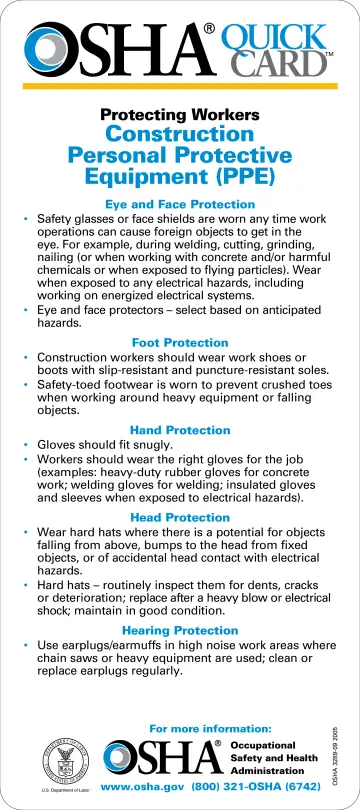
1 slidesConstruction PPE QuickCard (OSHA 3289)
Pocket card on hard hats, eye, hearing, hand and foot protection on construction sites.
U.S. Department of Labor, OSHAPublic domain
pdfes
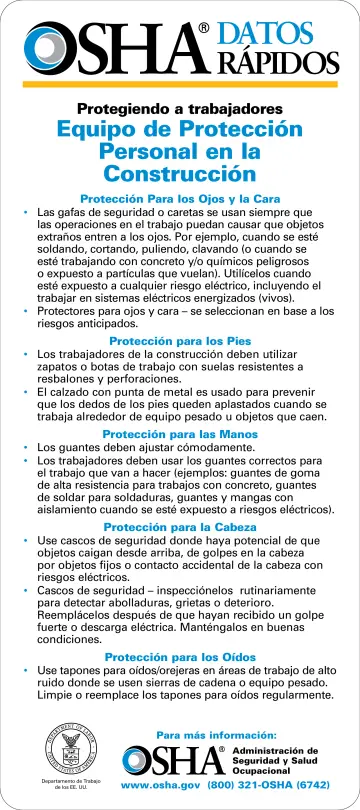
1 slidesTarjeta: EPP en la construcción (OSHA 3289)
Spanish construction PPE QuickCard.
U.S. Department of Labor, OSHAPublic domain
pdf
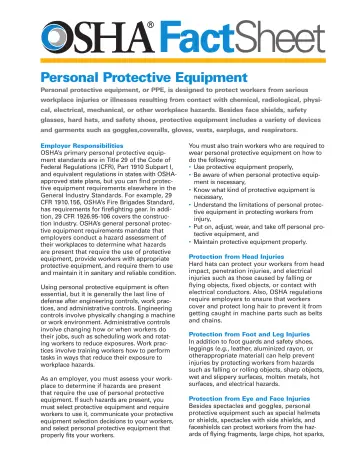
2 slidesPersonal Protective Equipment Fact Sheet
OSHA fact sheet on PPE requirements and employer responsibilities.
U.S. Department of Labor, OSHAPublic domain