1 / 58Use ← → to flip
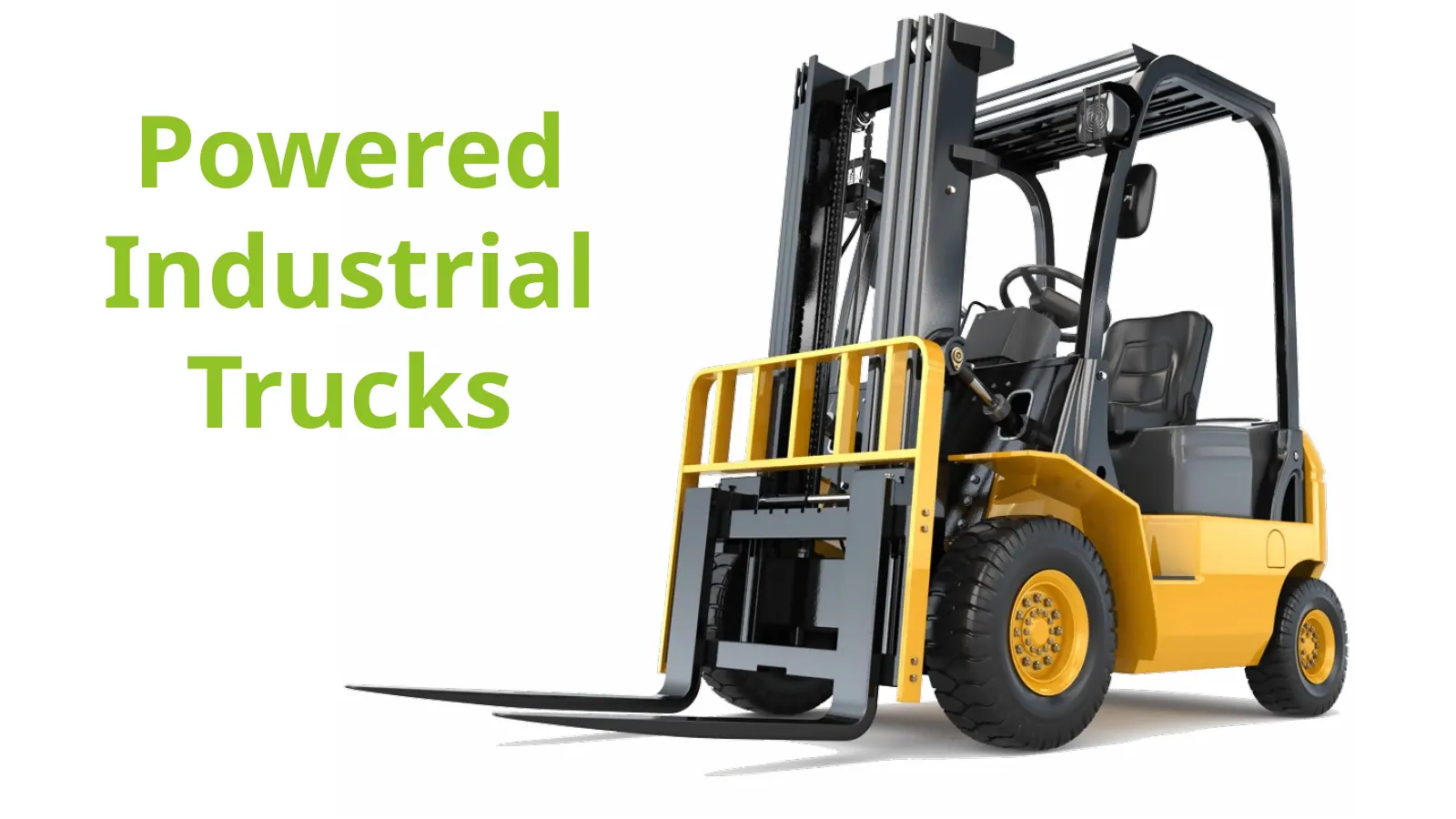
Powered Industrial Trucks
Forklift operator awareness deck from the Sustainable Workplace Alliance: truck classes, stability triangle, inspection and pedestrians.
Slide text
· 58 slides · by The Sustainable Workplace Alliance
The words on each slide as the author wrote them, read from the file by software so they can be searched. Layout, pictures and tables are not shown here: the slides above and the download are the original.
- Slide 1
Powered
- Industrial
- Trucks
- Slide 2
Disclaime
- Powered Industrial trucks
- This material was produced under grant number SH-05073-SH8 from the Occupational Safety and Health Administration, U.S. Department of Labor.
- It does not necessarily reflect the views or policies of the U.S. Department of Labor, nor does mention of trade names, commercial products, or organizations imply endorsement by the U.S. Government.
- Slide 3
Powered Industrial trucks
- Welcome
- P.I.T. Types & How
- they work
- Pre start Inspection
- Driving Safety
- Maintenance
- Slide 4
Powered Industrial trucks
- P.I.T. Types & How
- Module-
- 1
- they work
- Pre-Start Inspection
- Driving Safety
- Maintenance
- Slide 5
Typical Forklift
- Powered Industrial trucks
- Slide 6
Powered Industrial trucks
- Stand-On Reach Truck
- Slide 7
Walkie Rider
- Powered Industrial trucks
- Slide 8
Powered Industrial trucks
- How they Work
- Steering Your Forklift
- Isn’t as Simple as
- Turning the Wheel
- Slide 9
- Powered Industrial How they Work – Part 2
- trucks
- Steering Your Forklift Isn’t as Simple as Turning
- the Wheel
- Many accidents occur with industrial forklifts because the operators do not understand or have control of the machine’s rear end swing.
- Forklift trucks steer from the rear axle and pivot on the front wheels, the rear end (counterweight) swinging wide when turning. Ensure that the rear end swings clear of materials, racks equipment and pedestrians when rounding corners or maneuvering in aisle and tight places.
- Slide 10
- Powered Industrial How they Work – Part 3
- trucks
- Don’t expect a forklift to handle like a car or truck.
- Because of the counterweight over its rear wheels, a forklift is much heavier than a car. As a result, it can’t stop or turn quickly.
- When turning a forklift, watch behind you to make sure the rear end of the lift doesn’t run into anything – or anyone. Also keep an eye out for your forks and any load you may be carrying.
- Most forklifts have a three-point suspension system. The three points are the two front wheels and the pivot point of the rear axle. Connect the three points, and you have what’s called the stability triangle.
- Slide 11
- Powered Industrial
- trucks
- How they Work – Part
- 4
- FULCRUM
- Point
- Slide 12
- Powered Industrial How they Work – Part 5
- trucks
- FULCRUM
- Point
- Slide 13
- Powered Industrial How they Work – Part 6
- trucks
- Capacity and
- Load Centers
- Slide 14
- Powered Industrial How they Work – Part 7
- trucks
- Capacity and
- Load Centers
- Slide 15
- Powered Industrial
- trucks
- How they Work – Part
- 8
- Slide 16
Rated Capacity
- Powered Industrial trucks
- Slide 17
- Powered Industrial Rated Capacity – Part 2
- trucks
- Slide 18
Powered Industrial trucks
- P.I.T. Types & How
- Module-
- 2
- they work
- Pre-Start Inspection
- Driving Safety
- Maintenance
- Slide 19
Powered Industrial
- Pre-Start Inspection trucks
- It is necessary to inspect the work site also. Items to inspect include:
- The surface on which the Forklift will be used,
- Hazards that might create dangerous driving conditions,
- Above hazards that may effect personal while the Forklift is extended,
- Weather conditions
- Slide 20
- Powered Industrial
- trucks
- Pre-Start Inspection
- Part 2
- Visual Inspection
- Appearance
- Forks
- Hoses
- Name Plate
- Battery Connector
- Tires
- Overhead Guard
- Chain
- Leaks
- Battery Cables
- Slide 21
Powered Industrial
- Pre-Start Inspection
- Part 3
- trucks
- Forklift Nameplate:
- Basics A forklift's nameplate (also referred to as a data plate, weight plate or load plate)
- Provides integral information about the machine's capacity, fuel type, and weight.
- Workers and operators can refer to the nameplate to ensure safe and efficient operation.
- Slide 22
- Powered Industrial
- trucks
- Pre-Start Inspection
- Part 4
- Tires –
- What are they generally made of?
- Are they Damaged?
- Slide 23
- Powered Industrial
- trucks
- Pre-Start Inspection
- Part 5
- Forks –
- What are we looking for?
- Why?
- Slide 24
Powered Industrial
- Pre-Start Inspection – Part 6 trucks
- Hydraulics –
- Leaks?
- Parking area?
- Slide 25
- Powered Industrial
- trucks
- Pre-Start Inspection
- Part 7
- Hydraulics –
- Leaks?
- Parking area?
- Slide 26
- Powered Industrial
- trucks
- Pre-Start Inspection
- Part 8
- Mast –
- Cracks?
- Broken or Elongated links?
- Slide 27
- Powered Industrial Pre-Start Inspection – Part 9
- trucks
- Operating Checks
- Horn
- Hour Meter
- Seat/Belt
- Overhead Guard
- Battery Indicator
- All Lights
- Back-up Alarm
- Mirror
- Gauges
- Slide 28
Powered Industrial trucks
- P.I.T. Types & How
- Module-
- 3
- they work
- Pre-Start Inspection
- Driving Safety
- Maintenance
- Slide 29
Powered Industrial trucks
- Driving Safety
- Authorized operators only
- Quickly report accidents
- Always wear seat belts
- No person under the forks
- Operate controls only from driver’s seat
- Never block exits or
- emergency equipment
- Slide 30
- Powered Industrial
- trucks
- Driving Safety – Part
- 2
- Never overload forklift
- Check load weight
- Locate load’s
- center of gravity
- Inspect the load
- Restack or secure unstable loads
- Be sure forks are under load
- Tow from rear towing pin
- Loading and Unloading
- Slide 31
- Powered Industrial
- trucks
- Driving Safety – Part
- 3
- Look in the
- direction of travel
- Keep body inside cage
- Keep forks low when traveling
- Sound the horn
- Don’t speed
- Check clearance
- Travelin g
- Slide 32
Powered Industrial trucks
- Driving Safety – Part 4
- Avoid loose objects
- or holes
- Never carry passengers
- Pedestrians have
- the right-of-way
- Keep a safe distance
- from the edge of ramps or docks
- Never eat or drink
- No horseplay
- Travelin g
- Slide 33
- Powered Industrial
- trucks
- Driving Safety – Part
- 5
- Inspect the dock plate
- Check the trailer floor
- condition
- Make sure trailer wheels
- are chocked
- Ensure that the nose of
- the trailer is supported by the tractor or safety stabilizer.
- Loading Docks
- Slide 34
Powered Industrial trucks
- Driving Safety – Part 6
- Inspect the dock plate
- Check the
- trailer floor condition
- Make sure trailer wheels
- are chocked
- Ensure that the nose of
- the trailer is supported by the tractor or safety stabilizer.
- Loading Docks
- Slide 35
Powered Industrial
- Driving Safety – Part 7 trucks
- Don’t block exits
- or aisles
- Lower the forks
- Set gear to neutral
- Set the parking brake
- Turn off the ignition
- Parkin g
- Slide 36
Powered Industrial
- Don’t leave a forklift unattended. trucks
- A forklift is considered "unattended" when the operator is 25 ft. or more away from the vehicle even if it remains in his view, or whenever the operator leaves the vehicle and it is not in his view.
- When a forklift is left unattended, forks must be fully lowered, controls neutralized, power shut off, and brakes set.
- Wheels must be blocked if the truck is parked on an incline.
- Slide 37
Powered Industrial
- Don’t leave a forklift unattended. trucks
- Part 2
- A forklift is considered "unattended" when the operator is 25 ft. or more away from the vehicle even if it remains
- in his
- view, or whenever
- the
- When
- the operator
- of a forklift
- is within 25 ft. of the truck still
- leaves the vehicle and it is
- in operator
- his
- view, the load
- engaging
- means
- must
- be fully
- lowered,
- not in his view.
- controls
- neutralized, and the brakes set to prevent movement,
- When a forklift
- is left unattended, must
- be fully does
- lowered, controls
- but forks
- the power
- not
- need to be shut off.
- neutralized, power shut off, and brakes set.
- Wheels must be blocked if the truck is parked on an incline.
- Slide 38
Powered Industrial
- What to do in case of trucks
- a tipover
- If the forklift tips, keep your arms and legs inside and hold on to the steering wheel.
- Don’t attempt to jump out – you can’t move faster than the forklift can tip over. Most people who attempt to jump are killed by the impact of the overhead guard.
- Slide 39
- Powered Industrial
- trucks
- Don’t travel with a raised
- load
- Slide 40
Powered Industrial trucks
- Seatbelts
- Seatbelts are required on all forklifts manufactured since 1992 and can be retrofitted on all older models.
- You are required to uses it when it is supplied with the forklift. It will save your life.
- Buckle Up - Before you drive!!
- Slide 41
Powered Industrial
- Proper loading of the fork truck:
- trucks
- Adjust the forks to distribute the weight evenly. Note that forks are adjustable.
- Tilt the mast back carefully to stabilize the load.
- Do not attempt to physically move or push a fallen or misaligned load back onto the forks. ensure that the forks do not go through to the other side where pallets are closely stacked.
- Slide 42
Powered Industrial trucks
- Forklift Do’s And Don'ts
- No one else on the forklift except the operator, unless the forklift has a seat for a rider.
- Always drive with the forks lowered and lower forks to floor when parking the forklift.
- No Speeding - Speed Limit not to exceed 6 MPH.
- No faster than a brisk walk
- Slide 43
Powered Industrial
- Proper loading of the fork truck:
- trucks
- Adjust the forks to distribute the weight evenly. Note that forks are adjustable.
- Tilt the mast back carefully to stabilize the load.
- Do not attempt to physically move or push a fallen or misaligned load back onto the forks. ensure that the forks do not go through to the other side where pallets are closely stacked.
- Slide 44
Powered Industrial trucks
- P.I.T. Types & How
- Module-
- 4
- they work
- Pre-Start Inspection
- Driving Safety
- Maintenance
- Slide 45
Powered Industrial
- Forklift Inspection trucks
- and Maintenance
- All forklifts be examined at least daily before being used. Forklifts used on a round-the-clock basis must be examined at the start of each shift.
- Check the following:
- Fluid levels -- oil, water, and hydraulic fluid.
- Leaks, cracks or other visible defect in hydraulic hoses and mast chains.
- Safety decals and nameplates in place and legible.
- All safety devices working properly including the seat belt and backup alarm.
- Slide 46
Powered Industrial trucks
- Trained and Authorized Operators
- Only operate Forklifts if trained and Authorized
- Understand Operating Instructions and Safety rules.
- Receive Hands-on Training from a Qualified
- Person.
- Know how to Inspect Equipment and Work Area.
- Demonstrate How to Safely Operate Equipment.
- Keep at Least 10 feet Away from Power Lines.
- Never disable a safety or warning device.
- Slide 47
Review
- Powered Industrial trucks
- Slide 48
Knowledge Check
- 1. What are the three basic types of
- Powered Industrial Trucks?
- Slide 49
Knowledge Check – Part
- 2
- 1. What are the three basic types of
- Powered Industrial Trucks?
- a. Standard Sit-down Forklift
- b. Reach Truck
- c. Walkie-Rider
- Slide 50
Knowledge Check –
- Part 3
- 2. Forklifts turn on which axle?
- Slide 51
Knowledge Check –
- Part 4
- 2. Forklifts turn on which axle?
- Powered Industrial Trucks turn with their rear wheels and pivot on the front wheels, the rear end swings wide. The operator must develop the habit of allowing room for this in order to avoid hitting anything.
- Slide 52
Knowledge Check –
- Part 5
- What is the Fulcrum point?
- Slide 53
Knowledge Check –
- Part 6
- What is the Fulcrum point?
- Slide 54
Knowledge Check –
- Part 7
- 4. A visual Inspection should include….?
- Slide 55
Visual Inspection
- Knowledge Check –
- Part 8
- 4. A visual Inspection should include….?
- Appearance
- Forks
- Hoses
- Name Plate
- Battery Connector
- Leaks
- Tires
- Overhead Guard
- Chain
- Battery Cables
- Slide 56
Knowledge Check –
- Part 9
- 5. When is a Forklift considered
- . UNATTENDED?
- Slide 57
Knowledge Check –
- Part 10
- 5. When is a Forklift considered
- . UNATTENDED?
- A forklift is considered "unattended" when the operator is 25 ft. or more away from the vehicle even if it remains in his view, or whenever the operator leaves the vehicle and it is not in his view.
- Slide 58
Additional Resources
- OSHA website: http://www.osha.gov and OSHA offices: Call or
- Write (800-321-OSHA)
- Compliance Assistance Specialists in the area offices
- National Institute for Occupational Safety and Health (NIOSH) –
- OSHA’s sister agency
- OSHA Training Institute Education Centers
- Standards that Apply OSHA Standards: 29 CFR 1910.67, 29 CFR 1910.269(p), 29 CFR 1926.21, 29 CFR 1926.453, 29 CFR 1926.502. American National Standards Institutes standards: ANSI/SIA A92.2-1969, ANSI/SIA A92.3, ANSI/SIA A92.5, ANSI/SIA A92.6.
More on Forklifts
ppt
64 slidesPowered Industrial Truck Operator Training (OSHA Office of Training and Education)
OSHA's own operator-training deck for the powered industrial truck standard (1910.178(l), also applied to construction by 1926.602(d)): truck types, stability, load handling, inspection and refueling.
U.S. Department of Labor, OSHAArchivedPublic domain
pdf
4 slidesPowered Industrial Trucks: Developing a Training Program (OSHA)
OSHA handout on how to build a forklift operator training and evaluation program.
U.S. Department of Labor, OSHAArchivedPublic domain
pdf
2 slidesPowered Industrial Trucks: Sample Training Outline (OSHA)
One-page sample outline for forklift operator training.
U.S. Department of Labor, OSHAArchivedPublic domain