1 / 150Use ← → to flip
Systems of Safety for Materials Handling
Worker-trainer materials handling module (18 pages) from the Graphic Communications Conference/IBT (2009).
Page text
· 150 pages · by Graphic Communications Conference/IBT
The words on each page as the author wrote them, read from the file by software so they can be searched. Layout, pictures and tables are not shown here, and long pages are shortened: the pages above and the download are the original.
- Page 1
Awareness Training
- GCC/IBT/Labor Institute
- Systems of Safety Materials Handling, Hazardous Materials, Cranes and Slings
- Compiled by The Labor Institute and the
- Graphic Communications Conference of International
- Brotherhood of Teamsters (GCC/IBT)
- OSHA Grant # SH-19486-09-60-F11
- Draft 1.1
- April 2010
- …
- Page 2
Awareness Training
- GCC/IBT/Labor Institute
- Systems of Safety
- Materials Handling, Hazardous
- Materials, Cranes, and Slings
- Compiled by The Labor Institute and the
- Graphic Communications Conference of International Brotherhood of Teamsters (GCC/IBT)
- Draft 1.1
- April 2010
- ©2010 The Labor Institute
- Page 3
Project Team
- Principal GCC-IBT Officers in Charge:
- Robert Lacey, GCC/IBT International Vice President
- Grant Director:
- Kathy Burris, The Labor Institute
- Training and Curriculum
- Director:
- Les Leopold, The Labor Institute
- Associate Director:
- Paul Renner, The Labor Institute
- Training and Evaluation
- …
- Page 4
Table of Contents
- Introduction
- 1
- Activity 1: Hazards of Materials Handling including Cranes, Slings and Hazardous Materials (2 tasks)
- 5
- Activity 2: Materials Handling Hazard Identification (2 tasks)
- 27
- Activity 3: Systems of Safety
- 45
- (3 tasks)
- Activity 4: Near Misses and Prevention (2 tasks)
- 65
- …
- Page 5
- iv
- Page 6
Introduction
- Why Is This Training Taking Place?
- The Graphic Communications Conference of the International Brotherhood of Teamsters (GCC/IBT), in cooperation with The Labor Institute of New York, received a two-year training grant from the U. S. …
- …
- Page 7
Introduction
- Worker-Trainers
- The Labor Institute has a long history of involvement with health and safety efforts and training. It is our belief that our membership is really the best resource for making our facilities safe and for protecting the community from harm.
- …
- Page 8
Introduction
- The Small Group Activity Method (SGAM)
- The training activities in this workbook use the Small Group Activity Method.
- Why a Non-Lecture Approach?
- Worker-oriented educators have learned the hard way that working adults learn best in situations that maximize active participation and…
- …
- Page 9
Introduction
- The Small Group Activity Method (SGAM) (continued)
- Basic Structure
- The Small Group Activity Method is based on Activities. An Activity can take from 30 minutes to an hour. Each Activity has a common basic structure:
- Small Group Tasks
- Report-Back
- Summary
- …
- Page 10
Activity 1: Hazards of Material Handling including Cranes, Slings and Hazardous Materials
- Purpose:
- To understand the potential hazards of handling and storing materials.
- This Activity has two tasks.
- Page 11
Activity 1: Hazards of Material Handling
- Task 1
- Factsheet Reading Method for Task 1:
- The Small Group Activity Method places workers at the center of the learning experience. It is designed to draw on two bodies of knowledge: 1) The knowledge and experiences workers bring into the room and 2) the…
- …
- Page 12
1. Vital to our Operations
- Activity 1: Hazards of Material Handling
- Handling and storing materials involves diverse operations such as:
- Hoisting tons of paper rolls with a crane,
- Driving a truck loaded with shredded paper sheets,
- Manually carrying bags and material and
- …
- Page 13
2. Potential Hazards of Material Handling
- Activity 1: Hazards of Material Handling
- Workers frequently cite the weight and bulkiness of objects being lifted as major contributing factors to their injuries. In 1990, back injuries resulted in 400,000 workplace accidents.
- …
- Page 14
3. Major Material Handling Accident Causes
- Activity 1: Hazards of Material Handling
- A material handling accident analysis revealed that the six major problem areas which accounted for a large number of accidents include:
- …
- Page 15
4. Moving Materials
- Activity 1: Hazards of Material Handling
- When manually moving materials, workers should seek help:
- When a load is so bulky it cannot be properly grasped or lifted,
- When they cannot see around or over it or
- When a load cannot be safely handled.
- …
- Page 16
5. Handling Materials, Blocking and Handles and Holders
- Activity 1: Hazards of Material Handling
- All materials handling equipment have rated capacities that determine the maximum weight the equipment can safely handle and the conditions under which it can handle those weights.
- …
- Page 17
6. Crane Hazards
- Activity 1: Hazards of Material Handling
- Only thoroughly trained and competent persons are permitted to operate cranes.
- When loads are crated or covered, operators should know what they are lifting and what it weighs.
- …
- Page 18
Activity 1: Hazards of Material Handling
- This will prevent the crane from tipping during use.
- Hoisting chains and ropes must always be free of kinks or twists and must never be wrapped around a load.
- Loads should be attached to the load hook by slings, fixtures or other devices that have the capacity…
- …
- Page 19
7. Conveyor Hazards
- Activity 1: Hazards of Material Handling
- When using conveyors:
- Workers’ hands may be caught in nip points where the conveyor runs over support members or rollers;
- Workers may be struck by material falling off the conveyor; or
- …
- Page 20
Activity 1: Hazards of Material Handling
- Task 1 (continued)
- Purpose Restated: To understand the potential hazards of handling and storing materials.
- Scenario:
- XYZ Storage Facility had an immediate shipment to a local vendor. Three workers were assigned to move 130 pallets using a forklift and…
- …
- Page 21
Activity 1: Hazards of Material Handling
- Task 2
- Factsheet Reading Method for Task 2:
- The Small Group Activity Method places workers at the center of the learning experience. It is designed to draw on two bodies of knowledge: 1) The knowledge and experiences workers bring into the room and 2) the…
- …
- Page 22
8. Slings
- Activity 1: Hazards of Material Handling
- A sling is an assembly which connects the load to material handling equipment.
- When working with slings, employers must ensure that they are visually inspected before use and during operation, especially if used under heavy stress. …
- …
- Page 23
9. Importance of the Operator
- Activity 1: Hazards of Material Handling
- The operator must exercise intelligence, care and common sense in the selection and use of slings.
- Slings must be selected in accordance with:
- Their intended use,
- Based upon the size,
- Type of load and
- …
- Page 24
10. Sling Types
- Activity 1: Hazards of Material Handling
- The dominant characteristics of a sling are determined by the components of that sling. For example, the strengths and weaknesses of a wire rope sling are essentially the same as the strengths and weaknesses of the wire rope of which it is…
- …
- Page 25
11. Field Lubrication and Storage
- Activity 1: Hazards of Material Handling
- Although every wire rope sling is lubricated during manufacture and in order to lengthen its useful service life, it must also be lubricated “in the field.” Also, you should follow the manufacturer’s instructions regarding…
- …
- Page 26
12. Discarding Slings
- Activity 1: Hazards of Material Handling
- Wire rope slings can provide a margin of safety by showing early signs of failure. Factors requiring that a wire sling be discarded include the following:
- Severe corrosion,
- Localized wear (shiny worn spots) on the outside,
- …
- Page 27
Activity 1: Hazards of Material Handling
- Task 2 (continued)
- Purpose Restated: To understand the potential hazards of handling and storing materials.
- Scenario:
- Three tons of re-bar was being lifted from the ground to the back of a flat bed truck. The load was slung with webbing straps. …
- …
- Page 28
Activity 1: Hazards of Material Handling
- THI
- INT
- LEF IONA
- Page 29
Summary: Hazard of Material Handling and Storage
- Activity 1: Hazards of Material Handling
- 1. The efficient handling and storing of materials is vital to industry and it is accomplished in a number of ways.
- 2. Material handling and storage are dangerous workplace activities causing back injuries…
- …
- Page 30
EVALUATION
- Activity 1: Hazards of Material Handling
- Activity 1: Hazards of Material Handling and Storage
- 1. How important is this Activity for workers? Please circle one number.
- Activity Is Not Important
- Activity Is Very Important
- …
- Page 31
Activity 1: Hazards of Material Handling
- Page 32
Activity 2: Mapping Hazards at Work
- Purpose
- To learn how to develop a Hazard Map that workers can use to identify and locate hazards so that those hazards can be targeted for elimination.
- This Activity has two tasks.
- Page 33
Activity 2: Materials Handling Hazard Identification
- Task 1
- Factsheet Reading Method for Task 1:
- Factsheets will be assigned as follows:
- Once everyone has read their assigned factsheets, your scribe will go around the table and ask each of you to explain to the rest of your group what you have…
- …
- Page 34
1. Using Hazard Mapping to Identify Possible Risks
- Activity 2: Material Handling Hazard Identification
- A Hazard Map is a visual representation of the workplace where there are hazards that could cause injuries or illness.
- …
- Page 35
2. Using Hazard Mapping to Identify Area-Wide Hazards or Hazards in Specific Areas of Work
- Activity 2: Materials Handling Hazard Identification
- The Hazard Mapping process can be used to identify risks at a large workplace and to specify hazards associated with an AREA, BUILDING, JOB CLASSIFICATION or…
- …
- Page 36
3. Why Hazard Map?
- Activity 2: Material Handling Hazard Identification
- Hazard Mapping is only one method for identifying occupational safety and health hazards. If your workplace has other systems for identifying hazards, those results can be included on your Hazard Map.
- …
- Page 37
4. Hazard Mapping Labels
- Activity 2: Materials Handling Hazard Identification
- HAZARD CODE KEY
- Blue
- Electrical Hazard
- Green
- Chemical Hazard
- Orange
- Physical Hazard
- Brown
- Flammable/Explosive Hazard
- Black
- Other Hazards (specify)
- Level of Hazard Key
- 1
- Low Hazard
- 2
- Medium Hazard
- 3
- High Hazard
- 4
- …
- Page 38
5. Examples of Hazard Mapping Labels
- Activity 2: Material Handling Hazard Identification
- 2
- EXAMPLES: HAZARD CODES AND LEVELS
- 3
- 4
- OF HAZARD
- 1
- A number “2” inside a Blue Circle indicates 2
- 2
- “Class 2, Medium Hazard, Electrical.”
- 3
- A number “3” inside a Green Circle indicates
- …
- Page 39
6. Example of a Hazard Map
- Activity 2: Materials Handling Hazard Identification
- On the next page is an example of a hazard map. These are included to:
- Show how a workplace would appear when you identify present hazards and assign them a level of severity. …
- …
- Page 40
6a. Crane Diagram Example
- Activity 2: Material Handling Hazard Identification
- Wheels off track
- Load
- not secured correctly
- Paper Dust
- Frayed strap
- Faulty Wiring
- Worker
- able to be in a hazardous place
- Page 41
6b. In a Paper Coating Room in a Paper Plant (One Small Area of Plant)
- Activity 2: Materials Handling Hazard Identification
- OVERHEAD BRIDGE CRANE
- Cut hazard
- (Orange)
- 2
- Knife
- 3
- Splice roll
- Nip point
- (Orange)
- #4 Dead roll rack
- Refrigerator plugged into ungrounded receptacle (Blue)
- Transport truck
- …
- Page 42
Activity 2: Material Handling Hazard Identification
- Task 1 (continued)
- Purpose Restated: To identify potential material handling hazards at our workplaces.
- Task
- Now that you have read and discussed Factsheets 1 through 6, work together in your small groups, to map a work area where material handling…
- …
- Page 43
Activity 2: Materials Handling Hazard Identification
- Task 1 (continued)
- Step 1:
- Make a drawing on the sheet of paper provided that shows a rough picture of the scene. Write large and use the entire sheet of paper for your drawing. Label specific danger areas and equipment.
- Step 2:
- …
- Page 44
Activity 2: Material Handling Hazard Identification
- Task 2
- Purpose Restated: To identify potential material handling hazards at our workplaces.
- This Hazard Mapping Project was designed for workers to use to eliminate hazards in their workplace. Four important elements of the project are listed below.
- …
- Page 45
Activity 2: Materials Handling Hazard Identification
- Task 2 (continued)
- 1. Who will circulate the map so that all in the area can add to the map? What steps need to be done to circulate the map and who is responsible for each step?
- …
- Page 46
Activity 2: Material Handling Hazard Identification
- ENT
- GE
- LEF
- LAN
- Page 47
Summary: Mapping Hazards at Work
- Activity 2: Materials Handling Hazard Identification
- 1. In creating a Hazard Map, we are making a visual representation of workplace hazards that could lead to injury, illness or even death.
- …
- Page 48
EVALUATION
- Activity 2: Material Handling Hazard Identification
- Activity 2: Material Handling Hazard
- Identification
- 1. How important is this Activity for workers? Please circle one number.
- Activity Is Not Important
- Activity Is Very Important
- …
- Page 49
Activity 2: Materials Handling Hazard Identification
- Page 50
Activity 3: Systems of Safety
- Purpose
- To introduce the concept of Systems of Safety and accident prevention.
- This Activity has three tasks.
- Page 51
Activity 3: Systems of Safety
- Task 1
- Factsheet Reading Method for Task 1:
- Factsheets will be assigned as follows:
- Once everyone has read their assigned factsheets, your scribe will go around the table and ask each of you to explain to the rest of your group what you have learned. …
- …
- Page 52
1. What Are Systems of Safety?
- Activity 3: Systems of Safety
- Systems of Safety are proactive systems that actively seek to identify, control and/or eliminate workplace hazards.
- Let’s look at an incident where a worker bumped his head on a low pipe. How could this hazard be addressed by each of our…
- …
- Page 53
2. The Personal Protective Factors System
- Activity 3: Systems of Safety
- 1. Personal Decision-making and Actions
- Look and think critically at the workplace;
- Work collectively to identify hazards; and
- Contribute ideas, experience and know-how that will lead to correcting the systems flaws.
- …
- Page 54
3. The Procedures and Training System
- Activity 3: Systems of Safety
- The operation and maintenance of processes that are dangerous require a system of written procedures and training. The greater the hazard, the greater is the need for Procedures and Training.
- Page 55
4. The Warning System
- Activity 3: Systems of Safety
- The Warning System of Safety includes the use of devices that warn of a dangerous or potentially dangerous situation. These devices require a person’s intervention to control or mitigate the hazardous situation.
- Page 56
5. The Mitigation System
- Activity 3: Systems of Safety
- The Mitigation System of Safety involves the use of equipment that automatically acts to control or reduce the harmful consequences of hazardous incidents. Mitigation should be automatic and reliable.
- Page 57
6. The Maintenance and Inspection System
- Activity 3: Systems of Safety
- Properly designed equipment can turn into unsafe junk if it isn’t properly maintained, inspected, and repaired. If the phrase “if it ain’t broke, don’t fix it” is used within a plant, the Maintenance and Inspection System is a…
- …
- Page 58
7. Design and Engineering System of Safety
- Activity 3: Systems of Safety
- A central purpose of the Design System of Safety is to eliminate hazards through the selection of safe or low-risk processes and chemicals whenever possible.
- …
- Page 59
8. Systems and Sub-Systems (Examples)
- Activity 3: Systems of Safety
- Major Safety System
- Design and Engineering
- Level of Prevention
- Highest—the first line of defense
- Effectiveness
- Goal
- Maintenance and Inspection
- Mitigation Devices
- Warning Devices
- Training and Procedures
- …
- Page 60
Activity 3: Systems of Safety
- Task 1 (continued)
- Purpose Restated: To introduce the concept of Systems of Safety and accident prevention.
- Task:
- Please begin by reading the following scenario:
- At XYZ plant, forklift operators use the aisle between the finishing department and number one Machine Room…
- …
- Page 61
Activity 3: Systems of Safety
- Task 1 (continued)
- The injured employee said that she had always taken the same route to her work station. She walked behind the same forklift operator on numerous occasions and that he had always seen her before.
- …
- Page 62
Activity 3: Systems of Safety
- ENT
- GE
- LEF IONA
- Page 63
Task 2
- Activity 3: Systems of Safety
- Purpose Restated: To introduce the concept of Systems of Safety and accident prevention.
- Using Factsheets 1 through 8 on pages 47 through 54, discuss the following questions with members of your group. Select a scribe to report your answers back to the class.
- …
- Page 64
Activity 3: Systems of Safety
- THI
- INT
- ENT AGE
- LEF IONA
- Page 65
Activity 3: Systems of Safety
- Task 3
- Purpose Restated: To introduce the concept of Systems of Safety and accident prevention.
- The real test of a system “fix” is determined by whether the root causes are corrected.
- In your group review the fixes listed below:
- 1. Install backup alarm on all forklifts.
- …
- Page 66
Activity 3: Systems of Safety
- If the root cause would not be adequately corrected, then answer “no” in the second column and make recommendations that would completely correct the root cause. These recommendations should be recorded on the chart below.
- Root Causes
- Adequately Fixed
- (Yes/No)
- …
- Page 67
Summary: Systems of Safety
- Activity 3: Systems of Safety
- 1. Proactive Systems of Safety are the key to preventing disasters and injuries.
- 2. Major Systems of Safety include:
- Design and Engineering;
- Maintenance and Inspection;
- Mitigation Devices;
- Warning Devices;
- Procedures and Training; and
- …
- Page 68
EVALUATION
- Activity 3: Systems of Safety
- 1. How important is this Activity for workers? Please circle one number.
- Activity Is Not Important
- Activity Is Very Important
- 2. Which factsheets are the most important to distribute to the workers? (Please list the page numbers.)
- …
- Page 69
Activity 3: Systems of Safety
- ENT
- GE
- LEF IONA
- Page 70
Activity 4: Near Misses and Prevention
- Purpose
- To apply the concept of near miss reporting to achieve the highest level of prevention possible.
- To practice identifying the root causes of a near miss as early in the chain of events as possible.
- This Activity has two tasks.
- Page 71
Activity 4: Near Misses and Prevention
- Task 1
- Purposes Restated:
- To apply the concept of near miss reporting to achieve the highest level of prevention possible.
- To practice identifying the root causes of a near miss as early in the chain of events as possible.
- …
- Page 72
Activity 4: Near Misses and Prevention
- Task 2
- Factsheet Reading Method for Task 2:
- The Small Group Activity Method places workers at the center of the learning experience. It is designed to draw on two bodies of knowledge: 1) The knowledge and experiences workers bring into the room and 2) the…
- …
- Page 73
1. Near Miss, the Standard Definition
- Activity 4: Near Misses and Prevention
- The standard definition of a near miss is:
- “Any event that could have caused an injury or damage property.”
- Near miss = Event - injury/damage
- Generally, this is the definition used almost universally for near miss programs.
- Page 74
2. What is an Accident?
- Activity 4: Near Misses and Prevention
- Webster’s dictionary describes an accident as:
- An unfortunate mishap; especially one causing damage or injury.
- Anything that happens suddenly or by chance without an apparent cause.
- The legal definition includes the following:
- …
- Page 75
3. What is a Hazard?
- Activity 4: Near Misses and Prevention
- A hazard is defined as:
- A hazard is any source of potential damage, harm or adverse health effects on something or someone under certain conditions at work.
- Basically, a hazard can cause harm or adverse affects to:
- …
- Page 76
4. Hazards Cause Accidents
- Activity 4: Near Misses and Prevention
- In the chain of events that cause accidents leading to death, injury or property damage, the existence of a work place hazard is always the starting point, therefore:
- Hazards = Accidents
- …
- Page 77
5. Near Misses are Existing Hazards
- Activity 4: Near Misses and Prevention
- A new definition:
- “A near miss is an existing hazard, a trap waiting to be sprung. “
- The hose lying across the dark path that no one trips on is a near miss.
- …
- Page 78
6. Near Miss Early Detection
- Activity 4: Near Misses and Prevention
- The chain of events leading to an accident always contains multiple near misses. As we move backwards from the accident there are numerous opportunities to interrupt the causal chain of events, therefore preventing the accident.
- …
- Page 79
7. The Blame Game
- Activity 4: Near Misses and Prevention
- Traditional near miss programs look to events that could have caused an accident, illness or injury. Something in the sequence of actions didn’t quite come together in these events to turn them into an accident, so it is referred to as a near…
- …
- Page 80
8. Barriers to Reporting Near Misses
- Activity 4: Near Misses and Prevention
- According to a study of near miss programs by the Wharton School of Business at the University of Pennsylvania, the failure to report near misses is the main reason that programs don’t work
- …
- Page 81
9. Near miss Programs can be Valuable to Workers.
- Activity 4: Near Misses and Prevention
- Benefits of a functional near miss program can be valuable to workers.
- A near miss program that involves workers who are intimately familiar with daily system operations; therefore, potential problems are easily…
- …
- Page 82
10. Program Problems According to Wharton—Lack of Management Commitment
- Activity 4: Near Misses and Prevention
- Failure of management to remain committed to near miss programs:
- Can, in turn decrease employee reporting and
- …
- Page 83
Activity 4: Near Misses and Prevention
- Task 2 (continued)
- Purposes Restated:
- To apply the concept of near miss reporting to achieve the highest level of prevention possible.
- To practice identifying the root causes of a near miss as early in the chain of events as possible.
- …
- Page 84
Activity 4: Near Misses and Prevention
- Page 85
Summary: Near Misses and Prevention
- Activity 4: Near Misses and Prevention
- 1. A near miss is the existence of a hazard. It is a trap waiting to be sprung.
- 2. There are numerous identifiable hazards in the chain of events leading up to an accident. Hazards = Accidents.
- …
- Page 86
EVALUATION
- Activity 4: Near Misses and Prevention
- 1. How important is this Activity for workers? Please circle one number.
- Activity Is Not Important
- Activity Is Very Important
- 2. Which factsheets are the most important to distribute to the workers? (Please list the page numbers.)
- …
- Page 87
Activity 4: Near Misses and Prevention
- Page 88
Activity 5: Incident Investigation using Root Cause Analysis
- Purpose
- To understand the differences between the preliminary factors of incidents and accidents and the root causes.
- This Activity has two tasks.
- Page 89
Activity 5: Incident Investigation using the Root Cause Analysis
- Task 1
- Factsheet Reading Method for the Task 1.
- The Small Group Activity Method places workers at the center of the learning experience. It is designed to draw on two bodies of knowledge: The knowledge and experiences workers bring into…
- …
- Page 90
1. Systems vs. Symptoms
- Activity 5: Incident Investigation using the Root Cause Analysis
- When focusing attention on worker injuries, we only see the tip of the safety iceberg. Changing the unsafe behaviors of an injured worker does not take us very far down the road to prevention.
- …
- Page 91
2. Finding the Root Cause
- Activity 5: Incident Investigation using the Root Cause Analysis
- Experts in the field of process safety like The Center for Chemical Process Safety defines “root causes” as:
- “Management systems failures; such as faulty design or inadequate training, that led to an unsafe act…
- …
- Page 92
3. What Are Preliminary Factors?
- Activity 5: Incident Investigation using the Root Cause Analysis
- Most investigations only address the preliminary factors involved in an incident. Preliminary factors include things such as a sling failure, a worker not following a procedure or making a mistake. …
- …
- Page 93
4. What Are Root Causes?
- Activity 5: Incident Investigation using the Root Cause Analysis
- The root causes of incidents are the prime factors that underlie the preliminary factors of an accident. Root causes are sometimes referred to as “basic” causes. …
- …
- Page 94
5. Preliminary Factors vs. Root Causes
- Activity 5: Incident Investigation using the Root Cause Analysis
- The chart on this page uses an electrocution example to depict the differences between preliminary factors and root causes. Root causes are always found beneath preliminary factors.
- ELECTROCUTION
- …
- Page 95
6. Safety Systems and Sub-Systems (Examples)
- Activity 5: Incident Investigation using the Root Cause Analysis
- Major Safety System
- Design &
- Engineering
- Level of Prevention
- Highest—the first line of defense
- Effectiveness
- Goal
- Maintenance & Inspection
- Mitigation Devices
- Warning Devices
- …
- Page 96
7. The Problems with Procedures
- Activity 5: Incident Investigation using the Root Cause Analysis
- Many incident and injury investigations end when it is concluded that an injured worker did not follow the procedure for a job task. …
- …
- Page 97
Activity 5: Incident Investigation using the Root Cause Analysis
- Task 1 (continued)
- Purpose Restated: To understand the differences between the preliminary factors of incidents and accidents and the root causes.
- Scenario:
- …
- Page 98
Activity 5: Incident Investigation using the Root Cause Analysis
- There was no procedure for tracking the history, care and usage of slings.
- The crane hook was slightly off the center of gravity therefore causing an angle on one of the legs.
- …
- Page 99
Task 1 (continued)
- Activity 5: Incident Investigation using the Root Cause Analysis
- Worker killed by overhead crane load
- Load Shifted & swung crushing worker
- Load off balance
- Chain Sling
- Failed
- Crane hook not centered
- Defective Sling used
- Sling not inspected
- No inspection program for slings
- SOS
- …
- Page 100
Activity 5: Incident Investigation using the Root Cause Analysis
- ENT
- GE
- LEF
- LAN
- Page 101
Task 2
- Activity 5: Incident Investigation using the Root Cause Analysis
- Purpose Restated: To understand the differences between the preliminary factors of incidents and accidents and the root causes.
- Your group has also been asked to review the investigation committee’s report. …
- …
- Page 102
Activity 5: Incident Investigation using the Root Cause Analysis
- THI
- INT
- LEF IONA
- Page 103
Summary: Understanding Root Causes
- Activity 5: Incident Investigation using the Root Cause Analysis
- 1. The idea that incidents and accidents are caused by unthinking or accident-prone workers is not only outdated, but inaccurate.
- …
- Page 104
EVALUATION
- Activity 5: Incident Investigation using the Root Cause Analysis
- Activity 5: Incident Investigation using
- Root Cause Analysis
- 1. How important is this Activity for workers? Please circle one number.
- Activity Is Not Important
- Activity Is Very Important
- …
- Page 105
Activity 5: Incident Investigation using the Root Cause Analysis
- Page 106
Activity 6: Applying the OSHA Standards for Prevention
- Purpose
- To gain a general understanding of the OSHA standard 1910.179, 1910.180 and 1910.184.
- To learn how to reference these standards.
- This Activity has one task.
- Page 107
Actvity 6: Applying the OSHA Standards
- Task
- Purposes Restated:
- To gain a general understanding of the OSHA standard 1910.179, 1910.180 and 1910.184.
- To learn how to reference these standards.
- Scenario:
- Millard Smith, a material handler, was killed when crushed by a 16,000 lb. …
- …
- Page 108
Activity 6: Applying the OSHA Standards
- The tool bin had been recently moved and there were no systems in place for storing slings according to load capacity.
- There was no procedure for tracking the history, care and usage of slings.
- …
- Page 109
Actvity 6: Applying the OSHA Standards
- Overhead and gantry cranes. - 1910.179
- Regulations (Standards - 29 CFR) - Table of Contents
- Part Number:
- 1910
- Part Title:
- Occupational Safety and Health Standards
- Subpart:
- Subpart Title:
- Materials Handling and Storage
- Standard Number:
- 1910.179
- Title:
- …
- Page 110
Activity 6: Applying the OSHA Standards
- 1910.179(a)(9)
- “Power-operated crane” means a crane whose mechanism is driven by electric, air, hydraulic, or internal combustion means.
- 1910.179(a)(10)
- A “pulpit-operated crane” is a crane operated from a fixed operator station not attached to the crane.
- …
- Page 111
Actvity 6: Applying the OSHA Standards
- 1910.179(a)(22)
- “Bridge travel” means the crane movement in a direction parallel to the crane runway.
- 1910.179(a)(23)
- A “bumper” [buffer] is an energy absorbing device for reducing impact when a moving crane or trolley reaches the end of its permitted travel; or…
- …
- Page 112
Activity 6: Applying the OSHA Standards
- 1910.179(a)(35)
- “Designated” means selected or assigned by the employer or the employer's represen tative as being qualified to perform specific duties.
- 1910.179(a)(36)
- A “drift point” means a point on a travel motion controller which releases the brake while…
- …
- Page 113
Actvity 6: Applying the OSHA Standards
- 1910.179(a)(48)
- “Main hoist” means the hoist mechanism provided for lifting the maximum rated load.
- 1910.179(a)(49)
- A “man trolley” is a trolley having an operator's cab attached thereto.
- 1910.179(a)(50)
- …
- Page 114
Activity 6: Applying the OSHA Standards
- 1910.179(a)(62)
- A “master switch” is a switch which dominates the operation of contactors, relays, or other remotely operated devices.
- 1910.179(a)(63)
- The “trolley” is the unit which travels on the bridge rails and carries the hoisting mechanism.
- …
- Page 115
Actvity 6: Applying the OSHA Standards
- 1910.179(b)(6)(i)
- Minimum clearance of 3 inches overhead and 2 inches laterally shall be provided and maintained between crane and obstructions in conformity with Crane Manufacturers Association of America, Inc, Specification No. …
- …
- Page 116
Activity 6: Applying the OSHA Standards
- 1910.179(d)(1)
- Location of footwalks.
- 1910.179(d)(1)(i)
- If sufficient headroom is available on cab-operated cranes, a footwalk shall be provided on the drive side along the entire length of the bridge of all cranes having the trolley running on the top of the…
- …
- Page 117
Actvity 6: Applying the OSHA Standards
- 1910.179(e)(1)
- Trolley stops.
- 1910.179(e)(1)(i)
- Stops shall be provided at the limits of travel of the trolley.
- 1910.179(e)(1)(ii)
- Stops shall be fastened to resist forces applied when contacted.
- 1910.179(e)(1)(iii)
- …
- Page 118
Activity 6: Applying the OSHA Standards
- 1910.179(e)(3)(iii)
- Bumpers or equivalent shall be designed and installed to minimize parts falling from the trolley in case of age.
- 1910.179(e)(4)
- Rail sweeps. Bridge trucks shall be equipped with sweeps which extend below the top of the rail and project in…
- …
- Page 119
Actvity 6: Applying the OSHA Standards
- 1910.179(f)(2)
- Holding brakes.
- 1910.179(f)(2)(i)
- Holding brakes for hoist motors shall have not less than the following percentage of the full load hoisting torque at the point where the brake is applied.
- 1910.179(f)(2)(i)(a)
- …
- Page 120
Activity 6: Applying the OSHA Standards
- 1910.179(f)(4)(ii)
- Brakes may be applied by mechanical, electrical, pneumatic, hydraulic, or gravity means.
- 1910.179(f)(4)(iii)
- Where necessary brakes shall be provided with adjustment means to compensate for wear.
- 1910.179(f)(4)(iv)
- …
- Page 121
Actvity 6: Applying the OSHA Standards
- 1910.179(f)(6)(ii)
- On cab-operated cranes with cab on trolley, a bridge brake of the holding type shall be required.
- 1910.179(f)(6)(iii)
- On all floor, remote and pulpit-operated crane bridge drives, a brake of noncoasting mechanical drive shall be provided.
- …
- Page 122
Activity 6: Applying the OSHA Standards
- 1910.179(g)(3)(i)
- Cranes not equipped with spring-return controllers or momentary contact pushbuttons shall be provided with a device which will disconnect all motors from the line on failure of power and will not permit any motor to be restarted until the…
- …
- Page 123
Actvity 6: Applying the OSHA Standards
- 1910.179(g)(5)
- Switches.
- 1910.179(g)(5)(i)
- The power supply to the runway conductors shall be controlled by a switch or circuit breaker located on a fixed structure, accessible from the floor, and arranged to be locked in the open position.
- 1910.179(g)(5)(ii)
- …
- Page 124
Activity 6: Applying the OSHA Standards
- 1910.179(h)
- Hoisting equipment -
- 1910.179(h)(1)
- Sheaves.
- 1910.179(h)(1)(i)
- Sheave grooves shall be smooth and free from surface defects which could cause rope damage.
- 1910.179(h)(1)(ii)
- …
- Page 125
Actvity 6: Applying the OSHA Standards
- 1910.179(h)(2)(v)
- Rope clips attached with U-bolts shall have the U-bolts on the dead or short end of the rope. Spacing and number of all types of clips shall be in accordance with the clip manufacturer's recommendation. …
- …
- Page 126
Activity 6: Applying the OSHA Standards
- 1910.179(j)(1)(ii)(a)
- Frequent inspection - Daily to monthly intervals.
- 1910.179(j)(1)(ii)(b)
- Periodic inspection - 1 to 12-month intervals.
- 1910.179(j)(2)
- Frequent inspection. The following items shall be inspected for defects at intervals as defined in…
- …
- Page 127
Actvity 6: Applying the OSHA Standards
- 1910.179(j)(3)(i)
- Deformed, cracked, or corroded members.
- 1910.179(j)(3)(ii)
- Loose bolts or rivets.
- 1910.179(j)(3)(iii)
- Cracked or worn sheaves and drums.
- 1910.179(j)(3)(iv)
- Worn, cracked or distorted parts such as pins, bearings, shafts, gears, rollers, locking…
- …
- Page 128
Activity 6: Applying the OSHA Standards
- 1910.179(k)
- Testing -
- 1910.179(k)(1)
- Operational tests.
- 1910.179(k)(1)(i)
- Prior to initial use all new and altered cranes shall be tested to insure compliance with this section including the following functions:
- 1910.179(k)(1)(i)(a)
- Hoisting and lowering.
- …
- Page 129
Actvity 6: Applying the OSHA Standards
- 1910.179(l)(2)(i)(b)
- All controllers shall be at the off position.
- 1910.179(l)(2)(i)(c)
- The main or emergency switch shall be open and locked in the open position.
- 1910.179(l)(2)(i)(d)
- …
- Page 130
- Activity 6: Applying the OSHA Standards
- discarded. Repairs by welding or reshaping are not generally recommended. If such repairs are attempted they shall only be done under competent supervision and the hook shall be tested to the load requirements of paragraph (k)(2) of this section before further…
- …
- Page 131
- Actvity 6: Applying the OSHA Standards
- inspection before it is used. This inspection shall be for all types of deterioration and shall be performed by an appointed person whose approval shall be required for further use of the rope. …
- …
- Page 132
Activity 6: Applying the OSHA Standards
- 1910.179(n)(3)(iii)(b)
- The load does not contact any obstructions.
- 1910.179(n)(3)(iv)
- Cranes shall not be used for side pulls except when specifically authorized by a responsible person who has determined that the stability of the crane is not thereby…
- …
- Page 133
Actvity 6: Applying the OSHA Standards
- 1910.179(o)(1)
- Ladders.
- 1910.179(o)(1)(i)
- The employer shall insure that hands are free from encumbrances while personnel are using ladders.
- 1910.179(o)(1)(ii)
- Articles which are too large to be carried in pockets or belts shall be lifted and lowered by hand…
- …
- Page 134
Activity 6: Applying the OSHA Standards
- Slings. - 1910.184
- Part Number:
- 1910
- Part Title:
- Occupational Safety and Health Standards
- Subpart:
- Subpart Title:
- Materials Handling and Storage
- Standard Number:
- 1910.184
- Title:
- Slings.
- 1910.184(a)
- …
- Page 135
Actvity 6: Applying the OSHA Standards
- Cross rod is a wire used to join spirals of metal mesh to form a complete fabric. (See Fig. N-184-2.)
- Designated means selected or assigned by the employer or the employer's representative as being qualified to perform specific duties.
- …
- Page 136
Activity 6: Applying the OSHA Standards
- Rated capacity or working load limit is the maximum working load permitted by the provisions of this section.
- Reach is the effective length of an alloy steel chain sling measured from the top bearing surface of the upper terminal component to the bottom bearing…
- …
- Page 137
Actvity 6: Applying the OSHA Standards
- 1910.184(c)(6)
- Slings shall be securely attached to their loads.
- 1910.184(c)(7)
- Slings shall be padded or protected from the sharp edges of their loads.
- 1910.184(c)(8)
- Suspended loads shall be kept clear of all obstructions.
- 1910.184(c)(9)
- …
- Page 138
Activity 6: Applying the OSHA Standards
- 1910.184(e)(3) Inspections.
- 1910.184(e)(3)(i)
- In addition to the inspection required by paragraph (d) of this section, a thorough periodic inspection of alloy steel chain slings in use shall be made on a regular basis, to be determined on the basis of (A)…
- …
- Page 139
1910.184(e)(7)(ii)
- Actvity 6: Applying the OSHA Standards
- Mechanical coupling links or low carbon steel repair links shall not be used to repair broken lengths of chain.
- 1910.184(e)(8)
- Effects of wear. If the chain size at any point of any link is less than that stated in Table N-184- 2, the sling…
- …
- Page 140
Activity 6: Applying the OSHA Standards
- TABLE N-184-2. - MINIMUM ALLOWABLE CHAIN SIZE AT ANY POINT OF LINK
- Chain size, inches
- Minimum allowable chain size, inches
- 1 1/8
- 1 1/4
- 1 3/8
- 1 3/32
- 1 1/2
- 1 3/16
- 1 3/4
- 1 13/32
- 1910.184(e)(9)(ii)
- …
- Page 141
..1910.184(f)(4)(ii)
- Actvity 6: Applying the OSHA Standards
- 1910.184(f)(3)
- Safe operating temperatures. Fiber core wire rope slings of all grades shall be permanently removed from service if they are exposed to temperatures in excess of 200 deg. F. …
- …
- Page 142
Activity 6: Applying the OSHA Standards
- TABLE N-184-3. - RATED CAPACITIES FOR SINGLE LEG SLINGS (CONTINUED)
- 6x19 and 6x37 Classification Improved Plow Steel Grade Rope With Fiber Core (FC)
- Rope
- Dia (inches)
- 1 1/8
- 1 1/4
- 1 3/8
- 1 1/2
- 1 5/8
- 1 3/4
- …
- Page 143
Actvity 6: Applying the OSHA Standards
- TABLE N-184-4. - RATED CAPACITIES FOR SINGLE LEG SLINGS
- 6x19 and 6x37 Classification Improved Plow Steel Grade Rope With Independent Wire Rope Core (IWRC)
- Rope
- Rated capacities, tons (2,000 lb.)
- Vertical
- Dia (inches) Constr
- HT
- MS
- Choker
- HT
- MS
- 6x19
- 0.53
- 0.56
- 0.59
- …
- Page 144
Activity 6: Applying the OSHA Standards
- TABLE N-184-4. - RATED CAPACITIES FOR SINGLE LEG SLINGS CONTINUED
- 6x19 and 6x37 Classification Improved Plow Steel Grade Rope With Independent Wire Rope Core (IWRC)
- Rope
- Dia (inches)
- 1 1/8
- 1 1/4
- 1 3/8
- 1 1/2
- 1 5/8
- 1 3/4
- …
- Page 145
Actvity 6: Applying the OSHA Standards
- TABLE N-184-5. -- RATED CAPACITIES FOR SINGLE LEG SLINGS
- Cable Laid Rope -- Mechanical Splice Only
- 7x7x7 & 7X19 Constructions Galvanized Aircraft Grade Rope 7x6x19 IWRC Construction Improved Plow Steel Grade Rope
- Rope
- Dia (inches)
- 1 1/8
- 1 1/4
- 1 1/8
- 1 1/4
- 1 5/16
- …
- Page 146
Activity 6: Applying the OSHA Standards
- TABLE N-184-6. -- RATED CAPACITIES FOR SINGLE LEG SLINGS 8-Part and 6-Part Braided Rope
- 6x7 and 6x19 Construction Improved Plow Steel Grade Rope
- 7x7 Construction Galvanized Aircraft Grade Rope
- Componet Ropes
- Rated capacities, tons (2,000 lb)
- Vertical
- …
- Page 147
Actvity 6: Applying the OSHA Standards
- TABLE N-184-7.-- RATED CAPACITIES FOR 2-LEG
- AND 3-LEG BRIDLE SLINGS
- [Continued]
- 6x19 and 6x37 Classification Improved Plow Steel
- Grade Rope With Fiber Core (FC)
- [Horizontal angles shown in parentheses]
- Rope
- Rated Capacities, tons (2,000 lb)
- 2-leg bridle slings
- …
- Page 148
Activity 6: Applying the OSHA Standards
- = Hand Tucked Splice.
- MS = Mechanical Splice.
- TABLE N-184-8 -- RATED CAPACITIES FOR 2-LEG
- AND 3-LEG BIRDLE SLINGS
- 6x17 and 6x37 Classification Improved Plow Steel
- Grade Rope with Independent Wire Rope Core (IWRC)
- (Horizontal angles shown in parentheses)
- Page 149
Actvity 6: Applying the OSHA Standards
- TABLE N-184-8 -- RATED CAPACITIES FOR 2-LEG
- AND 3-LEG BIRDLE SLINGS
- (CONTINUED)
- 6x17 and 6x37 Classification Improved Plow Steel
- Grade Rope with Independent Wire Rope Core (IWRC)
- (Horizontal angles shown in parentheses)
- HT = Hand Tucked Splice
- …
- Page 150
Activity 6: Applying the OSHA Standards
- TABLE N-184-9. -- RATED CAPACITIES FOR 2-LEG
- AND 3-LEG BRIDLE SLINGS
- Cable Laid Rope - Mechanical Splice Only
- 7x7x7 and 7x7x19 Construction Galvanized Aircraft Grade Rope 7x6x19 IWRC Construction Improved Plow Steel Grade Rope [Horizontal angles shown in…
- …
More on Materials

pptx
42 slidesMaterials Handling, Storage, Use, and Disposal (OSHA 10-Hour Construction Outreach)
OSHA's own 10-hour Construction Outreach deck on materials handling, storage, rigging, forklifts and disposal (2015 edition).
U.S. Department of Labor, OSHA (with the OTIEC Outreach Workgroup)ArchivedPublic domain
pdf
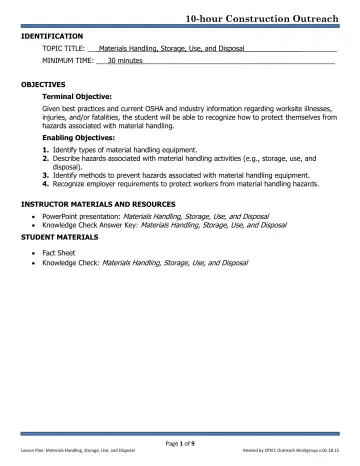
9 slidesMaterials Handling, Storage, Use, and Disposal: Lesson Plan (OSHA 10-Hour Construction Outreach)
Instructor lesson plan with objectives, timing and teaching procedures for the OSHA materials handling, storage, use, and disposal outreach deck.
U.S. Department of Labor, OSHA (with the OTIEC Outreach Workgroup)ArchivedPublic domain
pdf
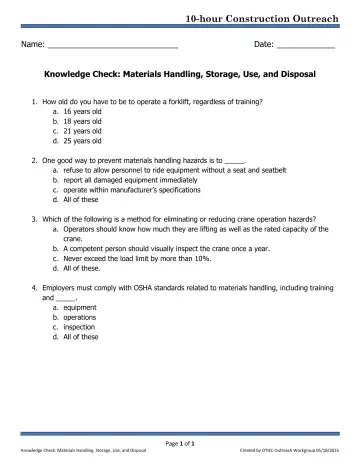
1 slidesMaterials Handling, Storage, Use, and Disposal: Knowledge Check (OSHA 10-Hour Construction Outreach)
Student knowledge-check quiz that accompanies the OSHA materials handling, storage, use, and disposal outreach deck.
U.S. Department of Labor, OSHA (with the OTIEC Outreach Workgroup)ArchivedPublic domain