1 / 53Use ← → to flip
Materials Handling
Materials handling module from TEEX's OSHA standards course (2006, written for the oil and gas industry).
Slide text
· 53 slides · by Texas Engineering Extension Service
The words on each slide as the author wrote them, read from the file by software so they can be searched. Layout, pictures and tables are not shown here: the slides above and the download are the original.
- Slide 1
MODULE 18
- Materials Handling
- Slide 2
Materials Handling on Oil and Gas Sites
- What materials are handled?
- What machines are used to handle them?
- What precautions are taken to avoid accidents and injuries?
- Slide 3
Regulations
- 29 CFR 1910 Subpart N
- 29 CFR 1926 Subparts H and N
- API RP 54, 4G, 9B
- ANSI B56.6 for forklifts
- Crane standards for derricks?
- RP 54 and general duty clause
- Look at application for each crane standard
- Slide 4
Materials Handling and Storage
- 29 CFR 1910 SUBPART N
- Slide 5
Organization of Subpart N
- 1910.176 - Handling materials - general
- 1910.177 - Servicing multi-piece and single piece rim wheels
- 1910.178 - Powered industrial trucks
- 1910.178 App A – Stability of powered industrial trucks (non-mandatory)
- 1910.179 - Overhead and gantry cranes
- 1910.180 - Crawler locomotive and truck cranes
- 1910.181 - Derricks
- 1910.183 - Helicopters
- 1910.184 - Slings
- Slide 6
1910.176 Handling materials - general
- Mechanical equipment: safe clearances; permanent passageways marked
- Housekeeping – avoid tripping, fire, explosion, or pest harborage hazards
- Covers or guardrails for open pits, tanks, vats, ditches
- Slide 7
1910.176 Handling materials - general
- Storage must not create a hazard: Stable/secure against sliding or collapse
- Slide 8
1910.177 Servicing multi-piece and single-piece rim wheels
- Applies to large vehicles; not pickups, automobiles, or vans
- Training
- Tire servicing equipment
- Wheel component acceptability
- Safe operating procedures
- Slide 9
Powered Industrial Trucks
- 29 CFR 1910.178
- Slide 10
1910.178 Powered industrial trucks
- Contains safety requirements relating to:
- Fire protection
- Design
- Maintenance
- Use of fork trucks, tractors, platform lift trucks, motorized hand trucks, and other specialized industrial trucks powered by electric motors or internal combustion engines
- Slide 11
1910.178 Powered industrial trucks
- ANSI B56.1 1969
- Marking indicating approval by testing laboratory
- No modifications that affect capacity and safe operation without manufacturer’s prior written approval
- Front-end attachments identified
- Markings maintained legible
- Slide 12
1910.178(b) and (c)
- Designations for industrial trucks by fuel and safeguards against ignition source
- Designated locations where specific types of trucks may be used
- Table N-1
- Slide 13
1910.178(e) Safety guards
- Overhead guards for High Lift Rider trucks if operations permit
- Vertical load backrest extension for types of loads that present hazards
- Slide 14
1910.178(f) Fuel handling and storage
- Storing and handling of liquid fuels: Follow NFPA No. 30-1969
- Storing and handling of LPG fuel: Follow NFPA No. 58-1969
- Slide 15
1910.178(g) Changing and charging storage batteries
- Battery charging installations located in areas designated for that purpose
- Facilities provided for
- Flushing and neutralizing spilled electrolyte,
- For fire protection,
- For protecting charging apparatus from damage by trucks, and
- For adequate ventilation for dispersal of fumes from gassing batteries
- Slide 16
1910.178(g) Changing and charging storage batteries
- Conveyor, overhead hoist, or equivalent provided for handling batteries
- Reinstalled batteries properly positioned and secured in the truck
- Slide 17
1910.178(g) Changing and charging storage batteries
- When charging batteries, acid poured into water; not water poured into acid
- Trucks properly positioned and brake applied before attempting to change or charge batteries
- Care taken to assure that vent caps are functioning
- Slide 18
1910.178(g) Changing and charging storage batteries
- Smoking prohibited in the charging area
- Precautions taken to prevent open flames, sparks, or electric arcs in battery charging areas
- Tools and metallic
- DANGER
- DANGER
- objects kept away
- No smoking
- from the tops of sparks or batteries
- open flames
- Slide 19
1910.178(h) and (i)
- Auxiliary directional lighting on truck if lighting <2 lumens per square foot
- Control carbon monoxide to levels in 1910.1000
- Slide 20
1910.178(k) Trucks and railroad cars
- Brakes set and wheel chocks placed for highway trucks boarded with powered industrial trucks
- Positive protection to keep train cars from moving while loading or with dockboards/bridge plates
- Fixed jacks for uncoupled semitrailer during loading
- Slide 21
1910.178(l) Operator training
- Ensure that before employee operates a powered industrial truck, operator has completed training and evaluation successfully
- Trainees may operate a powered industrial truck only:
- Under direct supervision of persons with the knowledge, training, and experience to train operators and evaluate their competence; and
- Where such operation does not endanger the trainee or other employees.
- Slide 22
1910.178(l) Operator training
- Required:
- Lecture or other formal instruction (computer, video tape, written)
- Practical training (demonstrations and exercises)
- Evaluation by trainer of operator performance in workplace
- Refresher training required after certain conditions in (4)
- Slide 23
1910.178(l)(3) Training program content
- Truck-related training topics:
- Operating instructions, warnings, and precautions
- Differences between the truck and the automobile
- Truck controls and instrumentation:
- where they are located
- what they do
- how they work
- Engine or motor operation
- Steering and maneuvering
- Fork and attachment adaptation
- Slide 24
1910.178(l)(3) Training program content
- Truck-related training topics:
- Vehicle capacity
- Vehicle stability
- Any vehicle inspection and maintenance that the operator will be required to perform
- Refueling and/or charging and recharging of batteries
- Operating limitations
- Operating instructions, warnings, or precautions listed in the operator's manual
- Slide 25
1910.178(l)(3) Training program content
- Workplace-related topics:
- Surface conditions
- Composition of loads and load stability
- Load manipulation, stacking, and unstacking
- Pedestrian traffic in areas where the vehicle will be operated
- Ramps and other sloped surfaces that could affect the vehicle's stability
- Slide 26
1910.178(l) Certification
- The certification shall include:
- Name of the operator;
- Date of the training;
- Date of the evaluation, and;
- Identity of the person(s)
- performing the training or evaluation
- Previous training does not need to be repeated if operator can operate safely
- Slide 27
1910.178(m) Truck operations
- Trucks never driven up to anyone standing in front of a bench or other fixed object
- No one allowed to stand or pass under the elevated portion of any truck, whether loaded or empty
- Unauthorized personnel not permitted to ride on powered industrial trucks
- A safe place to ride provided where riding of trucks is authorized
- Slide 28
1910.178(m) Truck operations
- Prohibit arms or legs from being placed between the uprights of the mast or outside the running lines of the truck
- When truck left unattended (25 ft. away or out of view):
- load engaging means fully lowered
- controls neutralized
- power shall be shut off
- brakes set
- Slide 29
1910.178(m) Truck operations
- Maintain safe distance from edges of ramps or platforms while on any elevated location
- Never use trucks to open or close freight doors
- Trucks, trailers, and railroad cars: Immobilize vehicles and check floors for breaks and weakness before driving on
- Slide 30
1910.178(m) Truck operations
- Overhead guard as protection against falling objects
- Intended to offer protection from the impact of small packages, boxes, bagged material, etc.
- Not intended to withstand the impact of a falling capacity load
- Slide 31
1910.178(n) Traveling
- Follow all traffic regulations, including authorized speed limits
- Maintain safe distance approximately three truck lengths from the truck ahead
- Keep truck under control at all times
- Three truck lengths minimum
- Slide 32
1910.178(n) Traveling
- Never pass other trucks traveling in the same direction at intersections, blind spots, or other dangerous locations
- Slow down and sound horn at cross aisles and other locations where vision is obstructed
- If the load being carried obstructs forward view, travel with the load trailing
- Slide 33
1910.178(n) Traveling
- Ascending or descending grades >10%: drive loaded trucks with the load upgrade
- On all grades the load and load engaging means tilted back if applicable, and raised only as far as necessary to clear the road surface
- Slide 34
Overhead and Gantry Cranes
- 29 CFR 1910.179
- Slide 35
1910.179(b) General Requirements
- Application: cranes with trolleys and other characteristics similar to gantry cranes
- ANSI B30.2.0-1967
- Rated load marking on each side and legible from the floor
- Operated by designated personnel only
- Slide 36
Organization of Standard
- c. Cabs – access, controls, location
- d. Footwalks and ladders – location, construction, walking/working surfaces
- e. Stops, bumpers, rail sweeps, and guards
- f. Brakes
- g. Electric equipment, including controllers
- Slide 37
Organization of Standard
- h. Hoisting equipment – sheaves, ropes, equalizers, hooks
- i. Warning device
- j. Inspection – frequent and periodic
- k. Testing – operational and load
- l. Maintenance
- m. Rope inspection
- Slide 38
Organization of Standard
- n. Handling the load
- 1. Size
- 2. Attaching the load
- 3. Moving the load
- 4. Hoist limit switch
- o. Other requirements – ladders, cabs, fire extinguishers
- Slide 39
29 CFR 1910.180
- Crawler, Locomotive, and Truck Cranes
- Slide 40
1910.180(b) General Requirements
- Application:
- Crawler cranes, locomotive cranes, wheel mounted cranes, used as lifting cranes
- Both truck and self-propelled wheel type
- Powered by internal combustion engines or electric motors
- Utilize drums and ropes
- ANSI B30.5-1968
- Operated by designated personnel only
- Slide 41
Organization of Standard
- c. Load ratings
- d. Inspection classification
- e. Testing
- f. Maintenance procedure – General
- g. Rope inspection
- h. Handling the load
- i. Other requirements
- j. Operations near overhead lines
- Slide 42
29 CFR 1910.181
- Derricks
- Slide 43
1910.181(b) General Requirements
- Application:
- “any modification of these types which retain their fundamental features, except for floating derricks”
- ANSI B30.6-1969
- Operated by designated personnel only
- Slide 44
Organization of Standard
- c. Load ratings – permanent and nonpermanent
- d. Inspection
- e. Testing
- f. Maintenance
- g. Rope inspection
- h. Operations of derricks
- i. Handling the load
- j. Other requirements
- Slide 45
29 CFR 1910.184
- Slings
- Slide 46
Application
- Used for hoisting of material
- Alloy steel chain
- Wire rope
- Metal mesh
- Natural or synthetic fiber rope
- Synthetic web
- Illustrations in (b)
- Slide 47
(c) Safe operating practices
- 1. Never use damaged / defective slings
- 2. Never shorten slings with makeshift devices
- 3. Never use kinked sling legs
- 4. Never load slings in excess of rated capacities
- 5. Balance loads in basket hitches to prevent slippage.
- Slide 48
(c) Safe operating practices
- 6. Attach slings securely to loads.
- 7. Pad / protect slings from sharp edges.
- 8. Keep suspended loads clear of obstructions
- 9. Keep employees clear of loads to be lifted and suspended loads.
- Slide 49
(c) Safe operating practices
- 10. Never place hands or fingers between sling and load while sling is being tightened.
- 11. Shock loading is prohibited – take up the slack in the sling slowly.
- 12. Never pull a sling out from under a load while the load rests on it.
- Slide 50
Organization of Standard
- c. Inspections – each day before use and during use
- d. Alloy steel chain slings
- e. Wire rope slings
- f. Metal mesh slings
- Slide 51
29 CFR 1926 Subparts H and N
- Construction Standards
- Slide 52
Applicability of Construction Standards in 29 CFR 1926
- Subpart H: Materials Handling, Storage, Use, and Disposal
- Subpart N: Cranes, Derricks, Hoists, Elevators, and Conveyors
- Do construction standards apply:
- To a derrick during drilling operations?
- To a crane setting up equipment at a site?
- Slide 53
Hazards & Standards for Oil & Gas
- API RP 54, RP4G, RP9B
More on Materials
pptx
42 slidesMaterials Handling, Storage, Use, and Disposal (OSHA 10-Hour Construction Outreach)
OSHA's own 10-hour Construction Outreach deck on materials handling, storage, rigging, forklifts and disposal (2015 edition).
U.S. Department of Labor, OSHA (with the OTIEC Outreach Workgroup)ArchivedPublic domain
pdf
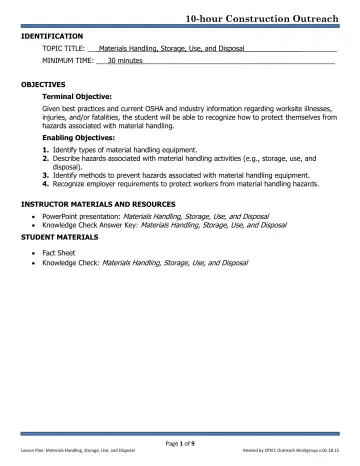
9 slidesMaterials Handling, Storage, Use, and Disposal: Lesson Plan (OSHA 10-Hour Construction Outreach)
Instructor lesson plan with objectives, timing and teaching procedures for the OSHA materials handling, storage, use, and disposal outreach deck.
U.S. Department of Labor, OSHA (with the OTIEC Outreach Workgroup)ArchivedPublic domain
pdf
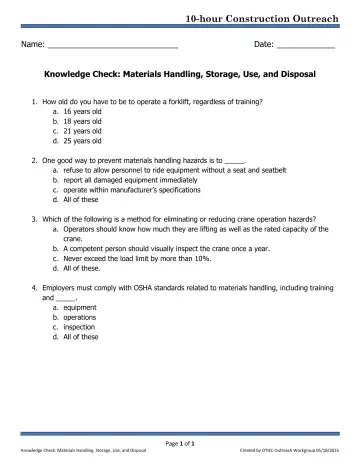
1 slidesMaterials Handling, Storage, Use, and Disposal: Knowledge Check (OSHA 10-Hour Construction Outreach)
Student knowledge-check quiz that accompanies the OSHA materials handling, storage, use, and disposal outreach deck.
U.S. Department of Labor, OSHA (with the OTIEC Outreach Workgroup)ArchivedPublic domain