1 / 86Use ← → to flip
Forklift Operator Safety Training
Forklift (powered industrial truck) operator safety training from Central Georgia Technical College.
Slide text
· 86 slides · by Central Georgia Technical College
The words on each slide as the author wrote them, read from the file by software so they can be searched. Layout, pictures and tables are not shown here: the slides above and the download are the original.
- Slide 1
Forklift Operator Safety Training
- This material was produced under grant number SH05059-SH8 from the Occupational Safety and Health Administration, U.S. Department of Labor. It does not necessarily reflect the views or policies of the U.S. Department of Labor, nor does mention of trade names, commercial products, or organizations imply endorsement by the U.S. Government.
- Slide 2
Objectives
- Explain regulatory standards
- Describe powered industrial truck/forklift
- Explain safety procedures
- Perform pre-operational checks
- Operate forklift in a simulated driving situation
- Slide 3
Objectives (cont.)
- Explain precautions for operating a forklift
- Practice good housekeeping
- Explain load capacities
- Demonstrate proper handling, stacking, loading and unloading
- Slide 4
House Rules
- No Cell Phones usage unless emergency!
- If you hear “ stop” !! You must STOP!
- No exceptions!
- Respect everyone
- No photography
- No video
- Slide 5
Occupational Safety and Health Administration (OSHA)
- On December 29, 1970, President
- Nixon signed the OSH Act
- This Act created OSHA, the agency, which formally came into being on April 28, 1971
- OSHA falls under the U.S.
- department of Labor
- Slide 6
OSHA’s Mission
- The mission of OSHA is to assure safe and healthful working conditions for working men and women by setting and enforcing standards and by providing training, outreach, education and assistance.
- OSHA does this by:
- Developing job safety and health standards and enforcing them through worksite inspections
- Providing training programs to increase knowledge about occupational safety and health
- Slide 7
Regulatory Standards
- O ccupational S afety and H ealth A dministration (OSHA) 29
- Code of Federal Regulation (CFR) 1910.178, Powered Industrial Trucks
- ANSI/ITSDF B56.1-2009, Safety Standards for Low Lift and
- High Lift Trucks
- American National Standards Institute (ANSI)
- Industrial Trucks Standards Development Foundation
- (ITSDF)
- Slide 8
OSHA Makes A Difference
- Prior to OSHA there were 13,800 workplace deaths per year
- 4,405 workers were killed on the job in
- 2013 (3.2 per 100,000 full-time equivalent workers)
- Nearly 3.0 million serious workplace injuries and illnesses were reported by private industry employers in 2012
- Slide 9
OSHA Works
- “In more than four decades, OSHA and our state partners, coupled with the efforts of employers, safety and health professionals, unions and advocates, have had a dramatic effect on workplace safety.”
- Slide 10
OSHA Works – Incidence Reports
- Slide 11
Powered Industrial Truck/Forklift
- Self-propelled vehicles with 3 or 4 wheels designed to lift, transport, and position materials
- Controlled by the steering of the back wheels. The front wheels are what are powered during operation
- Fueled by LP (liquid propane), diesel fuel system, gasoline system, or battery
- Slide 12
Many Different Types
- Sit-down and stand-up powered industrial trucks come in a variety of models ranging from small compact three wheel indoor unit to large diesel powered outdoor yard models.
- Each model varies in lifting capacity, operating environment, and size.
- Slide 13
PIT/Forklift
- Built on the lever principle
- Front or drive wheels act as the fulcrum point
- Counterweight counterbalances the weight of the load on the forks or clamps
- Slide 14
Different Types
- Walk behinds are also considered “forklifts”
- Slide 15
Many Different Types Material Handling
- A variety of material handling implements are used such as clamps, forks, or other attachments.
- Each has several things in common that must be discussed from a safety and operational standpoint.
- Slide 16
Many Different Types Lifts
- Slide 17
Equipment Descriptions
- The powered industrial truck is a vehicle that has many controls and parts.
- The following items mentioned are common to most powered industrial trucks:
- Slide 18
Equipment Descriptions – Points On Forklift
- Slide 19
Equipment Controls
- Accelerator, Foot Brake, and Clutch
- Slide 20
Directional Control Levers - Equipment Controls
- Slide 21
Equipment Controls - Fork, Mast and Fork/Clamps
- One controls the up and down movement (forks)
- The other controls the tilt or rotating movement (mast)
- The other controls the side shift motion (forks/clamps)
- Slide 22
Equipment Controls - Gauges
- Gauges
- Mounted on the truck instrument panel.
- They indicate the engine
- temperature, oil pressure, generator charging rate, condition of directional control, etc.
- Slide 23
Safety
- Only trained, certified and authorized drivers over the age of 18 will operate powered industrial trucks.
- Know how to use all safety devices and functions.
- Follow safety procedures at all times.
- Slide 24
Safety Mindset
- Slide 25
Safety – Buckle Up
- Most models are operated from a sitting position.
- Mount and dismount correctly.
- It is important that the operator be properly seated and seat belt fastened before operating any forklift controls.
- When your seat hits the seat, BUCKLE UP!
- Slide 26
Stand-up Models
- Stand-up models are operated from a standing position.
- Fasten personal restraint harness before operating any forklift controls.
- Slide 27
Safety - Examples
- Keep arms, hands, legs, and feet in proper position.
- Never place them between mast uprights or outside the running lines.
- Stay within the boundaries of the overhead guard
- Slide 28
Safety Examples Cont.
- Do not let anyone stand or move under raised forks
- Do not carry any materials on the overhead guard
- Do not hoist people using powered industrial truck forks.
- Slide 29
Safety - Signs
- Obey all posted signs, including stop signs.
- Operate the truck at a speed permitting it to stop in a safe manner.
- Do not pass other trucks traveling in the same direction.
- Slide 30
Safety Discussion - Cont.
- A pedestrian always has the right of way over a powered industrial truck.
- A hand truck always has the right of way over a powered industrial truck.
- A loaded powered industrial truck has the right of way over an empty powered industrial truck.
- Slide 31
Safety Discussion
- Always use the aisle, if available
- Never cut corners to avoid traffic
- Start in low gear (if equipped)
- Avoid fast starts and stops
- Avoid running over obstacles
- No smoking within 50 feet of the battery or LP changing station
- Slide 32
Safety Loaded
- Drive with forks or clamps about 4 to 8 inches above the floor
- If loaded, tilt the load all the way back
- Slide 33
Safety – Backing Up
- Drive backwards when transporting a load that obstructs your vision
- When approaching employees or visitors from behind…Give a few short blasts of the horn when approximately 20 feet away.
- Slide 34
Safety - Overhead
- Watch overhead clearances (sprinkler heads, conduits, product conveyor, and doors.)
- Always keep in mind the size of the powered industrial truck being operated.
- Slide 35
Safety – Rail Specifications
- Always use an approved lifting platform
- Must be securely attached to the forks and backrest
- Harness must also be worn
- Must be authorized by the supervisor
- Specifications
- 42” top rail, 21” center rail, 4” toe board, door opens
- Slide 36
Safety – Front End and Rear End
- Always allow for “rear end swing” and “front end swing”
- Larger lift trucks have more “swing”
- Slide 37
Safety – Rotation of Lift
- Slide 38
Safety - Speed
- Reduce speed when turning.
- Never turn on a slope or ramp.
- Never turn when the load is elevated
- Slide 39
Safety – Vertical Stability
- Slide 40
Safety – Tip Over
- In the event of a tip over
- Do not jump
- Stay in the seat with the seatbelt fastened
- Grip the steering wheel tightly
- Brace your feet and allow yourself to tip over with the truck
- Slide 41
Safety - Parking
- If leaving the powered industrial truck even for a moment, park in a safe place out of aisles and away from fire escapes.
- Lower the load (or forks) and set the parking brake.
- Tilt the mast forward slightly and place fork tines flat on the floor.
- Turn off the ignition.
- Slide 42
Safety – Lift Parking
- Slide 43
Safety Hazards
- Leaving the powered industrial truck forks or any attachment high in the air while parked could cause serious injury.
- Slide 44
Safety - NEVER
- NEVER operate a forklift in need of repair.
- NEVER drive trucks up to anyone standing in front of a bench or other fixed object.
- NEVER carry other individuals.
- NEVER operate a forklift for any purpose other than what it was designed for.
- Slide 45
Safety – Do NOT
- Slide 46
Safety Hazard
- Slide 47
Safety - Discussion
- Slide 48
Unsafe
- Slide 49
tilted
- Slide 50
Safety - Statistics
- 85 to 100 fatalities per year.
- About 35,000 serious injuries
- About 62,000 non-serious injuries
- Injury and/or fatality occurs every three days
- 900,000+ forklifts
- 11 percent in some kind of accident
- Useful truck life is about 8 years
- 90 percent in some kind of accident
- Slide 51
Safety - Conplacency
- Main types of accidents
- Tip over’s
- Crushed between forklift and a surface
- Crushed between two forklifts
- Struck or run over by forklift
- Struck by falling material
- Fall from platform on forks
- 42% 25% 11% 10% 8% 4%
- COMPLACENCY is the #1 CAUSE of Forklift accidents
- Slide 52
Safety - Where fatalities occur
- Manufacturing facilities
- 42%
- Construction
- 23.8%
- Wholesale trade
- 12.5%
- Transportation
- 11%
- Retail trade
- 9%
- Mining
- 1.2%
- Slide 53
Pre-Operational Check
- Identify Key (Motor) Off inspection criteria. KEY-OFF
- Identify Key (Motor) On inspection criteria. KEY-ON
- It is important to perform a pre-operational check of the powered industrial truck before operating the vehicle. (Ref: 1910.178(q)(7))
- Slide 54
Pre-Operational Inspection
- Any powered industrial truck not in safe operating condition is to be removed from service.
- The pre-operational check/inspection shall be performed at least daily or prior to use.
- The pre-operational check/inspection shall be performed after each shift.
- Slide 55
Operation
- Only trained operators certified and authorized by the company who are 18 years and older are allowed to operate powered industrial trucks.
- You are entrusted with the proper care and operation of an expensive and valuable piece of equipment.
- Slide 56
Operation - Versatility
- Powered industrial trucks are quite versatile. Learning the capacity of the powered industrial truck is important.
- Slide 57
Operation - Similarities
- Understand the similarities and differences between a standard size automobile and that of a powered industrial truck.
- Slide 58
Operation - Automobiles and lift trucks (forklifts) have many dissimilarities.
- Lift Trucks (forklifts)
- High center of gravity
- Short, narrow
- Automobiles
- Low center of gravity
- Long, wide wheel
- Slide 59
PIT Operation
- Powered industrial trucks are specialized machines with unique operating characteristics designed to perform specific jobs.
- Function and operation are not like an automobile.
- Never assume you can operate a powered industrial truck in the same manner as you would an automobile.
- Never assume one forklift operates just like another.
- Slide 60
Operation – Data Plate
- Each powered industrial truck has a data plate.
- This data plate will indicate the maximum weight the truck can handle without overloading it.
- It will also indicate maximum loads, depending on the load center.
- Slide 61
Sample Data Plates
- Slide 62
Operation - Warning
- 8380
- 120PSI 100PSI
- 131.5
- 5500 5000 4400
- 20 24 30
- Slide 63
Operation –Stability Triangle
- The powered industrial truck is a precision piece of equipment set up on a fulcrum and lever balance.
- Operate the vehicle inside its stability (operating) triangle.
- STABILITY TRIANGLE
- Slide 64
Center of Gravity
- Vehicle Center of
- Gravity
- (Unloaded)
- Center of Gravity of Vehicle and Maximum Load (Theoretical)
- Slide 65
Operation – Balanced Load
- Vehicle Center of
- Gravity
- (loaded)
- Load
- Center
- Slide 66
Operation – Unbalanced Load
- Vehicle Center of
- Gravity
- (loaded)
- Load
- Center
- Slide 67
Operation - Overload
- The heaviest point is to the rear of the vehicle closest to the counterweight on the steer axle.
- As you add weight on the forks or the front of the vehicle, the balance point or weight moves forward toward the drive axle.
- Never go beyond the operating parameters of the forklift.
- Overloading, traveling with the load too high, taking corners too fast and too sharp will cause the operator to go beyond these operating parameters.
- Slide 68
Operation – Cover Controls
- Familiarize yourself with the levers that control the forks or clamps so you know exactly what lever controls each movement.
- Slide 69
Operation - Mounting
- Mount the truck using 3 points of contact and fasten the seat belt.
- Place the transmission lever in neutral
- Slide 70
Operation - Battery
- Engage the starter by turning the ignition switch to the start position.
- DO NOT engage the starter for more than 30 seconds.
- DO NOT RUN THE BATTERY DOWN
- Check that all instruments on the control panel are operating.
- DO NOT idle the engine unnecessarily.
- Raise the forks, clamps, or other attachments off the floor about 4 to 8 inches.
- Slide 71
Handling and Stacking Procedures – 1 of 12
- Picking Up the Load
- All powered industrial trucks have a rating capacity data plate.
- If in doubt about the load’s weight, check with the supervisor.
- Slide 72
Handling and Stacking Procedures 2 of 12
- Approach the load slowly and straight on with the forks parallel to the floor.
- Make sure the forks are low enough to slide under the load.
- Slide 73
Handling and Stacking Procedures – 3 of 12
- Drive forward until the load touches against the backrest.
- Adjust the forks sideways on the fork bar to center the load.
- When forks are not centered under the load, the load may slide off the forks and become damaged.
- Slide 74
Handling and Stacking Procedures 4 of 12
- Lift the load slightly.
- Tilt the mast back.
- Allow enough backward tilt to stabilize the load
- Make sure the load is square against the carriage and load backrest.
- Slide 75
Handling and Stacking Procedures 5 of 12
- Exercise extreme care when tilting the mast/load forward or backward.
- Watch the load closely.
- Slowly back away from the stack.
- Lower it to traveling position.
- Slide 76
Handling and Stacking Procedures 6 of 12
- Driving with the load
- Always use the aisle, if available.
- Never cut corners to avoid traffic.
- Start in low gear (if equipped).
- Avoid fast starts and stops.
- Avoid running over obstacles.
- Slide 77
Handling and Stacking Procedures 7 of 12
- Avoid railroad crossings.
- Approach [uneven] roadways and railroad crossings at an angle and hold steering wheel tightly.
- When driving with a load that blocks vision, drive backward.
- NEVER DRIVE WITH VISION
- BLOCKED!
- Slide 78
Handling and Stacking Procedures 8 of 12
- Watch overhead obstructions closely and make sure you have clearance before proceeding.
- Watch out for weak floors.
- Do not drive on any floor/ground that cannot support forklift and the load.
- Slide 79
Handling and Stacking Procedures 9 0f 12
- Never drive onto an elevator whose listed capacity cannot support the combined weight of forklift and its load.
- Slide 80
Handling and Stacking Procedures 10 of 12
- Lowering and Unloading a Load
- Never stop lowering action suddenly.
- Do not lift or lower a load while traveling.
- Causes loss of stability
- Set loads down slowly in desired position.
- Never butt or ram loads.
- If a load is incorrectly placed, correctly maneuver it.
- Slide 81
Handling and Stacking Procedures 11 of 12
- Stacking
- Approach to within a foot or so of the stack or tier.
- Raise the load slowly.
- Tilt the mast slightly forward until it is vertical.
- Squarely position load over the stack.
- Back truck away slowly.
- Slide 82
Handling and Stacking Procedures 12 of 12
- Obey stacking instructions regarding heights.
- Never allow workers or visitors to stand nearby when stacking.
- Never allow anyone to stand under or walk under elevated loads.
- Carefully lower the forks.
- Extreme care must be taken.
- The heavier the load and the higher it is raised, the truck's center of gravity (COG) reduces stability.
- Slide 83
Driving Skills
- Slide 84
Driving Familiarization: Steps 1 -3
- Step 1
- Pre-operational check.
- Step 2
- Familiarize yourself with the controls and practice with the forklift while it’s stationary.
- Step 3
- Make sure the forks are set to the proper width to carry what you are about to lift.
- Slide 85
Driving Familiarization: Steps 4 - 7
- Step 4
- Always yield to people or vehicles in the road during practice.
- Step 5
- Start the forklift using the key. Move it through basic operations.
- Step 6
- Practice driving the forklift in an open area.
- Practice handling and stacking procedures, and loading and unloading pallet(s)
- Step 7
- Park the forklift when you are finished.
- Slide 86
Summary
- Regulatory standards
- Describe powered industrial truck/forklift
- Safety procedures
- Pre-operational checks
- Operate forklift in a simulated driving situation
- Precautions for operating a forklift
- Load capacities
- Demonstrate proper handling, stacking, loading and unloading
More on Materials
pptx
42 slidesMaterials Handling, Storage, Use, and Disposal (OSHA 10-Hour Construction Outreach)
OSHA's own 10-hour Construction Outreach deck on materials handling, storage, rigging, forklifts and disposal (2015 edition).
U.S. Department of Labor, OSHA (with the OTIEC Outreach Workgroup)ArchivedPublic domain
pdf
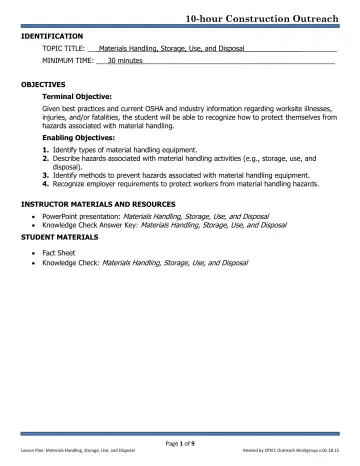
9 slidesMaterials Handling, Storage, Use, and Disposal: Lesson Plan (OSHA 10-Hour Construction Outreach)
Instructor lesson plan with objectives, timing and teaching procedures for the OSHA materials handling, storage, use, and disposal outreach deck.
U.S. Department of Labor, OSHA (with the OTIEC Outreach Workgroup)ArchivedPublic domain
pdf
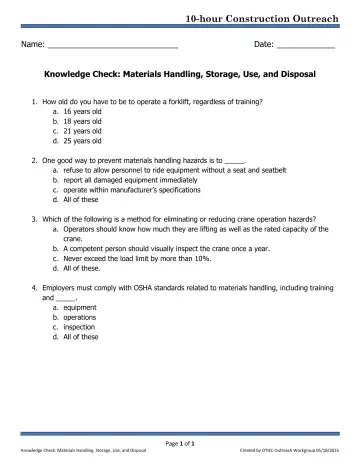
1 slidesMaterials Handling, Storage, Use, and Disposal: Knowledge Check (OSHA 10-Hour Construction Outreach)
Student knowledge-check quiz that accompanies the OSHA materials handling, storage, use, and disposal outreach deck.
U.S. Department of Labor, OSHA (with the OTIEC Outreach Workgroup)ArchivedPublic domain