1 / 5Use ← → to flip
Rotary Valve/Airlock and Lock-Out/Tag-Out Hazards: Preventing Amputation Injuries (OSHA SHIB 11-08-2021)
OSHA fact sheet or bulletin, for General Industry classes.
Page text
· 5 pages · by U.S. Department of Labor, OSHA
The words on each page as the author wrote them, read from the file by software so they can be searched. Layout, pictures and tables are not shown here: the pages above and the download are the original.
- Page 1
Rotary Valve/Airlock and Lock-Out/Tag-Out Hazards: Preventing Amputation Injuries
- U.S. Department of Labor
- Occupational Safety and Health Administration
- Directorate of Technical Support and Emergency Management
- Office of Science and Technology Assessment
- Safety and Health Information Bulletin
- SHIB 11-08-2021
- Introduction
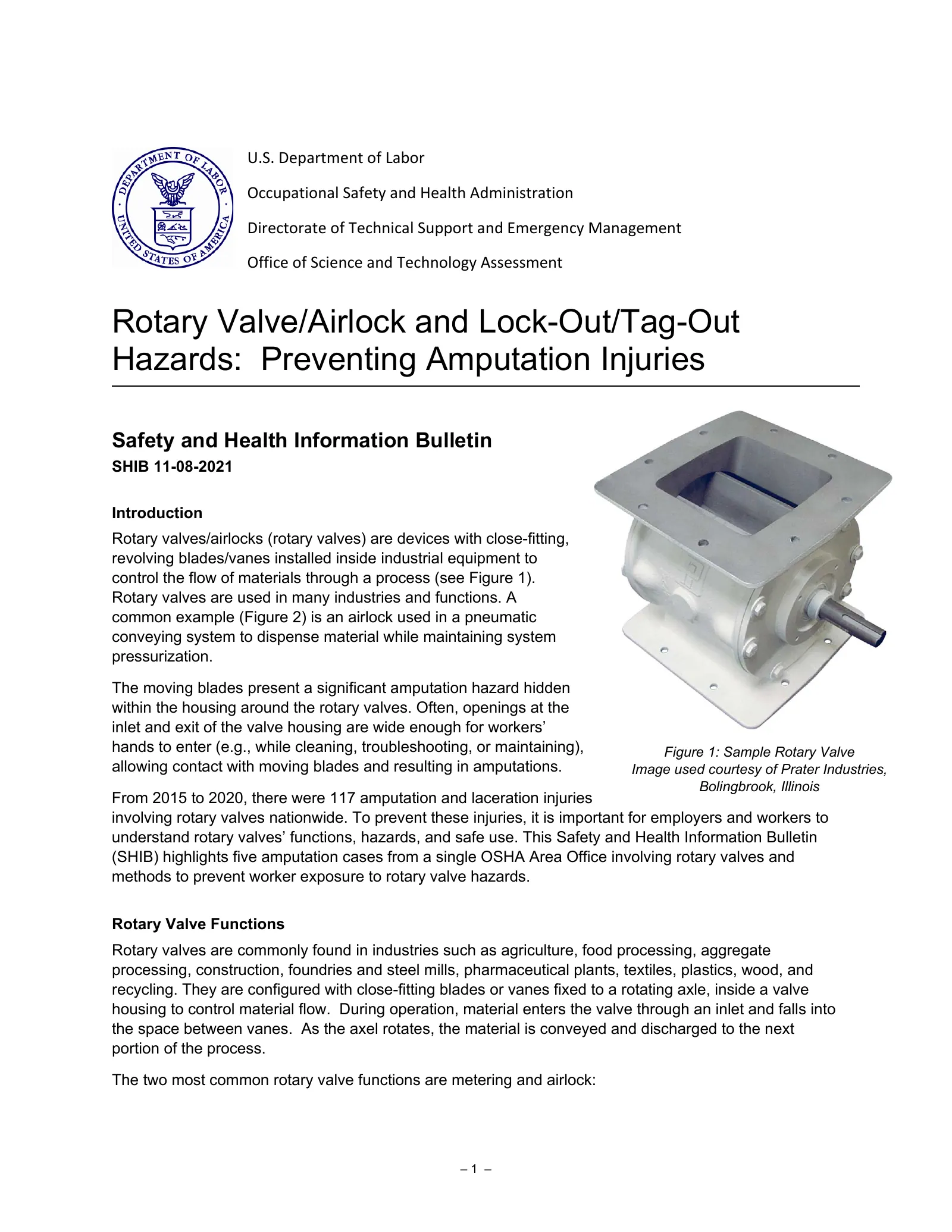
- Rotary valves/airlocks (rotary valves) are devices with close-fitting, revolving blades/vanes installed inside industrial equipment to control the flow of materials through a process (see Figure 1). Rotary valves are used in many industries and functions. A common example (Figure 2) is an airlock used in a pneumatic conveying system to dispense material while maintaining system pressurization.
- The moving blades present a significant amputation hazard hidden within the housing around the rotary valves. Often, openings at the inlet and exit of the valve housing are wide enough for workers’ hands to enter (e.g., while cleaning, troubleshooting, or maintaining), allowing contact with moving blades and resulting in amputations.
- Figure 1: Sample Rotary Valve
- Image used courtesy of Prater Industries, Bolingbrook, Illinois
- From 2015 to 2020, there were 117 amputation and laceration injuries involving rotary valves nationwide. To prevent these injuries, it is important for employers and workers to understand rotary valves’ functions, hazards, and safe use. This Safety and Health Information Bulletin (SHIB) highlights five amputation cases from a single OSHA Area Office involving rotary valves and methods to prevent worker exposure to rotary valve hazards.
- Rotary Valve Functions
- Rotary valves are commonly found in industries such as agriculture, food processing, aggregate processing, construction, foundries and steel mills, pharmaceutical plants, textiles, plastics, wood, and recycling. They are configured with close-fitting blades or vanes fixed to a rotating axle, inside a valve housing to control material flow. During operation, material enters the valve through an inlet and falls into the space between vanes. As the axel rotates, the material is conveyed and discharged to the next portion of the process.
- The two most common rotary valve functions are metering and airlock:
- Page 2
- Metering rotary valves transfer materials at precise flow rates or measurements. These are commonly used to ensure proper process speed or material quantities
- Airlock rotary valves move materials between two spaces with different pressures (e.g., from a gravity fed system to a pneumatic system). The blades form a constant seal between the inlet (see top in Figure 2) and the outlet to prevent air loss and continuously move material with constant air pressure.
- Rotary Valve Hazards and Case Patterns
- Amputations and lacerations are the most common injuries associated with rotary valves and occur when workers physically contact the moving vanes. In many cases, workers are unaware of the moving vanes because the vanes are inside of the machine housing, not readily visible, or not labeled.
- Many rotary valve accidents have similar causes. During one year, an OSHA Area Office investigated the following five rotary valve accidents:
- Case #1 – While cleaning a blender with compressed air, a
- Figure 2: Rotary valve diagram courtesy
- worker grasped a nearby rotary valve for balance. The of OSHA worker could not see the moving vanes inside the rotary valve. The rotary valve was not labeled, guarded, or locked out. The worker’s left hand contacted the moving vanes and the worker suffered partial amputations on left index, middle, and ring fingers.
- Case #2 – A worker was attempting to clean a clumped sugar jam from a magnet chamber immediately below a rotary valve. The worker turned the rotary valve off, removed the guarding, and then proceeded to clear the jam. However, the rotary valve was not locked out. Another worker turned the power back on while the first worker’s hand was inside the valve. The worker suffered a complete amputation to their left index finger.
- Case #3 – A worker was cleaning a plastic resin dust collector, which included two rotary valves. A second worker turned off the dust collector prior to cleaning. The regular drum containers that sit between the rotary valves, and block access (i.e., guard), were removed and replaced with open bulk boxes (e.g. Gaylord containers) to collect residual dust for the cleaning operation. The second worker started the dust collector, causing the rotary valves to unexpectedly start while the first worker’s right hand was inside the dust collector. The first worker could not see or hear the rotary valve inside the dust collector prior to reaching in, and it was not labeled, guarded or locked out. The worker suffered partial amputations to his right index, middle, and ring fingers.
- Case #4 – A worker was cleaning a magnet chamber directly below a rotary valve and reached into the rotary valve area to feel for remaining residue. The worker was unable to see that the rotary valve was still moving, and it was not labeled, guarded or locked out. The worker suffered partial amputation of the left thumb and complete amputation of the left index, middle, and ring fingers.
- Case #5 – A worker was troubleshooting a grinder and reached into the nearby rotary valve’s discharge area to check for a blockage. The rotary valve was still running and the worker suffered
- Page 3
- a complete amputation of the right middle finger. The rotary valve was not labeled, guarded, or locked out.
- In the cases above, the worker did not know there were moving parts inside the system they were reaching into because:
- Rotary valves were not visible.
- Rotary valves were not labeled.
- Workers were not trained on rotary valve locations.
- Rotary valves were not guarded (no guards existed or they were removed).
- Rotary valves or connected process equipment were not locked out.
- Addressing these issues is an effective means of incorporating rotary valve safety into a safety program and preventing injuries.
- Figure 3: Hazard warning sign for rotary valve equipment. Courtesy of Conveyor Equipment Manufacturers Association
- Prevention and Training
- A progressive approach to safely using rotary valves can prevent rotary valve injuries. This approach includes identifying and labeling all rotary valve locations, installing appropriate guarding, implementing a lockout/tagout program, and training workers on these methods.
- First, identify where each rotary valve is located in each process and label them appropriately (see Figure 3). Ensure workers are trained on where the rotary valves are located and on recognizing appropriate hazard labels.
- Second, verify all machine guarding required by 29 CFR 1910.212 is present and installed. Rotary valve blades must be enclosed or guarded by fixed barrier guards or movable guards with safety-rated interlock switches, electronic devices or other equivalent means, to provide safe access for minor servicing. OSHA recommends that the employer train workers on the following:
- Identifying and labeling hazards for particular machines and rotary valves.
- How the machine guarding provides protection.
- How to use the guards.
- How and under what circumstances guarding can be removed, and by whom (in most cases, repair or maintenance personnel only).
- Identifying defective, damaged, or improperly installed machine guarding. The employer is responsible for replacing defective, damaged or improperly installed guarding.
- Third, develop, implement, and enforce an energy control program (lockout/tagout). In accordance with 29 CFR 1910.147, employers are required to use lockout/tagout to isolate energy sources when servicing or maintaining machines. Lockout/tagout prevents injury from residual motion and unexpected startup through orderly shut-down, isolation, and lock out of the rotary valve’s energy source. Employers must ensure that all workers are trained on their role and these procedures and assess the program and machine specific procedures at least annually. Worker training on lockout/tagout requires:
- Specific lockout/tagout procedures including at least these three areas:
- The employer’s energy control program components;
- Energy control procedure elements relevant to the worker’s duties or assignment; and
- OSHA requirements related to lockout/tagout.
- Page 4
- Safe shutdown and start-up procedures in accordance with the manufacturer’s instructions and company lockout/tagout policy.
- Safe work procedures when working with opened and accessible rotary valves.
- Additional hazard prevention methods include:
- Job hazard assessments for all production, servicing, and maintenance tasks performed by workers on or near rotary valves.
- Warning/danger signs or pictograms.
- Policies that restrict reconfiguring or removing system components to allow access to rotary valve moving parts.
- Regular inspections and monitoring to ensure compliance with established procedures.
- Lastly, employers must ensure that the training appropriately addresses all workplace hazards that workers will encounter and that the training is provided in a language that workers can understand.
- Resources
- 29 CFR 1910.212: General requirements for all machines
- 29 CFR 1910.147: Control of hazardous energy (lockout/tagout)
- OSHA Hazard Communication Safety and Health Topics Page
- OSHA Recommended Practices for Safety and Health Programs
- NFPA 69, Standard on Explosion Prevention Systems
- Additional Information
- OSHA provides compliance assistance through a variety of programs. OSHA’s On-Site Consultation Program offers no-cost and confidential occupational safety and health services to small and mediumsized businesses. On-Site consultation services are separate from OSHA enforcement efforts and do not result in penalties or citations. However, employers must agree to correct any serious and imminent danger hazards identified in a timely manner. To locate the OSHA On-Site Consultation Program nearest you, call 1-800-321-OSHA (6742) or visit https://www.osha.gov/consultation.
- Workers' Rights
- Workers have the right to:
- Working conditions that do not pose a risk of serious harm.
- Receive information and training (in a language and vocabulary the worker understands) about workplace hazards, methods to prevent them, and the OSHA standards that apply to their workplace.
- Review records of work-related injuries and illnesses.
- File a complaint asking OSHA to inspect their workplace if they believe there is a serious hazard or that their employer is not following OSHA's rules. OSHA will keep all identities confidential to the extent permitted by law.
- Exercise their rights under the Occupational Safety and Health Act (OSH Act) without retaliation, including reporting an injury or raising health and safety concerns with their employer or OSHA. To preserve a claim for unlawful retaliation under the OSH Act, a worker must file a complaint with OSHA no later than 30 days after the alleged unfavorable action occurs.
- Page 5
- Exercise their rights under the Consumer Product Safety Improvement Act (CPSIA) without retaliation, including reporting a potentially unsafe or defective product to their employer, the Federal Government (such as the Consumer Product Safety Commission (CPSC)), or a State Attorney General. To preserve a claim for unlawful retaliation under the CPSIA, a worker must file a whistleblower complaint with OSHA no later than 180 days after an alleged violation of the CPSIA whistleblower provision occurs.
- For additional information, see OSHA's Workers page.
- Contact OSHA
- Under the OSH Act, employers are responsible for providing safe and healthful workplaces for their employees. OSHA's role is to help ensure these conditions for America's working men and women by setting and enforcing standards, and providing training, education and assistance. For more information, visit www.osha.gov/ or call OSHA at 1-800-321- OSHA (6742), TTY 1-877-889-5627.
- This Safety and Health Information Bulletin is not a standard or regulation, and it creates no new legal obligations. The Bulletin is advisory in nature, informational in content, and is intended to assist employers in providing a safe and healthful workplace. Pursuant to the Occupational Safety and Health Act (OSH Act), employers must comply with hazard-specific safety and health standards and regulations promulgated by OSHA or by a state with an OSHA-approved state plan. In addition, pursuant to Section 5(a)(1), the General Duty Clause of the Act, employers must provide their employees with a workplace free from recognized hazards likely to cause death or serious physical harm. Employers can be cited for violating the General Duty Clause if there is a recognized hazard and they do not take reasonable steps to prevent or abate the hazard. However, failure to implement any recommendations in this Safety and Health Information Bulletin is not, in itself, a violation of the General Duty Clause. Citations can only be based on standards, regulations, and the General Duty Clause.
- Twenty-eight states and territories operate their own occupational safety and health State Plans approved by OSHA. State Plans may have different or additional requirements. A list of State Plans is available at: http://www.osha.gov/dcsp/osp/.
More on Lockout/Tagout
pptx
30 slidesLockout/Tagout: Hazardous Energy Control
Lockout/tagout deck from Central Georgia Technical College: energy sources, procedures and device use.
Central Georgia Technical CollegeOSHA Harwood grant

ppt
50 slidesLockout/Tagout
TEEX deck on the control of hazardous energy standard (1910.147).
Texas Engineering Extension ServiceArchivedOSHA Harwood grant
ppt
33 slidesHazardous Energy
Hazardous energy control module from the WVU oil and gas site course.
West Virginia UniversityArchivedOSHA Harwood grant