1 / 2Use ← → to flip
Heat Stress: Work/Rest Schedules (NIOSH 2017-127)
NIOSH fact sheet with a sample work/rest schedule and temperature adjustments for hot outdoor work.
Page text
· 2 pages · by National Institute for Occupational Safety and Health (NIOSH)
The words on each page as the author wrote them, read from the file by software so they can be searched. Layout, pictures and tables are not shown here: the pages above and the download are the original.
- Page 1
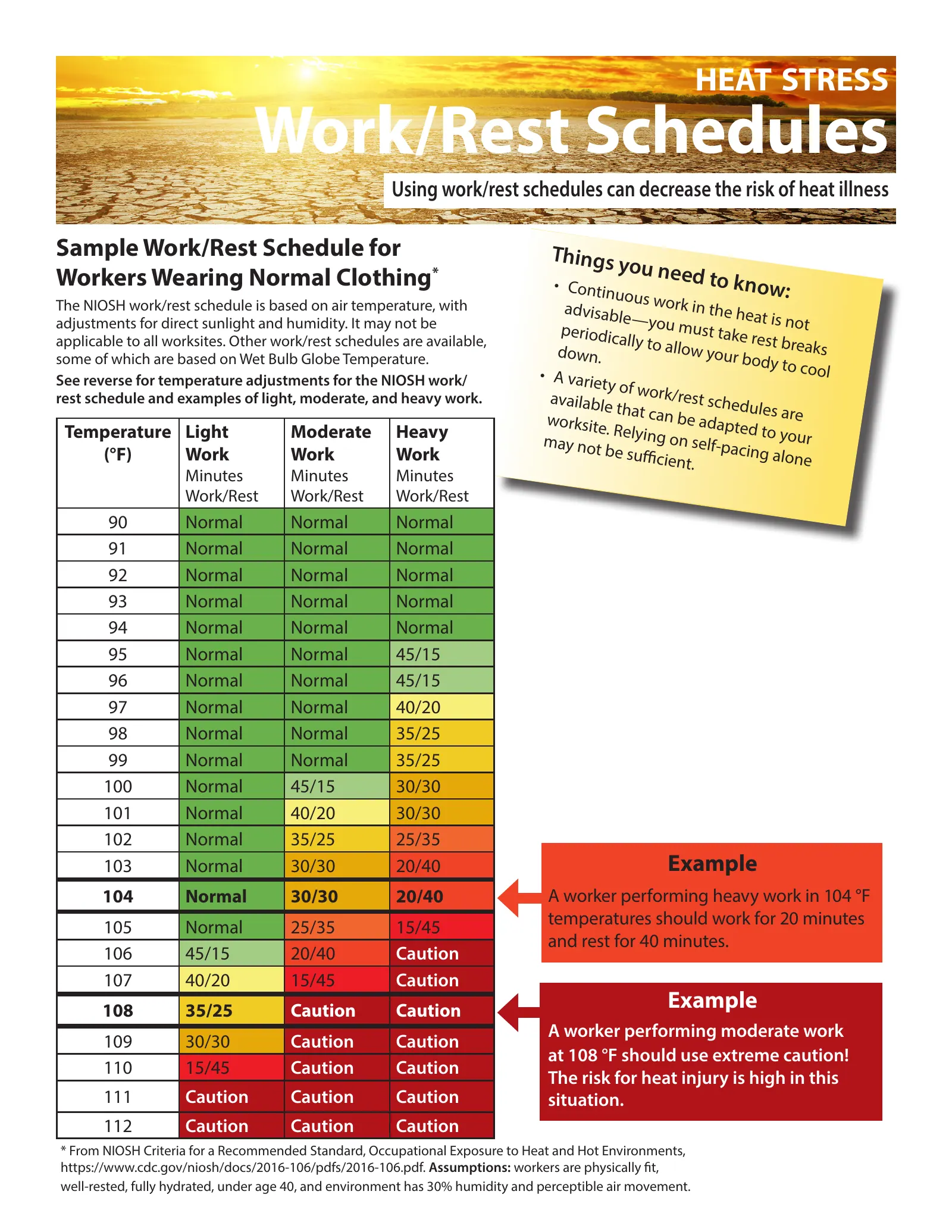
Work/Rest Schedules
- heat stress
- Using work/rest schedules can decrease the risk of heat illness
- Sample Work/Rest Schedule for Workers Wearing Normal Clothing *
- The NIOSH work/rest schedule is based on air temperature, with adjustments for direct sunlight and humidity. It may not be applicable to all worksites. Other work/rest schedules are available, some of which are based on Wet Bulb Globe Temperature.
- See reverse for temperature adjustments for the NIOSH work/ rest schedule and examples of light, moderate, and heavy work.
- Temperature Light
- (°F)
- Work
- Minutes
- Work/Rest
- Moderate
- Work
- Heavy Work
- Minutes
- Work/Rest
- Minutes
- Work/Rest
- 90 91 92 93 94 95 96 97 98 99 100 101 102 103
- Normal Normal Normal Normal Normal Normal Normal Normal Normal Normal Normal Normal Normal Normal
- Normal Normal Normal Normal Normal Normal Normal Normal Normal Normal 45/15 40/20 35/25 30/30
- Normal Normal Normal Normal Normal 45/15 45/15 40/20 35/25 35/25 30/30 30/30 25/35 20/40
- Normal
- 105 106 107
- Normal 45/15 40/20
- 25/35 20/40 15/45
- 15/45 Caution Caution
- Caution
- Caution
- 109 110
- 30/30 15/45
- Caution Caution
- Caution
- Caution
- Caution
- Caution
- Caution
- Caution
- Things y
- u nee
- d to kno
- Contin
- w:
- uous wo
- rk in the advisab
- heat is n
- le—you
- ot
- must tak
- periodic
- e rest br
- ally to a eaks
- llow you
- down.
- r body t
- o cool
- A varie
- ty of wo
- rk/rest s
- available
- chedule
- that can
- s are be adap
- worksite
- ted to yo
- . Relying
- ur
- on self-p
- may not
- acing alo
- be suffic
- ne
- ient.
- Example
- A worker performing heavy work in 104 °F temperatures should work for 20 minutes and rest for 40 minutes.
- Example
- A worker performing moderate work at 108 °F should use extreme caution! The risk for heat injury is high in this situation.
- From NIOSH Criteria for a Recommended Standard, Occupational Exposure to Heat and Hot Environments, https://www.cdc.gov/niosh/docs/2016-106/pdfs/2016-106.pdf. Assumptions: workers are physically fit, well-rested, fully hydrated, under age 40, and environment has 30% humidity and perceptible air movement.
- Page 2
Photo by ©Thinkstock
- heat stress
- Work/Rest Schedules
- Temperature Adjustments for this Work/Rest Schedule
- Adjust the temperature in the table based on:
- Environmental conditions
- AND
- Full sun (no clouds): Add 13 °F
- Partly cloudy/overcast: Add 7 °F
- No shadows visible, in the shade, or at night: No adjustment
- Humidity
- 40% humidity: Add 3 °F
- 50% humidity: Add 6 °F
- 60% humidity or more: Add 9 °F
- Example Adjustment
- Conditions at a mine are 90 °F, with partly cloudy skies and 50% humidity. Adjust the table as follows:
- Add 7 °F for partly cloudy skies and 6 °F for 50% humidity, to arrive at 103 °F.
- Examples of Work at Different Intensity Levels
- Light work
- Moderate work
- Heavy work
- Operating equipment
- Inspection work
- Walking on flat, level ground
- Using light hand tools (wrench, pliers, etc.). However, this may be moderate work depending on the task
- Travel by conveyance
- Jack-leg drilling
- Installing ground support
- Loading explosives
- Carrying equipment/supplies weighing 20–40 pounds
- Using hand tools (shovel, fin-hoe, scaling bar) for short periods
- Climbing
- Carrying equipment/supplies weighing 40 pounds or more
- Installing utilities
- Using hand tools (shovel, fin-hoe, scaling bar) for extended periods
- Case Study: Use of Work/Rest Schedule
- A crew was shoveling ore out from under the primary conveyor at a surface mine in Arizona in August. The high temperature that day was 113 °F. The crew was rotating in 10-minute shifts and hydrating between shifts. Coworkers noticed signs of heat illness in two employees, and they were transferred to the medical station for evaluation. From there they were sent to the hospital, where they were given IV saline and released home. Both employees recovered after rehydration at the hospital.
- Lessons Learned
- In extreme heat, even a work/rest schedule may not eliminate the risk of heat illness. In this case, use of work/rest schedules, frequent hydration, and team monitoring helped keep this situation from becoming even more serious. Without those safety precautions the workers could have potentially suffered more severe heat illness, possibly including heat stroke, which is life threatening.
- DEPARTMENT OF HEALTH AND HUMAN SERVICES Centers for Disease Control and Prevention
- National Institute for Occupational Safety and Health
- DHHS (NIOSH) Publication No. 2017-127
More on Heat
pptx
96 slidesHeat Illness Prevention Worker Training
Heat illness prevention worker training from the University of Houston-Clear Lake.
University of Houston Clear LakeOSHA Harwood grant
pptxes
95 slidesPrevención contra enfermedades por el calor
Spanish edition of the UHCL heat illness prevention worker training.
University of Houston Clear LakeOSHA Harwood grant
pptx
32 slidesHeat-Related Illnesses (Employee)
Employee heat-related illness training from Sonora Environmental Research Institute.
Sonora Environmental Research InstituteOSHA Harwood grant