1 / 32Use ← → to flip
Hand and Power Tools (OSHA 3080)
OSHA booklet on hand and power tool hazards and safeguards.
Page text
· 32 pages · by U.S. Department of Labor, OSHA
The words on each page as the author wrote them, read from the file by software so they can be searched. Layout, pictures and tables are not shown here, and long pages are shortened: the pages above and the download are the original.
- Page 1
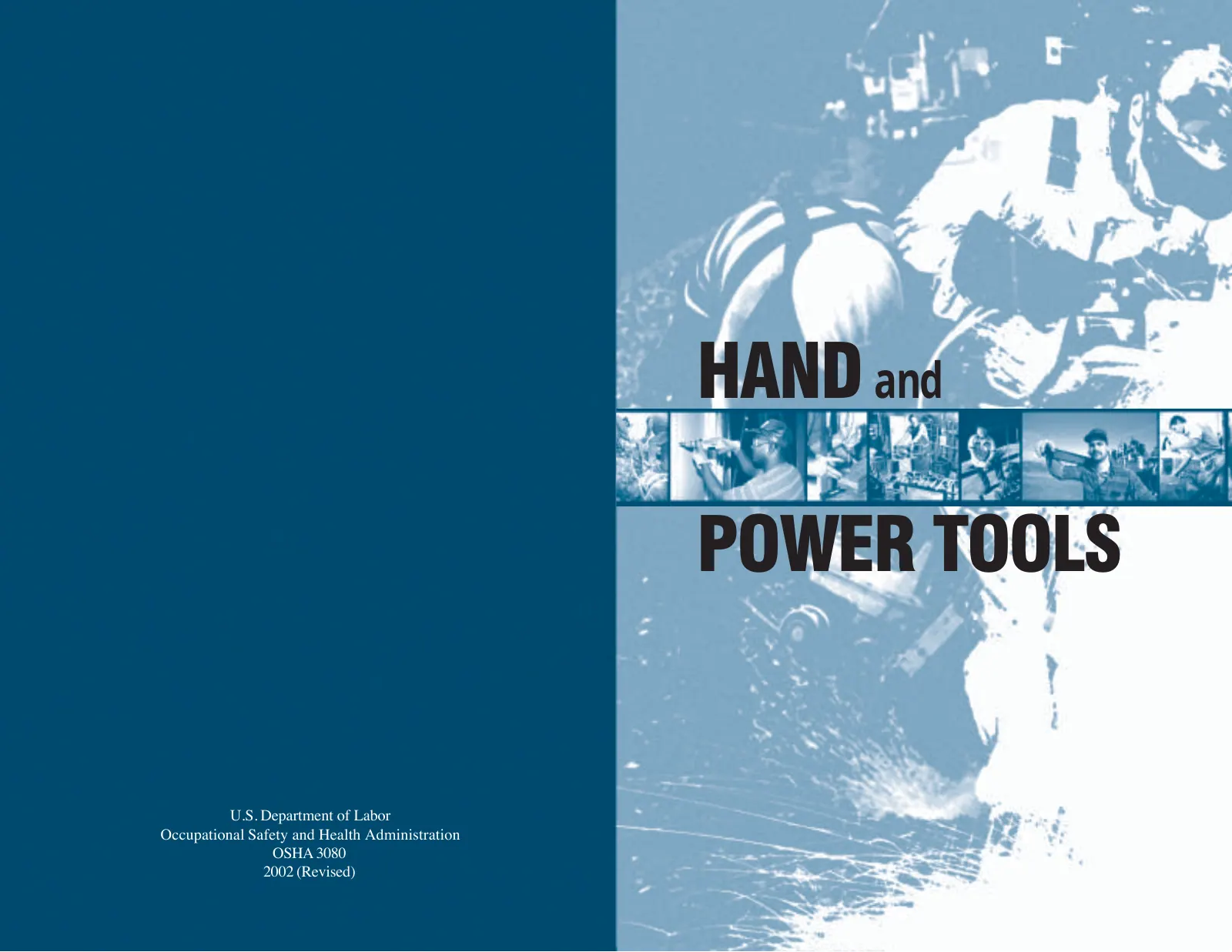
HAND and
- POWER TOOLS
- U.S. Department of Labor
- Occupational Safety and Health Administration
- OSHA 3080
- 2002 (Revised)
- Page 2
- This informational booklet is intended to provide a generic, non-exhaustive overview of a particular standards-related topic. This publication does not itself alter or determine compliance responsibilities, which are set forth in OSHA standards themselves and the Occupational
- Safety and Health Act. Moreover, because interpretations and enforcement policy may change over time, for additional guidance on OSHA compliance requirements, the reader should consult current and administrative interpretations and decisions by the Occupational Safety and
- Health Review Commission
- and the courts.
- Material contained in this publication is in the public domain and may be reproduced, fully or partially, without permission of the Federal Government. Source credit is requested but not required.
- This information will be made available to sensory impaired individuals upon request.
- Voice phone: (202) 693-1999
- …
- Page 3
Hand and Power Tools
- U.S. Department of Labor
- Occupational Safety and Health Administration
- OSHA 3080
- 2002 (Revised)
- Page 4
- Contents
- iii
- What Is the Purpose of This Booklet? … 1
- What Are the Hazards of Hand Tools? … 3
- What Are the Dangers of Power Tools? … 4
- Guards … 5
- Operating Controls and Switches … 5
- Electric Tools … 6
- Portable Abrasive Wheel Tools … 7
- Pneumatic Tools … 8
- Liquid Fuel Tools … 9
- Powder-Actuated Tools … 9
- Hydraulic Power Tools … 11
- What Help Can OSHA Provide? … 13
- Safety and Health Program Management Guidelines 13
- State Programs … 13
- Consultation Services … 14
- Voluntary Protection Programs … 15
- Strategic Partnership Program … 15
- Training and Education … 15
- Electronic Information … 16
- OSHA Publications … 17
- Emergencies, Complaints, and Further Assistance … 18
- States and Territories with Approved Plans … 19
- OSHA Consultation Project Directory … 22
- OSHA Area Offices … 24
- OSHA Regional Offices … 27
- Contents
- Page 5
What Is the Purpose of This Booklet?
- This booklet is designed to present to emplo yees and employers a summary of the basic safety procedures and safe guards associated with hand and portable po wer tools.
- Material in this booklet is based on the standards of the Occupational Safety and Health Administration; this booklet, ho wever, should not be considered as a substitute for the full safety and health standards for general industry (published in Title 29 Code of Federal Regulations (CFR), Part 1910, Subpart P), or for the construction industry (published in 29 CFR Part 1926, Subpart I). These are also available on the World Wide Web at www.osha.gov.Employers and employees in the 26 states and territories with OSHA-approved state safety and health plans should check with their state agency. …
- …
- Page 6
- Provide and use properly the right personal protecti ve equipment.
- Employees and employers should work together to establish safe working procedures. If a hazardous situation is encountered, it should be brought immediately to the attention of the proper individual for hazard abatement.
- The following sections identify various types of hand and po wer tools and their potential hazards. They also identify ways to prevent worker injury through proper use of the tools and through the use of appropriate personal protecti ve equipment.
- Page 7
What Are the Hazards of Hand Tools?
- Hand tools are tools that are powered manually. Hand tools include anything from axes to wrenches. The greatest hazards posed by hand tools result from misuse and improper maintenance.
- Some examples include the following:
- If a chisel is used as a screwdriver, the tip of the chisel may break and fly off, hitting the user or other employees.
- If a wooden handle on a tool, such as a hammer or an axe, is loose, splintered, or cracked, the head of the tool may fly off and strike the user or other employees.
- If the jaws of a wrench are sprung, the wrench might slip.
- If impact tools such as chisels, wedges, or drift pins have mushroomed heads, the heads might shatter on impact, sending sharp fragments flying toward the user or other employees. The employer is responsible for the safe condition of tools and equipment used by employees. …
- …
- Page 8
What Are the Dangers of Power Tools?
- Appropriate personal protective equipment such as safety goggles and gloves must be worn to protect against hazards that may be encountered while using hand tools.
- Workplace floors shall be k ept as clean and dry as possible to prevent accidental slips with or around dangerous hand tools.
- Power tools must be f itted with guards and safety switches; the y are extremely hazardous when used improperly. The types of power tools are determined by their po wer source: electric, pneumatic, liquid fuel, hydraulic, and po wder-actuated.
- To prevent hazards associated with the use of po wer tools, workers should observe the following general precautions:
- Never carry a tool by the cord or hose.
- Never yank the cord or the hose to disconnect it from the receptacle.
- Keep cords and hoses away from heat, oil, and sharp edges.
- …
- Page 9
Guards
- The exposed moving parts of power tools need to be safeguarded. Belts, gears, shafts, pulle ys, sprockets, spindles, drums, flywheels, chains, or other reciprocating, rotating, or mo ving parts of equipment must be guarded.
- Machine guards, as appropriate, must be pro vided to protect the operator and others from the follo wing:
- Point of operation.
- In-running nip points.
- Rotating parts.
- Flying chips and sparks.
- Safety guards must never be removed when a tool is being used. Portable circular saws having a blade greater than 2 inches (5.08 centimeters) in diameter must be equipped at all times with guards. An upper guard must cover the entire blade of the sa w. A retractable lower guard must cover the teeth of the sa w, except where it makes contact with the work material. The lower guard must automatically return to the co vering position when the tool is withdrawn from the work material.
- Operating Controls and Switches
- …
- Page 10
- laminate trimmers, nibblers, shears, and scroll sa ws; and jigsaws, saber and scroll saws with blade shanks a nominal 1 / 4 -inch (6.35 millimeters) or less in diameter. It is recommended that the constant-pressure control switch be re garded as the preferred de vice. Other hand-held power tools such as circular saws ha ving a blade diameter greater than 2 inches (5.08 centimeters), chain sa ws, and percussion tools with no means of holding accessories securely must be equipped with a constant-pressure switch.
- Electric Tools
- Employees using electric tools must be aw are of several dangers. Among the most serious hazards are electrical b urns and shocks. Electrical shocks, which can lead to injuries such as heart f ailure and burns, are among the major hazards associated with electricpowered tools. Under certain conditions, e ven a small amount of electric current can result in f ibrillation of the heart and death. …
- …
- Page 11
- Do not use electric tools in damp or wet locations unless the y are approved for that purpose.
- Keep work areas well lighted when operating electric tools.
- Ensure that cords from electric tools do not present a tripping hazard.
- In the construction industry, employees who use electric tools must be protected by ground-f ault circuit interrupters or an assured equipment-grounding conductor program.
- Portable Abrasive Wheel Tools
- Portable abrasive grinding, cutting, polishing, and wire b uffing wheels create special safety problems because the y may throw off flying fragments. Abrasive wheel tools must be equipped with guards that: (1) co ver the spindle end, nut, and flange projections;
- (2) maintain proper alignment with the wheel; and (3) do not exceed the strength of the f astenings.
- Before an abrasive wheel is mounted, it must be inspected closely for damage and should be sound- or ring-tested to ensure that it is free from…
- …
- Page 12
II
- When using a powered grinder:
- Always use eye or face protection.
- Turn off the power when not in use.
- Never clamp a hand-held grinder in a vise.
- Pneumatic
- Tools
- Pneumatic tools are powered by compressed air and include chippers, drills, hammers, and sanders.
- There are several dangers associated with the use of pneumatic tools. First and foremost is the danger of getting hit by one of the tool's attachments or by some kind of fastener the worker is using with the tool.
- Pneumatic tools must be checked to see that the tools are fastened securely to the air hose to prevent them from becoming disconnected. A short wire or positive locking device attaching the air hose to the tool must also be used and will serve as an added safeguard.
- If an air hose is more than ½-inch (12.7 millimeters) in diameter, a safety excess flow valve must be installed at the source of the air supply to reduce pressure in case of hose failure.
- …
- Page 13
- Eye protection is required, and head and f ace protection is recommended for employees w orking with pneumatic tools. Screens must also be set up to protect nearby w orkers from being struck by flying fragments around chippers, ri veting guns, staplers, or air drills.
- Compressed air guns should ne ver be pointed toward anyone. Workers should never “dead-end” them against themselves or anyone else. A chip guard must be used when compressed air is used for cleaning.
- Use of heavy jackhammers can cause fatigue and strains. Hea vy rubber grips reduce these ef fects by providing a secure handhold. Workers operating a jackhammer must wear safety glasses and safety shoes that protect them against injury if the jackhammer slips or falls. A face shield also should be used.
- Noise is another hazard associated with pneumatic tools. Working with noisy tools such as jackhammers requires proper , effective use of appropriate hearing…
- …
- Page 14
- When using powder-actuated tools, an employee must wear suitable ear, eye, and face protection. The user must select a powder level—high or low velocity—that is appropriate for the powder-actuated tool and necessary to do the w ork without excessive force.
- The muzzle end of the tool must ha ve a protective shield or guard centered perpendicular to and concentric with the barrel to confine any fragments or particles that are projected when the tool is fired. A tool containing a high-v elocity load must be designed not to fire unless it has this kind of safety de vice.
- To prevent the tool from f iring accidentally, two separate motions are required for firing. The first motion is to bring the tool into the firing position, and the second motion is to pull the trigger . The tool must not be able to operate until it is pressed against the w ork surface with a force of at least 5 pounds (2.2 kg) greater than the total weight of…
- …
- Page 15
- When using powder-actuated tools to apply fasteners, se veral additional procedures must be follo wed:
- Do not fire fasteners into material that w ould allow the fasteners to pass through to the other side.
- Do not drive fasteners into very hard or brittle material that might chip or splatter or mak e the fasteners ricochet.
- Always use an alignment guide when shooting f asteners into existing holes.
- When using a high-velocity tool, do not dri ve fasteners more than 3 inches (7.62 centimeters) from an unsupported edge or corner of material such as brick or concrete.
- When using a high v elocity tool, do not place f asteners in steel any closer than 1 / 2 -inch (1.27 centimeters) from an unsupported corner edge unless a special guard, f ixture, or jig is used.
- Hydraulic Power Tools
- The fluid used in h ydraulic power tools must be an appro ved fireresistant fluid and must retain its operating characteristics at the most extreme…
- …
- Page 16
To set up a jack, mak e certain of the follo wing:
- The base of the jack rests on a f irm, level surface;
- The jack is correctly centered;
- The jack head bears against a le vel surface; and
- The lift force is applied e venly.
- Proper maintenance of jacks is essential for safety . All jacks must be lubricated regularly. In addition, each jack must be inspected according to the follo wing schedule: (1) for jacks used continuously or intermittently at one site—inspected at least once every 6 months, (2) for jacks sent out of the shop for special work— inspected when sent out and inspected when returned, and (3) for jacks subjected to abnormal loads or shock—inspected before use and immediately thereafter.
- Page 17
What Help Can OSHA Provide?
- OSHA can provide extensive help through a v ariety of programs, including assistance about safety and health programs, state plans, workplace consultations, voluntary protection programs, strate gic partnerships, training and education, and more.
- Safety and Health Program Management Guidelines
- Working in a safe and healthful en vironment can stimulate innovation and creativity and result in increased performance and higher productivity.
- To assist employers and employees in de veloping effective safety and health management systems, OSHA published recommended
- Safety and Health Program Management Guidelines (Federal
- Register 54(16): 3904-3916, January 26, 1989). These voluntary guidelines can be applied to all places of emplo yment covered by OSHA.
- The guidelines identify four general elements that are critical to the development of a successful safety and health management system. …
- …
- Page 18
- must adopt and enforce standards identical to, or at least as ef fective as, the federal standards and pro vide extensive programs of voluntary compliance and technical assistance, including consultation services.
- Consultation Services
- Consultation assistance is available on request to emplo yers who want help in establishing and maintaining a safe and healthful workplace. Largely funded by OSHA, the service is pro vided at no cost to the employer. Primarily developed for smaller employers with more hazardous operations, the consultation service is deli v-ered by state go vernments employing professional safety and health consultants. Comprehensive assistance includes a hazard surv ey of the worksite and appraisal of all aspects of the emplo yer’s existing safety and health management system. …
- …
- Page 19
Voluntary Protection Programs (VPP)
- Voluntary Protection Programs and onsite consultation services, when coupled with an ef fective enforcement program, expand worker protection to help meet the goals of the OSH Act. The three levels of VPP—Star, Merit, and Demonstration—are designed to recognize outstanding achievements by companies that ha ve developed and implemented ef fective safety and health management systems. The VPPs motivate others to achieve excellent safety and health results in the same outstanding w ay as they establish a cooperative relationship between emplo yers, employees, and OSHA. For additional information on VPPs and how to apply, contact the OSHA regional offices listed at the end of this publication.
- Strategic Partnership Program
- OSHA’s Strategic Partnership Program, the newest member of OSHA’s cooperative programs, helps encourage, assist, and recognize the efforts of partners to eliminate serious w…
- …
- Page 20
- The OSHA Training Institute also has established OSHA Training Institute Education Centers to address the increased demand for its courses from the private sector and from other federal agencies. These centers are nonprofit colleges, universities, and other or ganizations that have been selected after a competition for participation in the program.
- OSHA awards grants through its Susan Harwood Training Grant Program to nonprofit organizations to provide safety and health training and education to employers and w orkers in the workplace. The grants focus on programs that will educate w orkers and employers in small business (fewer than 250 employees), training work ers and employers about new OSHA standards or about high-risk acti vities or hazards. Grants are awarded for 1 year and may be rene wed for an additional 12-month period depending on whether the grantee has performed satisfactorily.
- …
- Page 21
- OSHA’s CD-ROM includes standards, interpretations, directi ves, and more and can be purchased on CD-R OM from the U.S. Government Printing Office. To order, write to the Superintendent of Documents, U.S. Government Printing Office, Washington, DC 20402, or phone (202) 512-1800. Specify OSHA Re gulations, Documents and Technical Information on CD-ROM (ORDT), GPO Order No. S/N 729-013-00000-5. The price is $45 per year ($63.00 overseas); $21 per single cop y ($26.25 overseas).
- OSHA Publications
- OSHA has an extensive publications program. For a listing of free or sales items, visit OSHA’s website at www.osha.gov or contact the OSHA Publications Office , U.S. Department of Labor, OSHA/OSHA Publications, PO Box 37535, Washington, DC 20013-7535. Telephone (202) 693-1888 or f ax to (202) 693-2498.
- All About OSHA - OSHA 2056
- Chemical Hazard Communication - OSHA 3084
- Controlling Electrical Hazards - OSHA 3075
- …
- Page 22
Emergencies, Complaints, and Further Assistance
- To report an emergency, file a complaint, or seek OSHA advice, assistance, or products, call (800) 321-OSHA or contact your nearest OSHA regional, area, state plan, or consultation of fice listed at the end of this publication. The teletypewriter (TTY) number is (877) 889-5627.
- You can also file a complaint online and obtain more information on OSHA federal and state programs by visiting OSHA’s website at www.osha.gov.
- Page 23
States and Territories with Approved Plans
- Commissioner
- Alaska Department of Labor
- 1111 West 8th Street
- Room 304
- Juneau, AK 99801-1149
- (907) 465-2700
- Director
- Industrial Comm. of Arizona
- 800 W. Washington
- Phoenix, AZ 85007-2922
- (602) 542-5795
- Director
- California Department of Industrial Relations 455 Golden Gate Avenue 10 th Floor
- San Francisco, CA 94102 (415) 703-5050
- Indiana Department of Labor State Office Building
- 402 West Washington Street Room W195
- Indianapolis, IN 46204-2751 (317) 232-2378
- Iowa Division of Labor Services
- 1000 E. Grand Avenue
- Des Moines, IA 50319-0209
- (515) 281-3447
- Secretary
- Kentucky Labor Cabinet
- 1049 U.S. Highway, 127 South
- Suite 4
- Frankfort, KY 40601
- (502) 564-3070
- Connecticut Departmentof Labor Maryland Division of Labor
- 200 Folly Brook Boulevard and Industry
- Wethersfield, CT 06109
- Department of Labor, Licensing, (203) 566-5123 and Regulation
- 1100 N. Eutaw Street, Room 613
- Director
- …
- Page 24
Commissioner
- Minnesota Department of Labor and Industry
- 443 Lafayette Road
- St. Paul, MN 55155-4307
- (651) 296-2342
- North Carolina Department of Labor
- 4 West Edenton Street
- Raleigh, NC 27601-1092
- (919) 807-2900
- Administrator
- Nevada Division of Industrial
- Relations
- 400 West King Street
- Carson City, NV 89710
- (775) 687-3032
- Department of Consumer
- and Business Services
- Occupational Safety and Health
- Division (OR-OSHA)
- 350 Winter Street, NE
- Room 430
- Salem, OR 97310-0220
- (503) 378-3272
- New Jersey Department of Labor
- John Fitch Plaza
- Market and Warren Streets
- P.O. Box 110
- Trenten, NJ 08625-0110
- (609) 292-2975
- Secretary
- New Mexico Environment
- Department
- 1190 St. Francis Drive
- P.O. Box 26110
- Santa Fe, NM 87502
- (505) 827-2850
- New York Department of Labor
- W. Averell Harriman State
- Office Building - 12
- Room 500
- Albany, NY 12240
- (518) 457-2741
- Secretary
- Puerto Rico Department of Labor and Human Resources
- Prudencio Rivera Martinez
- Building
- …
- Page 25
Commissioner
- Tennessee Department of Labor 710 James Robertson Parkway Nashville, TN 37243-0659 (615) 741-2582
- Labor Commission of Utah
- 160 East 300 South, 3rd Floor
- P.O. Box 146650
- Salt Lake City, UT 84114-6650 (801) 530-6898
- Vermont Department of Labor and Industry
- National Life Building
- Drawer 20
- National Life Drive
- Montpelier, VT 05260-3401
- (802) 828-5098
- States with Approved Plans
- Page 26
OSHA Consultation Project Directory
- State
- Telephone
- Alabama … (205) 348-3033 Alaska … (907) 269-4957 Arizona … (602) 542-1695 Arkansas … (501) 682-4522 California … (916) 574-2555 Colorado … (970) 491-6151 Connecticut … (860) 566-4550 Delaware … (302) 761-8219 District of Columbia … (202) 541-3727 Florida … (813) 974-9962 Georgia … (404) 894-2643 Guam … 9-1-(671) 475-0136 Hawaii … (808) 586-9100 Idaho … (208) 426-3283 Illinois … (312) 814-2337 Indiana … (317) 232-2688 Iowa … (515) 281-7629 Kansas … (785) 296-7476 Kentucky … (502) 564-6895 Louisiana … (225) 342-9601 Maine … (207) 624-6460 Maryland … (410) 880-4970 Massachusetts … (617) 727-3982 Michigan … (517) 322-6823 Minnesota … (651) 297-2393 Mississippi … (601) 987-3981 Missouri … (573) 751-3403 Montana … (406) 444-6418 Nebraska … (402) 471-4717 Nevada … (702) 486-9140 New Hampshire … (603) 271-2024 New Jersey … (609) 292-3923 New Mexico … (505) 827-4230 New York … (518)…
- …
- Page 27
- Puerto Rico … (787) 754-2171 Rhode Island … (401) 222-2438 South Carolina … (803) 734-9614 South Dakota … (605) 688-4101 Tennessee … (615) 741-7036 Texas … (512) 804-4640 Utah … (801) 530-6901 Vermont … (802) 828-2765 Virginia … (804) 786-6359 Virgin Islands … (809) 772-1315 Washington … (360) 902-5638 West Virginia … (304) 558-7890 Wisconsin … (608) 266-8579 Wyoming … (307) 777-7786
- OSHA Consultation Project Directory
- Page 28
OSHA Area Offices
- Area
- Telephone
- Birmingham, AL … (205) 731-1534 Mobile, AL … (334) 441-6131 Anchorage, AK … (907) 271-5152 Phoenix, AZ … (602) 640-2348 Little Rock, AR … (501) 324-6291(5818) San Diego, CA … (619) 557-5909 Sacramento, CA … (916) 566-7471 Denver, CO … (303) 844-5285 Englewood, CO … (303) 843-4500 Bridgeport, CT … (203) 579-5581 Hartford, CT … (860) 240-3152 Wilmington, DE … (302) 573-6518 Fort Lauderdale, FL … (954) 424-0242 Jacksonville, FL … (904) 232-2895 Tampa, FL … (813) 626-1177 Savannah, GA … (912) 652-4393 Smyrna, GA … (770) 984-8700 Tucker, GA … (770) 493-6644/6742/8419 Boise, ID … (208) 321-2960 Calumet City, IL … (708) 891-3800 Des Plaines, IL … (847) 803-4800 Fairview Heights, IL … (618) 632-8612 North Aurora, IL … (630) 896-8700 Peoria, IL … (309) 671-7033 Indianapolis, IN … (317) 226-7290 Des Moines, IA … (515) 284-4794 Wichita, KS … (316) 269-6644 Frankfort, KY … (502) 227-7024 Baton Rouge, LA…
- …
- Page 29
Area
- Telephone
- St. Louis, MO … (314) 425-4289 Billings, MT … (406) 247-7494 Raleigh, NC … (919) 856-4770 Omaha, NE … (402) 221-3182 Carson City, NV … (775) 885-6963 Concord, NH … (603) 225-1629 Avenel, NJ … (732) 750-3270 Hasbrouck Heights, NJ … (201) 288-1700 Marlton, NJ … (609) 757-5181 Parsippany, NJ … (973) 263-1003 Albuquerque, NM … (505) 248-5302 Albany, NY … (518) 464-4338 Bayside, NY … (718) 279-9060 Bowmansville, NY … (716) 684-3891 North Syracuse, NY … (315) 451-0808 Tarrytown, NY … (914) 524-7510 Westbury, NY … (516) 334-3344 Bismark, ND … (701) 250-4521 Cincinnati, OH … (513) 841-4132 Cleveland, OH … (216) 522-3818 Columbus, OH … (614) 469-5582 Toledo, OH … (419) 259-7542 Oklahoma City, OK … (405) 231-5351(5389) Portland, OR … (503) 326-2251 Allentown, PA … (610) 776-0592 Erie, PA … (814) 833-5758 Harrisburg, PA … (717) 782-3902 Philadelphia, PA … (215) 597-4955 Pittsburgh, PA … (412) 395-4903 Wilkes-Barre, PA ……
- …
- Page 30
Area
- Telephone
- Houston, TX … (281) 286-0583/0584 (5922) Lubbock, TX … (806) 472-7681 (7685) Salt Lake City, UT … (801) 530-6901 Norfolk, VA … (757) 441-3820 Bellevue, WA … (206) 553-7520 Charleston, WV … (304) 347-5937 Appleton, WI … (920) 734-4521 Eau Claire, WI … (715) 832-9019 Madison, WI … (608) 264-5388 Milwaukee, WI … (414) 297-3315
- Page 31
The Curtis Center - Suite 740 West 1999 Broadway
- OSHA Regional Offices
- Region I
- (CT,* MA, ME, NH, RI, VT*)
- JFK Federal Building
- Room E-340
- Boston, MA 02203
- Telephone: (617) 565-9860
- Region VI
- (AR, LA, MN,* OK, TX)
- 525 Griffin Street
- Room 602
- Dallas, TX 75202 Telephone: (214) 767-4731
- Region II
- (NJ,* NY,* PR,* VI*)
- 201 Varick Street
- Room 670
- New York, NY 10014
- Telephone: (212) 337-2378
- Region VII
- (IA,* KS, MO, NE)
- City Center Square
- 1100 Main Street, Suite 800 Kansas City, MO 64105 Telephone: (816) 426-5861
- Region VIII
- Region III
- (CO, MT, ND, SD, UT,* WY*) (DC, DE, MD,* PA, VA,* WV)
- Suite 1690
- 170 S. Independence Mall West
- Denver, CO 80802-5716 Philadelphia, PA 19106-3309
- Telephone: (303) 844-1600 Telephone: (215) 861-4900
- Region IX
- Region IV
- (American Samoa, AZ,* CA,* (AL, FL, GA, KY,* MS, NC,*
- Guam, HI,* NV,*
- SC,* TN*)
- Commonwealth of the
- Atlanta Federal Center
- …
- Page 32
HAND and
- POWER TOOLS
- U.S. Department of Labor
- Occupational Safety and Health Administration
- OSHA 3080
- 2002 (Revised)
More on Tools
pptx
38 slidesTools - Hand and Power (OSHA 10-Hour Construction Outreach)
OSHA's own 10-hour Construction Outreach deck on hand and power tool hazards, guarding, GFCIs, powder-actuated and pneumatic tools (2015 edition).
U.S. Department of Labor, OSHA (with the OTIEC Outreach Workgroup)ArchivedPublic domain
pdf
10 slidesTools - Hand and Power: Lesson Plan (OSHA 10-Hour Construction Outreach)
Instructor lesson plan with objectives, timing and teaching procedures for the OSHA tools - hand and power outreach deck.
U.S. Department of Labor, OSHA (with the OTIEC Outreach Workgroup)ArchivedPublic domain
pdf
1 slidesTools - Hand and Power: Knowledge Check (OSHA 10-Hour Construction Outreach)
Student knowledge-check quiz that accompanies the OSHA tools - hand and power outreach deck.
U.S. Department of Labor, OSHA (with the OTIEC Outreach Workgroup)ArchivedPublic domain